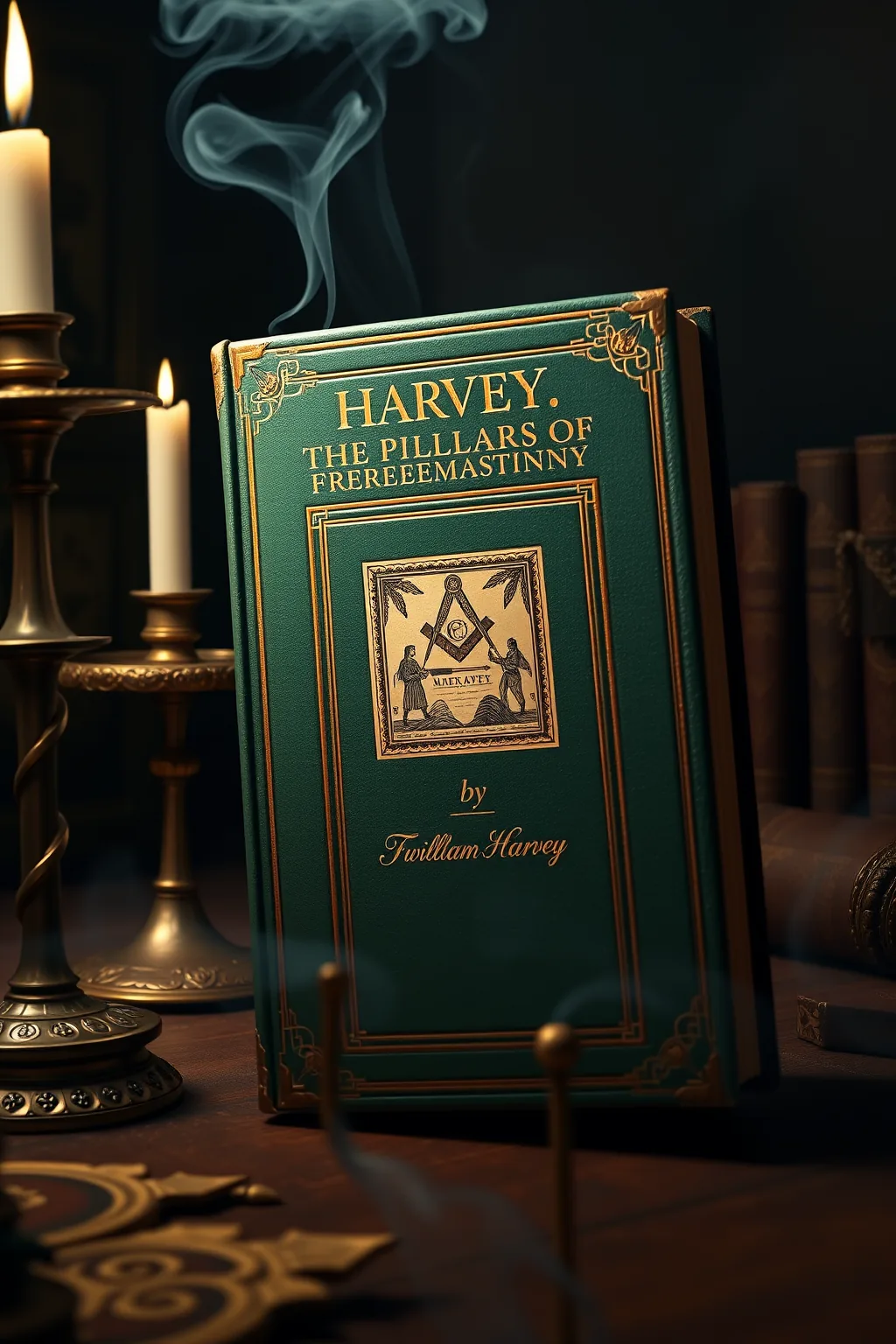
Harvey W The Pillars Of Freemasonry
 75
75

Harvey W The Pillars Of Freemasonry


As Evander Ashcroft, I find 'The Pillars of Freemasonry' to be a compelling exploration of the Craft's spiritual architecture. While the author remains an enigma, the depth of insight into Masonic symbolism and its esoteric connections is undeniable. The text masterfully navigates the interplay between allegory and gnosis, offering a lens through which to perceive the deeper, often-overlooked metaphysical currents within Freemasonry. It’s a valuable addition for serious students of Western Esotericism, particularly those interested in the intersection of ritual, cosmology, and personal transformation. This book is best suited for those who approach Freemasonry not just as a social fraternity, but as a potent vehicle for spiritual discovery.
📝 Description
75
Published as part of the William Harvey Collection, 'The Pillars of Freemasonry' examines the mystical foundations of the Craft.
This text moves past the standard Masonic rituals to uncover the ancient, mystical principles that have shaped Freemasonry over centuries. It details the esoteric structure of Masonic thought, showing how the fraternity's symbols and allegories function as pathways to concealed spiritual insights and universal knowledge. The author uses descriptive language to lead the reader through a complex system of symbols, relating them to ancient mystery traditions and hermetic philosophy. This book is more than a historical record; it is an encouragement to recognize the divine patterns embedded in existence, a reflection of lost wisdom for both the sincere inquirer and the committed Mason. Readers will encounter the deep philosophical and spiritual aspects that form the core of Masonic practice, promoting self-reflection and a stronger link to enduring truths.
This work fits within the broader spectrum of esoteric literature that seeks to interpret religious and philosophical systems through a hidden, spiritual lens. It aligns with traditions that view outward forms, like Masonic ritual, as symbolic representations of inner, universal laws. By connecting Masonic imagery to ancient hermeticism and mystery traditions, the book suggests a continuity of esoteric knowledge passed down through various historical currents. It treats Masonic symbols not as mere historical artifacts but as active keys to understanding deeper metaphysical realities.
💡 Why Read This Book?
Uncover the mystical underpinnings of Freemasonry, revealing ancient wisdom and hidden symbolism. This book is essential for seekers of esoteric knowledge, scholars of secret societies, and practitioners seeking to deepen their understanding of Masonic philosophy and its spiritual resonance. Discover the profound allegories that unlock universal truths.
⭐ Reader Reviews
Honest opinions from readers who have explored this book.
❓ Frequently Asked Questions
What is the primary focus of 'The Pillars of Freemasonry'?
The primary focus is on the esoteric and mystical dimensions of Freemasonry, exploring its symbolism, hidden knowledge, and philosophical underpinnings beyond its ritualistic aspects.
Who is the author of this work?
The author is listed as Unknown, though the work is part of the esteemed William Harvey Collection, suggesting a scholarly or curated origin.
What kind of symbolism is discussed in the book?
The book delves into rich, layered symbolism, drawing parallels to ancient mystery schools and hermetic traditions, interpreting Masonic allegories as keys to spiritual truths.
Is this book suitable for beginners to Freemasonry?
While accessible, it is best suited for those with some foundational interest or prior exposure to Masonic concepts, or those specifically drawn to its esoteric and philosophical explorations.
Does the book offer practical applications of Masonic principles?
It offers profound philosophical insights that can lead to personal introspection and a deeper understanding of spiritual principles, indirectly guiding practice through enhanced awareness.
🔮 Key Themes & Symbolism
The Esoteric Architecture of the Lodge
This theme explores how the physical and symbolic layout of a Masonic lodge serves as a microcosm of the universe and a blueprint for spiritual ascent. It explores the deeper meanings behind the various elements, tracing their lineage to ancient cosmological models and sacred geometry. The lodge is presented not just as a meeting place, but as a crucible for transformation, where the initiate engages with archetypal forces and begins to perceive the divine order.
Allegory as a Gateway to Gnosis
The text posits that Masonic rituals and degrees are not mere ceremonies but potent allegories designed to guide the aspirant towards higher knowledge (gnosis). It examines how these symbolic narratives are crafted to awaken the inner faculties, reveal universal truths, and facilitate a personal encounter with the divine. The emphasis is on understanding the symbolic language as a means to transcend the mundane and connect with eternal verities.
The Hermetic Roots of Masonic Philosophy
This theme highlights the profound influence of Hermeticism and ancient mystery traditions on the development of Masonic thought. It uncovers the shared principles of universal brotherhood, the pursuit of wisdom, and the belief in an underlying divine intelligence that permeates all creation. The book draws connections between Masonic teachings and the wisdom of figures like Hermes Trismegistus, positioning Freemasonry as a continuation of an unbroken chain of esoteric knowledge passed down through the ages.
💬 Memorable Quotes
Direct passages from the work, attributed to the author.
“Within the darkness of the lodge, the true light of wisdom is sought.”
— This highlights the paradoxical nature of esoteric seeking, where initial ignorance or the confrontation with shadow is necessary to discover profound spiritual illumination and truth.
“Each degree is a step upon the ladder of divine understanding.”
— This emphasizes the progressive nature of Masonic instruction, framing each stage of advancement as a necessary ascent towards a more profound comprehension of spiritual realities and cosmic principles.
“The silent stones of the temple speak volumes to the attentive soul.”
— This underscores the idea that the symbolic architecture and rituals of Freemasonry contain profound teachings that are accessible not through intellectual analysis alone, but through intuitive perception and inner receptivity.
“To build the inner temple is the true work of the Craft.”
— This succinctly captures the ultimate goal of Freemasonry: not the construction of physical edifices, but the spiritual and moral development of the individual practitioner, the creation of a perfected inner self.
💡 Key Ideas
Editorial paraphrase of the work's core concepts — not direct quotes.
The square and compasses are not mere tools, but symbols of divine proportion.
This quote suggests that the iconic Masonic tools transcend their literal function, representing the principles of order, balance, and the harmonious integration of the material and spiritual realms.
🌙 Esoteric Significance
Tradition
This work is deeply rooted in Western Esotericism, drawing heavily from Hermeticism, ancient mystery traditions (such as those of Egypt and Greece), and potentially elements of Kabbalistic philosophy. It positions Freemasonry as a modern inheritor of this ancient lineage of hidden knowledge, emphasizing universal principles and spiritual evolution.
Symbolism
The text meticulously unpacks the rich symbolic language of Freemasonry, interpreting elements like the tools of stonemasonry, architectural structures, and celestial bodies as keys to understanding cosmic order, human potential, and the path to spiritual enlightenment. It explores how these symbols act as mnemonic devices and conduits for higher consciousness.
Modern Relevance
In a world often characterized by materialism and fragmentation, 'The Pillars of Freemasonry' offers a timeless reminder of the importance of inner cultivation, moral integrity, and the search for universal truths. Its exploration of symbolism and esoteric philosophy provides a framework for personal growth and a deeper understanding of humanity's place in the cosmos.
👥 Who Should Read This Book
This volume is a treasure for dedicated seekers of esoteric wisdom, particularly those drawn to the mysteries of Freemasonry. Scholars of secret societies and Western Esotericism will find it an invaluable resource for understanding the philosophical underpinnings of the Craft. Practicing Masons seeking to deepen their comprehension of ritual and symbolism will benefit immensely. Even those new to the subject but curious about the intersection of philosophy, spirituality, and ancient traditions will find much to contemplate.
📜 Historical Context
Emerging from the speculative and operative guilds of stonemasons, Freemasonry as we know it began to coalesce into its modern form during the late 17th and early 18th centuries in England. This period was a fertile ground for intellectual and spiritual exploration, marked by the Enlightenment's emphasis on reason, but also by a sustained interest in older esoteric traditions. Philosophers and thinkers were re-examining Hermeticism, Kabbalah, and Neoplatonism, seeking a unifying spiritual or philosophical framework. Freemasonry, with its allegorical teachings and emphasis on moral and spiritual improvement, provided a compelling synthesis of these diverse threads, attracting individuals from various walks of life. The 'William Harvey Collection' itself likely represents a specific archival effort to preserve or study these foundational texts during a period when such literature was being actively compiled and debated, offering a glimpse into the intellectual milieu that shaped early Masonic thought.
📔 Journal Prompts
Reflect on a Masonic symbol that speaks to you; what deeper meaning does it hold in your life?
How can the principles of 'building the inner temple' be applied to your daily challenges?
Consider the concept of 'divine proportion' in your own life; where do you see order and where do you seek it?
In what ways do allegories and stories shape your understanding of spiritual truths?
How can the pursuit of 'hidden knowledge' contribute to personal and collective growth?
🗂️ Glossary
Gnosis
A Greek term meaning 'knowledge,' often referring to a spiritual or mystical understanding that transcends ordinary intellectual comprehension. In esoteric traditions, it signifies direct, intuitive insight into divine or ultimate truths.
Hermeticism
A religious, philosophical, and esoteric tradition based primarily upon writings attributed to Hermes Trismegistus. It emphasizes the unity of all things, the correspondence between the macrocosm and microcosm, and the pursuit of spiritual wisdom.
Allegory
A symbolic representation in which characters or events represent abstract ideas or principles. Masonic rituals and degrees often employ allegory to convey moral and spiritual lessons.
Macrocosm
The universe considered as a vast, ordered whole. It is often contrasted with the microcosm, representing the belief that the universe and humanity share similar structures and principles.
Esotericism
Belief systems, spiritual practices, and philosophical traditions that are concerned with 'inner' knowledge or wisdom. Esoteric teachings are often reserved for a select group of initiates or those who have undergone specific training.
This book appears in 2 collections
🔮 Readers Also Liked
Browse all →

![[Comte de Gabalis. English]. The diverting history of the Count de Gabalis: containing, I. An account of the Rosicrucian doctrine of spirits, viz. sylphs, salamanders, gnomes, and d¶mons; ... To which is prefix'd, Monsieur Bayle's account of this work, ... 1714](/img/thumb/comte-de-gabalis-english-the-diverting-history-of-the-count-de-gabalis-containing-i-an-account-of-the-rosicrucian-doctrine-of-spirits-viz-sylphs-salamanders-gnomes-and-d-mons-to-which-is-prefix-d-mons.webp)



From the “Secret Societies” Collection
View all →




More Free Freemasonry & Secret Societies Books
View all →