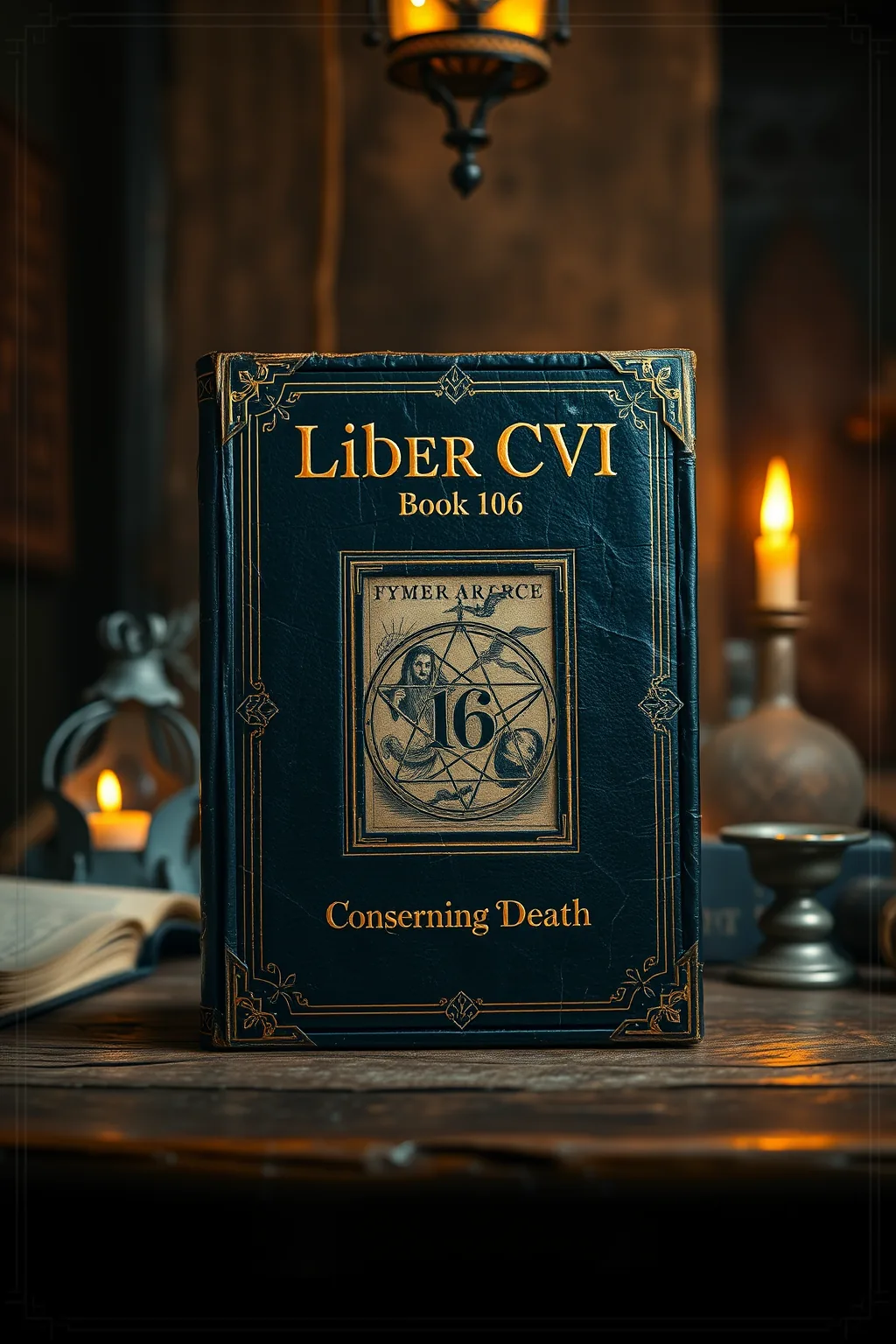
Liber CVI {Book 106} Concerning Death
 75
75

Liber CVI {Book 106} Concerning Death


Lorelei Sage (Contemplative Literature Editor) — Liber CVI by BAPHOMET XI° is a masterful exploration of death's esoteric facets, a profound addition to any occultist's library. The author's authoritative voice guides readers through complex symbolism with remarkable clarity, revealing death not as an end, but as a transformative passage. Its strength lies in its ability to provoke deep introspection, challenging conventional notions and offering solace through ancient, hidden knowledge. This work is indispensable for those engaged in advanced spiritual studies, particularly within Masonic and O.T.O. traditions, seeking a deeper understanding of the Great Mystery.
📝 Description
75
BAPHOMET XI°'s Liber CVI (Book 106) addresses death directly, dedicated to the memory of Frater Superior Hymenaeus Alpha 777 X° O.T.O.
Liber CVI, known also as Book 106, examines mortality. Authored by BAPHOMET XI°, this text is dedicated to the memory of Frater Superior Hymenaeus Alpha 777 X° O.T.O. It moves beyond simple philosophical discussion to consider the spiritual aspects of death, using symbolism and what it calls ancient wisdom. The book aims to offer a distinct viewpoint on this final transition.
This work is written for those who seriously seek knowledge, study diligently, or practice occult arts. It encourages a reconsideration of death, which the book frames as life's one certainty. The writing suggests secrets lie beyond the visible, prompting thought that goes past surface-level ideas about ending. It implies a connection between being and unmaking.
Liber CVI is situated within esoteric traditions that seek to understand death not as an end, but as a transformation or continuation. It draws on symbolism and conceptual frameworks common in occultism, which often reinterprets common understandings of mortality. The dedication to a figure within the O.T.O. (Ordo Templi Orientis) places it within a specific magical current that engages with Gnostic and Thelemic ideas, suggesting an approach that is both personal and part of a larger magical lineage.
💡 Why Read This Book?
Unveil the mystical secrets of death and transformation. Liber CVI offers esoteric insights into mortality, challenging conventional perceptions and illuminating the spiritual journey beyond life. Ideal for dedicated seekers, occult scholars, and practitioners of secret societies who yearn for profound understanding of this ultimate mystery.
⭐ Reader Reviews
Honest opinions from readers who have explored this book.
❓ Frequently Asked Questions
What is the primary focus of Liber CVI?
The primary focus of Liber CVI is the esoteric and mystical contemplation of death, exploring its spiritual significance and transformative potential beyond conventional understanding.
Who is the author, BAPHOMET XI°?
BAPHOMET XI° is an authoritative, albeit enigmatic, figure within esoteric traditions, known for their insightful contributions to occult literature, particularly concerning Freemasonry and secret societies.
What is the significance of the dedication?
The dedication to Frater Superior Hymenaeus Alpha 777 X° O.T.O. highlights the book's connection to specific occult orders and honors a significant figure within that lineage, underscoring its context.
Is this book suitable for beginners?
While rich in depth, Liber CVI is best suited for those with some prior exposure to esoteric concepts or an earnest desire for profound, challenging study.
What kind of knowledge can one expect to gain?
Readers can expect to gain a new perspective on death as a spiritual transition, infused with hidden symbolism, ancient wisdom, and a deeper understanding of cosmic cycles.
🔮 Key Themes & Symbolism
The Great Transition
This theme explores death not as an absolute end, but as a profound, cosmic transition. It studies the esoteric understanding of the soul's journey, the dissolution of the physical form, and the subsequent re-integration into higher planes of consciousness. The text illuminates the hidden symbolism associated with this ultimate metamorphosis, encouraging a re-framing of mortality as a crucial stage in the eternal cycle of existence, a gateway to unseen realms and deeper truths.
Veiled Symbolism of Mortality
Liber CVI masterfully deciphers the complex layers of symbolism that shroud the concept of death across various esoteric traditions. It reveals how ancient cultures and secret societies have encoded their understanding of mortality through allegories, myths, and rituals. The book invites readers to look beyond literal interpretations and perceive the deeper, often concealed, meanings that speak to the interconnectedness of life, death, and rebirth, offering a lexicon of symbols for spiritual interpretation.
Esoteric Perspectives on the Afterlife
Beyond mere philosophical speculation, this work presents an esoteric framework for understanding what lies beyond the veil of physical existence. It draws upon mystical traditions to illuminate potential states of consciousness, the nature of the astral or spiritual bodies, and the processes of spiritual evolution post-mortem. The text challenges the reader to confront their fears and embrace the unknown, offering a perspective that transforms death from a terrifying mystery into a profound opportunity for spiritual advancement and cosmic understanding.
💬 Memorable Quotes
Direct passages from the work, attributed to the author.
“The shadow of the tomb is but the doorway to the sun.”
— Suggests that the perceived darkness and finality of death is merely an illusion, a passage to a brighter, more enlightened state.
“In the silence of the end, the true music begins.”
— Implies that the cessation of earthly life allows for the perception of subtler, divine harmonies and spiritual truths.
“To die is to remember what it is to be truly alive.”
— Posits that the experience of death can unlock a deeper, more fundamental understanding of existence and consciousness.
“The final breath is the first whisper of eternity.”
— Connects the physical act of dying with the commencement of an eternal, spiritual existence beyond the confines of time.
💡 Key Ideas
Editorial paraphrase of the work's core concepts — not direct quotes.
Death is not the extinguishing of the flame, but the unfurling of the wings.
This quote reframes death as a liberation and transformation, emphasizing spiritual ascension and freedom rather than cessation.
🌙 Esoteric Significance
Tradition
This work is deeply rooted in the Western Esoteric Tradition, drawing heavily from Hermeticism, Gnosticism, and the mystical branches of Freemasonry and the O.T.O. It engages with concepts of spiritual alchemy, the transmigration of souls, and the hidden laws governing the universe, offering a unique synthesis for understanding mortality through an occult lens.
Symbolism
Liber CVI employs detailed symbolism, interpreting death through archetypal images such as the veiled maiden, the serpent shedding its skin, the closing of the eye, and the descent into the underworld. These symbols are not merely decorative but serve as keys to unlock deeper meanings regarding transformation, dissolution, and the cyclical nature of existence, guiding the reader toward a profound, symbolic comprehension.
Modern Relevance
In an age often characterized by secularism and a fear of mortality, Liber CVI offers a vital esoteric perspective. It provides tools for confronting death with wisdom and courage, encouraging spiritual growth and a deeper appreciation for the interconnectedness of all life. Its teachings remain profoundly relevant for those seeking to integrate their spiritual path with the ultimate mystery of existence.
👥 Who Should Read This Book
Liber CVI is a profound text for seasoned seekers of hidden knowledge, occult scholars, and practitioners within esoteric orders like Freemasonry and the O.T.O. While its depth may challenge beginners, those with a dedicated interest in spiritual philosophy, the mysteries of death, and esoteric symbolism will find invaluable insights. It is particularly resonant for individuals grappling with existential questions and seeking a mystical framework for understanding life's ultimate transition.
📜 Historical Context
Emerging from a period of fervent occult revival and the flourishing of secret societies in the late 19th and early 20th centuries, Liber CVI by BAPHOMET XI° reflects the intellectual and spiritual currents of its time. This era saw a resurgence of interest in Hermeticism, Gnosticism, Freemasonry, and Eastern philosophies, all seeking to decipher the mysteries of existence. The work likely found its initial audience within circles dedicated to advanced esoteric studies, such as the Ordo Templi Orientis (O.T.O.), as suggested by its dedication. It stands as a evidence of the enduring human quest for understanding death, offering a contemplative counterpoint to the mechanistic worldview, and preserving esoteric wisdom for future generations of practitioners and scholars.
📔 Journal Prompts
Reflect on your personal understanding of death before reading Liber CVI. How has your perspective shifted after engaging with this text?
Identify three key symbols from the book that resonate most with you. What do you believe they represent in your own life's journey?
Explore the concept of death as a 'transition' rather than an 'end.' How can this perspective influence your daily life and choices?
Consider the dedication of this epistle. What does honoring a departed 'Frater Superior' signify within an esoteric context?
Write a personal meditation on the 'unfurling of wings' after the 'extinguishing of the flame,' using your own symbolic language.
🗂️ Glossary
Epistle
A letter or literary composition in the form of a letter, often of a philosophical or spiritual nature, conveying teachings or insights.
Frater Superior
Latin for 'Higher Brother,' typically referring to a leader or high-ranking officer within an esoteric order or fraternity.
O.T.O.
Ordo Templi Orientis (Order of the Temple of the East), a fraternal organization founded in the early 20th century, known for its esoteric teachings and practices.
Esoteric
Intended for or likely to be understood by only a small number of people with a specialized knowledge or interest; relating to inner, spiritual truths.
Hermeticism
A religious, philosophical, and esoteric tradition based primarily upon writings attributed to Hermes Trismegistus, a legendary Hellenistic figure.
This book appears in 2 collections
🔮 Readers Also Liked
Browse all →









From the “Secret Societies” Collection
View all →


More Free Freemasonry & Secret Societies Books
View all →


![Gould R F History Of Freemasonry Throughout The World V 5 [ 1936 Ed][ 627p]](/img/thumb/gould-r-f-history-of-freemasonry-throughout-the-world-v-5-1936-ed-627p.webp)