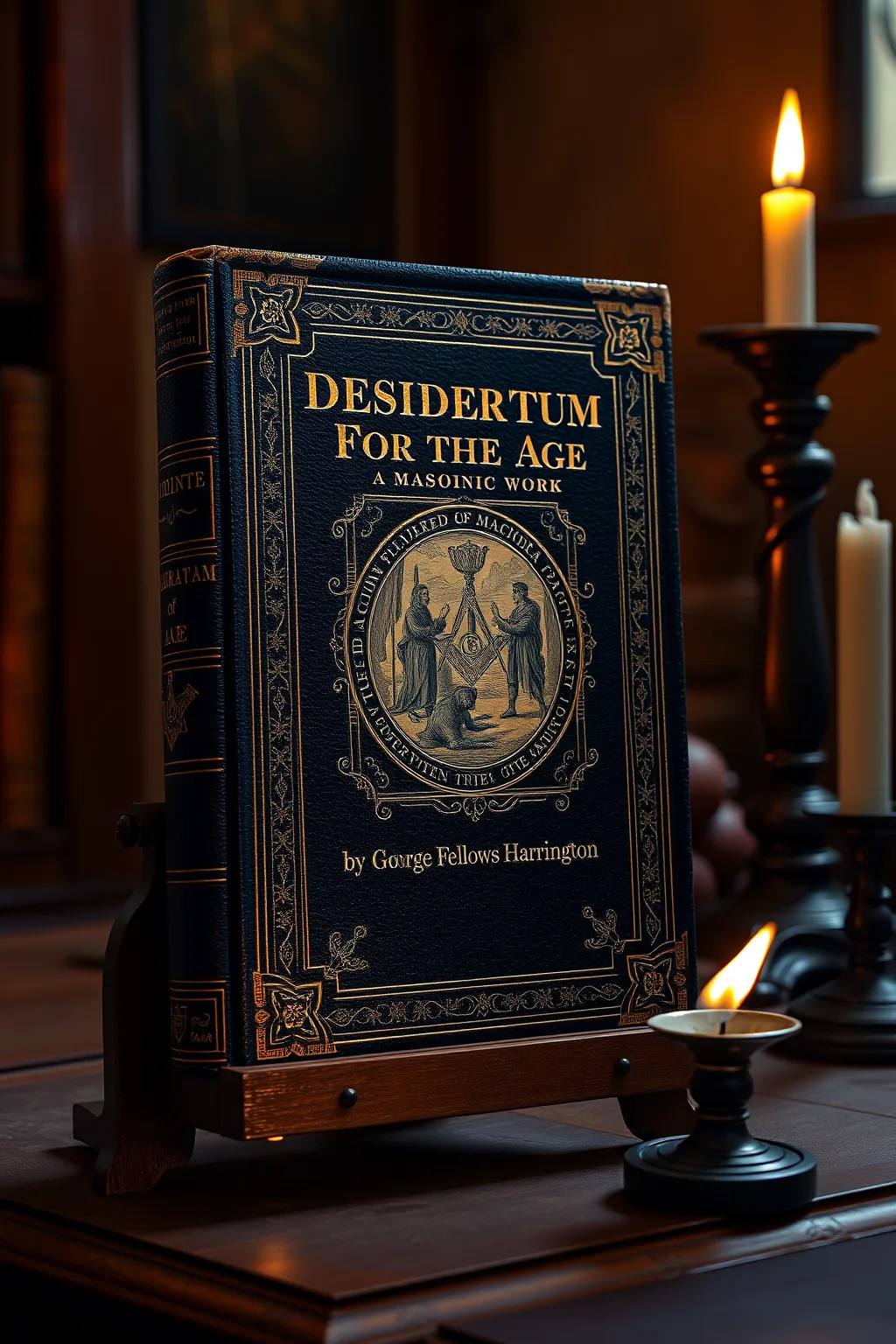
Harrington's desideratum for the age, a masonic work
 74
74

Harrington's desideratum for the age, a masonic work


Evander Ashcroft (Alchemy & Hermeticism Editor) — George Fellows Harrington's 'Desideratum' is a cornerstone for understanding the mystical underpinnings of Freemasonry. Harrington masterfully deciphers the symbolic language, revealing a rich vein of Hermetic and alchemical thought interwoven with Masonic practice. The strength of this work lies in its accessible yet profound exploration of spiritual evolution and the pursuit of inner harmony. It is an essential read for serious Masonic students, occult scholars, and anyone intrigued by the esoteric dimensions of Western mystery traditions, offering pathways to wisdom often obscured by surface-level interpretation.
📝 Description
74
George Fellows Harrington published 'Harrington's desideratum for the age' to explain Masonic philosophy.
George Fellows Harrington's 'Harrington's desideratum for the age' presents a detailed examination of Masonic philosophy and symbolism. Harrington structures the text to guide readers through the allegorical meanings found within Masonic rituals and degrees. He connects these ancient practices to spiritual and ethical development, suggesting a path for personal transformation. The book aims to bridge the gap between the material world and spiritual understanding. It proposes that applying Masonic principles can lead to individual growth and societal improvement. Harrington's work invites contemplation on universal themes like brotherhood and enlightenment.
This work belongs to the tradition of Masonic literature that interprets the fraternity's rituals and symbols as a system for spiritual and moral self-improvement. It follows in a lineage of texts that view Freemasonry not merely as a social organization, but as a vehicle for conveying esoteric knowledge. Such writings often seek to decode the allegorical layers of Masonic degrees, connecting them to broader philosophical and mystical concepts. Harrington's specific contribution lies in his particular interpretation of these elements for his contemporary age.
💡 Why Read This Book?
Uncover the hidden spiritual and philosophical dimensions of Freemasonry. Explore potent symbolism and allegorical teachings that resonate with universal wisdom. Ideal for seekers of esoteric knowledge, Masonic scholars, and practitioners interested in the deeper meanings behind ritual and symbolism.
⭐ Reader Reviews
Honest opinions from readers who have explored this book.
❓ Frequently Asked Questions
What is the primary focus of Harrington's Desideratum?
The primary focus is on the esoteric and philosophical teachings within Freemasonry, presenting it as a system for personal spiritual development and the pursuit of higher knowledge.
Who is the intended audience for this book?
The intended audience includes Freemasons seeking deeper understanding, students of Western esotericism, and individuals interested in the philosophical and symbolic aspects of secret societies.
Does this book require prior knowledge of Freemasonry?
While prior knowledge can enhance understanding, Harrington's work is written to be illuminating, guiding readers through its symbolic language and philosophical concepts.
What makes this a 'Masonic work'?
It is a Masonic work because it delves into the symbols, rituals, and philosophical underpinnings specific to the teachings and practices of Freemasonry.
Where can I find this digitized version?
This digitized version was uploaded to the Internet Archive by user tpb, originating from the library of Oxford University.
🔮 Key Themes & Symbolism
The Architect's Grand Design
This theme explores the Masonic concept of a Supreme Architect, not merely as a creator but as a source of universal order and cosmic law. Harrington elucidates how this concept serves as a foundational principle for understanding existence, morality, and the interconnectedness of all things. It looks at the idea that the universe itself is a grand edifice, and humanity's purpose is to comprehend and align with its divine blueprint through diligent study and ethical living, reflecting a profound metaphysical perspective.
The Ladder of Ascent
Central to the 'Desideratum' is the allegorical journey of spiritual progression, often visualized as a ladder or staircase within Masonic symbolism. Harrington illuminates how each degree and ritual represents a stage in this ascent, moving from the profane to the sacred, from ignorance to illumination. This theme emphasizes the internal transformation of the individual, the shedding of vices, and the cultivation of virtues as essential steps towards achieving higher consciousness and a more profound understanding of divine truths.
The Unveiling of Sacred Geometry
Harrington's work meticulously dissects the use of sacred geometry within Masonic teachings. This theme highlights how shapes, numbers, and proportions are not merely decorative but carry profound symbolic weight, acting as keys to unlock cosmic principles and the underlying structure of reality. It explores how these geometric representations are used to teach abstract concepts about harmony, balance, and the divine order, offering a visual language for understanding the universe and one's place within it.
💬 Memorable Quotes
Direct passages from the work, attributed to the author.
“The square of virtue doth guide the compass of our life.”
— This highlights the balance between ethical conduct (the square) and the boundless pursuit of knowledge and spiritual growth (the compass) in a well-lived life.
“Within the rough ashlar lies the perfect gem.”
— This symbolizes the unrefined individual's potential for perfection and spiritual refinement through Masonic labor and self-improvement.
“The trowel doth spread the cement of brotherly love.”
— This refers to the Masonic tool used to build, symbolizing the vital importance of unity, harmony, and affection among brethren.
“Wisdom is the key that unlocks the veiled mysteries.”
— This underscores the pursuit of knowledge and understanding as the primary means to access the deeper, esoteric truths embedded within Masonic teachings.
💡 Key Ideas
Editorial paraphrase of the work's core concepts — not direct quotes.
Seek not the outward show, but the inward light.
This quote emphasizes the core Masonic principle of seeking spiritual truth and personal enlightenment over superficial appearances or external validation.
🌙 Esoteric Significance
Tradition
This work is deeply rooted in the Western Esoteric Tradition, drawing heavily from Hermeticism, Kabbalah, and Neoplatonism. It interprets Masonic symbolism through the lens of these ancient philosophical and mystical systems, presenting Freemasonry as a continuation of an unbroken chain of wisdom aimed at spiritual transformation and the understanding of cosmic laws.
Symbolism
Harrington meticulously deciphers the strong symbolism embedded within Masonic rituals and degrees. Key symbols like the square, compass, plumb line, level, and the rough and perfect ashlar are explained not just as operative tools but as potent allegories for moral conduct, spiritual development, and the architectonic principles of the universe.
Modern Relevance
In an age often characterized by fragmentation and superficiality, 'Harrington's Desideratum' offers a compelling framework for seeking deeper meaning, ethical guidance, and inner harmony. Its emphasis on personal growth, brotherhood, and the pursuit of wisdom remains profoundly relevant for individuals working through the complexities of modern life and searching for enduring truths.
👥 Who Should Read This Book
This key work is useful for dedicated Freemasons seeking to deepen their understanding of the fraternity's esoteric dimensions. Scholars of Western esotericism and secret societies will find it a critical resource for tracing the lineage of mystical thought. Spiritual seekers yearning for a structured path to self-discovery and moral refinement will be drawn to its philosophical depth. Practitioners of contemplative arts and those interested in the intersection of ritual and personal transformation will discover clear insights within its pages.
📜 Historical Context
Published during a period of intense intellectual and spiritual ferment in the Western world, 'Harrington's Desideratum for the Age' emerges from the late 19th or early 20th century, a time when Freemasonry was widely seen as a repository of ancient wisdom and a vehicle for moral and philosophical instruction. This era witnessed a renewed interest in esotericism, mysticism, and the hidden currents of history, fueled by archaeological discoveries, philosophical inquiries, and a reaction against purely materialistic worldviews. Masonic authors like Harrington sought to articulate the profound spiritual and ethical dimensions of their fraternity, presenting it not just as a social organization but as a path to self-mastery and enlightenment, deeply influenced by Hermeticism, Neoplatonism, and the broader Western esoteric tradition.
📔 Journal Prompts
Reflect on a personal 'rough ashlar' and the tools or practices you use for its refinement.
How does the concept of a 'Supreme Architect' influence your understanding of order and purpose in your life?
Identify a symbol from your own life or studies that represents a spiritual 'ladder of ascent'. What does it signify?
Consider the 'cement of brotherly love' in your own community. How can it be strengthened?
In what ways can the principles of sacred geometry be applied to bring more harmony and balance into your daily existence?
🗂️ Glossary
Ashlar
In Freemasonry, refers to a stone. The 'rough ashlar' represents the unrefined individual, while the 'perfect ashlar' symbolizes the perfected, virtuous person achieved through Masonic labor.
Compass
A Masonic implement symbolizing the ability to circumscribe desires and control passions, representing spiritual and moral boundaries.
Square
A Masonic tool symbolizing morality, rectitude, and the need for one's actions to be aligned with ethical principles.
Plumb Line
A Masonic symbol representing uprightness, integrity, and acting in accordance with divine truth.
Trowel
A tool used to spread mortar, symbolizing in Masonry the spreading of brotherly love and affection among all men.
This book appears in 2 collections
🔮 Readers Also Liked
Browse all →







From the “Secret Societies” Collection
View all →




More Free Freemasonry & Secret Societies Books
View all →