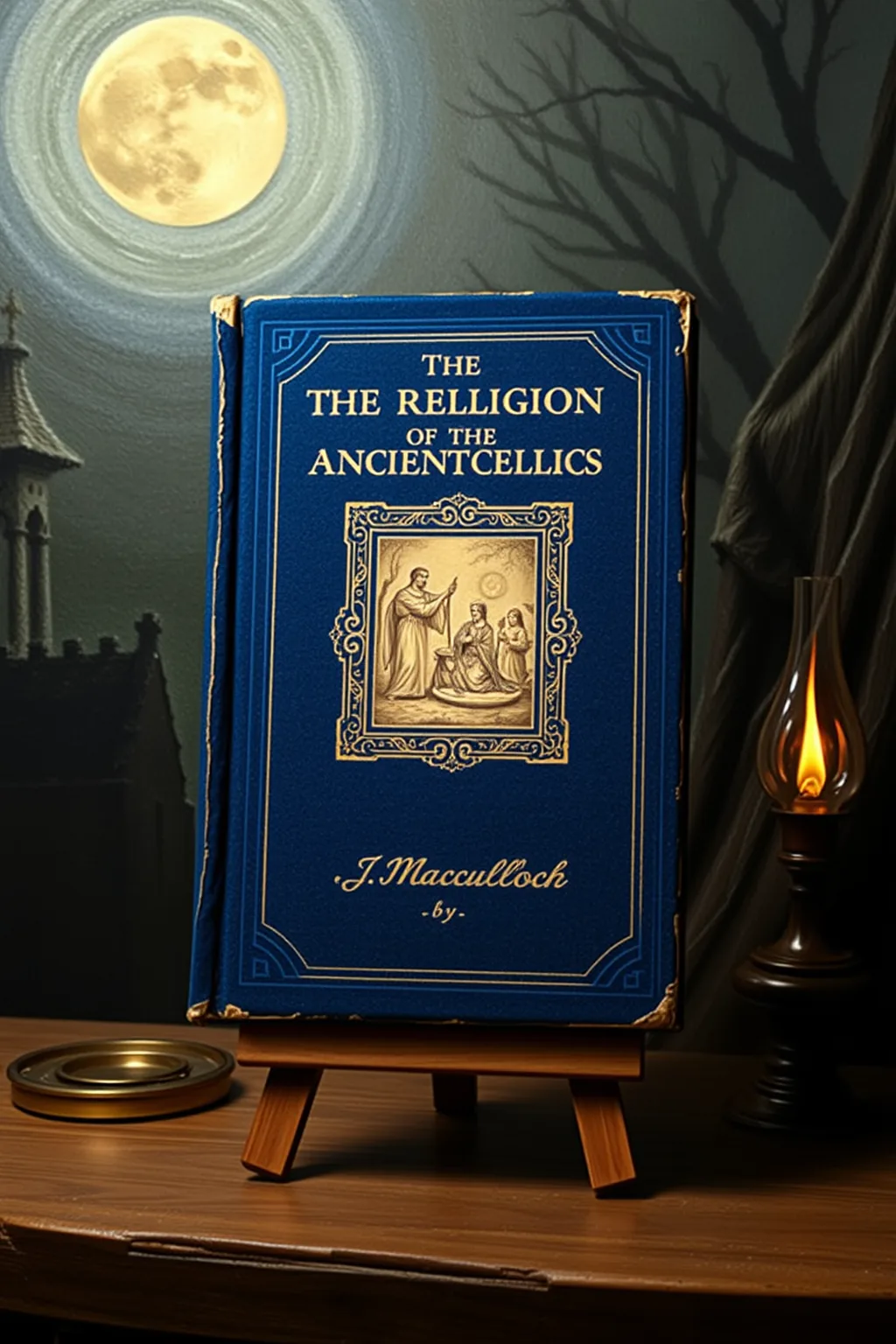
The Religion of the Ancient Celts
 77
77

The Religion of the Ancient Celts


J. A. Macculloch's 'The Religion of the Ancient Celts' remains an indispensable cornerstone for anyone seeking to comprehend the spiritual foundations of Celtic civilization. Published in 1911, it offers a rigorous, yet accessible, exploration of beliefs that resonate with enduring power. Macculloch masterfully deciphers the complexities of Celtic cosmology, from the profound concept of reincarnation to the vibrant pantheon of gods and the enigmatic practices of the Druids. His detailed analysis of animistic and totemistic elements provides crucial insights into a worldview deeply intertwined with nature. This work is a treasure trove for scholars, history enthusiasts, and practitioners of esoteric traditions seeking a foundational understanding of ancient European spirituality.
📝 Description
77
J. A. Macculloch published 'The Religion of the Ancient Celts' in 1911, examining their spiritual world.
This book examines the spiritual beliefs of the ancient Celts. Macculloch details their pantheon, including gods and goddesses tied to specific locations. He discusses concepts like reincarnation and the otherworld, a place for spirits and ancestors. The work also touches on totemistic bonds and animism, where natural elements held spiritual significance. Macculloch presents rituals, such as the symbolic 'Burning Man' ceremonies, and the social structures influencing Celtic spirituality.
The author also analyzes the connection between the Celts and the earth, highlighting their reverence for sacred places. He describes a worldview that shaped their civilization, offering insights into practices that were both striking and challenging to modern understanding. This study aims to reconstruct a comprehensive picture of Celtic religious life.
Published in 1911, Macculloch's work is a product of early 20th-century scholarship on ancient religions. It approached Celtic beliefs as a distinct spiritual system, seeking to understand its internal logic and practices. The book reflects a scholarly interest in reconstructing the religious lives of pre-Christian peoples, often examining them for connections to broader patterns of nature worship, ancestor veneration, and shamanic practices. It situates Celtic religion within a comparative framework, linking it to similar traditions studied by folklorists and ethnographers of the time.
✍️ Author
J A Macculloch
The origins of Clan MacCulloch are unknown, but there is a consensus that the family was one of the most ancient families of Galloway, Scotland, and a leading medieval family in that region. Despite the obscurity of the early history of the clan, the histo…
💡 Why Read This Book?
Unearth the hidden spiritual architecture of the ancient Celts. This book is for seekers yearning to understand reincarnation, the spectral otherworld, and a vast pantheon of deities. Scholars will find a rigorous foundation, while practitioners can glean insights into primal earth-based spirituality and ancient ritualistic practices. It offers a profound connection to forgotten wisdom.
⭐ Reader Reviews
Honest opinions from readers who have explored this book.
❓ Frequently Asked Questions
What is the central focus of Macculloch's work?
The book's central focus is a comprehensive examination of the religious beliefs, practices, and cosmology of the ancient Celts, exploring their pantheon, views on the afterlife, and unique spiritual traditions.
Does the book discuss Celtic mythology?
Yes, it delves deeply into the rich tapestry of Celtic mythology, detailing numerous gods, goddesses, and their associated lore, providing context for their spiritual understanding.
What is the significance of the 'Burning Man' in Celtic religion?
Macculloch discusses the symbolic and ritualistic significance of 'Burning Man' practices, which are often interpreted as forms of human sacrifice or effigy burning within certain Celtic traditions.
Is this book suitable for beginners in Celtic studies?
While comprehensive, Macculloch's work is written with academic rigor. Beginners may find it beneficial to approach with a general interest, perhaps supplemented by introductory materials.
What aspects of Celtic spirituality are considered 'esoteric'?
The esoteric elements include their complex beliefs in reincarnation, the nature of the Otherworld, the hidden powers attributed to Druids, and certain ritualistic practices that were not widely understood.
🔮 Key Themes & Symbolism
The Celtic Pantheon and Divine Archetypes
Macculloch meticulously catalogues the vast and complex pantheon of Celtic deities, moving beyond simple anthropomorphism to reveal profound archetypal forces. This section illuminates the interconnectedness of the divine with the natural world, exploring local deities, their domains, and their relationships with one another. It provides a deep dive into the spiritual architecture that underpinned Celtic society, offering insights into the human quest for meaning through divine connection and the appeasement of powerful, often primal, forces.
Reincarnation and the Spectral Otherworld
A core part of Celtic spiritual thought, the belief in reincarnation and the existence of a vibrant spectral Otherworld is explored in detail. Macculloch examines how the Celts perceived the cyclical nature of existence, the journey of the soul, and the profound significance of the afterlife. This theme examines the liminal spaces, the areas of ancestors and spirits, and how these beliefs influenced daily life, morality, and the understanding of destiny, offering a glimpse into a profoundly different perception of life and death.
Druidic Mysteries and Ritualistic Practices
This theme focuses on the enigmatic figure of the Druid, the spiritual and intellectual elite of Celtic society. Macculloch investigates their role as priests, judges, and lore-keepers, exploring the esoteric knowledge they held and the rituals they performed. The text also confronts the more controversial aspects, such as human sacrifice, cannibalism, and incest, not to sensationalize, but to understand the complex, and often alien, ethical and spiritual frameworks that governed these ancient societies and their deepest rites.
💬 Memorable Quotes
Direct passages from the work, attributed to the author.
“The Celts believed in a life after death.”
— This simple statement underscores a fundamental aspect of their worldview, highlighting a belief system that extended beyond the mortal coil and into realms unseen.
“The otherworld was a place of spirits and ancestors.”
— This phrase expresses the Celtic conception of the afterlife as a populated realm, deeply connected to the living, influencing their reverence for lineage and the spiritual landscape.
“Gods were often tied to specific localities.”
— Reveals the immanent nature of Celtic divinity, where sacred power was perceived as residing within the land itself, shaping localized spiritual practices and beliefs.
“The Druids held immense spiritual authority.”
— Points to the crucial role of spiritual intermediaries in Celtic society, hinting at hidden knowledge and profound influence wielded by these ancient mystics.
💡 Key Ideas
Editorial paraphrase of the work's core concepts — not direct quotes.
Cannibalism and incest were sometimes practiced.
This quote confronts the more challenging and taboo aspects of Celtic ritual, urging a nuanced understanding of their societal norms and potentially symbolic practices.
🌙 Esoteric Significance
Tradition
This work is foundational to the study of Western Esotericism, particularly the branch focused on Celtic traditions. It provides an academic lens through which to view pre-Christian European spirituality, exploring themes of shamanism, animism, and the veiled mysteries of the Otherworld, which resonate deeply within modern occult and spiritualist movements seeking ancient roots and primal wisdom.
Symbolism
Macculloch's exploration reveals the strong symbolism embedded in Celtic religion, from the sacred groves and wells to the animal totems and the complex iconography of deities. The belief in reincarnation and the interconnectedness of realms suggests a symbolic understanding of life as a continuous journey. The rituals described, even the controversial ones, can be interpreted through a lens of symbolic transformation and communion with primal forces.
Modern Relevance
The book's exploration of nature-based spirituality, ancestor veneration, and the cyclical understanding of life remains highly relevant to modern Pagan, Wiccan, and Neo-Druidic practitioners. It offers a historical and scholarly grounding for contemporary spiritual paths seeking to reconnect with indigenous European traditions and the profound wisdom of the earth and its cycles.
👥 Who Should Read This Book
This book is essential for scholars of ancient European history and comparative religion, providing a robust academic foundation. Seekers of esoteric knowledge will find it useful, offering deep dives into reincarnation, the Otherworld, and the Druidic mysteries. Practitioners of modern Pagan and nature-based spiritualities will discover historical context and inspiration. Even the curious general reader will be captivated by the collection of a civilization's spiritual heart, offering useful insights into humanity's enduring quest for meaning.
📜 Historical Context
Published in 1911, J. A. Macculloch's 'The Religion of the Ancient Celts' emerged during a period of intense scholarly interest in comparative mythology and ancient religions. The early 20th century saw a burgeoning desire to unearth the foundational beliefs of European cultures, often fueled by nationalist sentiments and a romantic fascination with pre-Christian eras. Macculloch’s work stands as a significant contribution to this field, drawing on philological evidence, archaeological findings, and classical accounts to construct a comprehensive picture of Celtic spirituality. It reflects the academic methodologies of its time, aiming for a systematic and authoritative presentation of a complex and often fragmented subject, seeking to illuminate a world that had long since passed into legend.
📔 Journal Prompts
Reflect on the concept of the 'spectral otherworld' presented by Macculloch. How might this influence one's perception of life and death?
Consider the connection between Celtic deities and specific localities. How does this differ from modern religious practices, and what does it reveal about their worldview?
Macculloch details practices that are taboo today. How can one approach these ethically and intellectually, seeking understanding rather than judgment?
Explore the possible symbolic meanings behind the 'Burning Man' rituals as described in the text. What might they have represented to the ancient Celts?
How do the Celtic beliefs in reincarnation and the cyclical nature of life, as presented, compare to your own understanding of existence and the soul's journey?
🗂️ Glossary
Animism
The belief that all natural objects, phenomena, and the universe itself possess a distinct spiritual essence or soul, a core concept in understanding Celtic spiritual perceptions of the world around them.
Reincarnation
The philosophical or religious concept that the non-physical essence of a living being begins a new life in a different physical form or organism after biological death, a key tenet in Celtic spiritual beliefs.
Otherworld
In Celtic mythology, a supernatural realm often inhabited by deities, spirits, and the dead, existing parallel to the human world and accessible through sacred sites or mystical means.
Pantheon
The collective gods and goddesses of a particular religion or mythology, in this case, the extensive array of deities worshipped and revered by the ancient Celtic peoples.
Totemism
A spiritual practice where a person or clan identifies with a particular animal or plant as a spiritual symbol or ancestor, often believed to offer protection or guidance.
This book appears in 1 collection
🔮 Readers Also Liked
Browse all →









From the “Transcendental Meditation” Collection
View all →








More Free Esoteric History & Biography Books
View all →