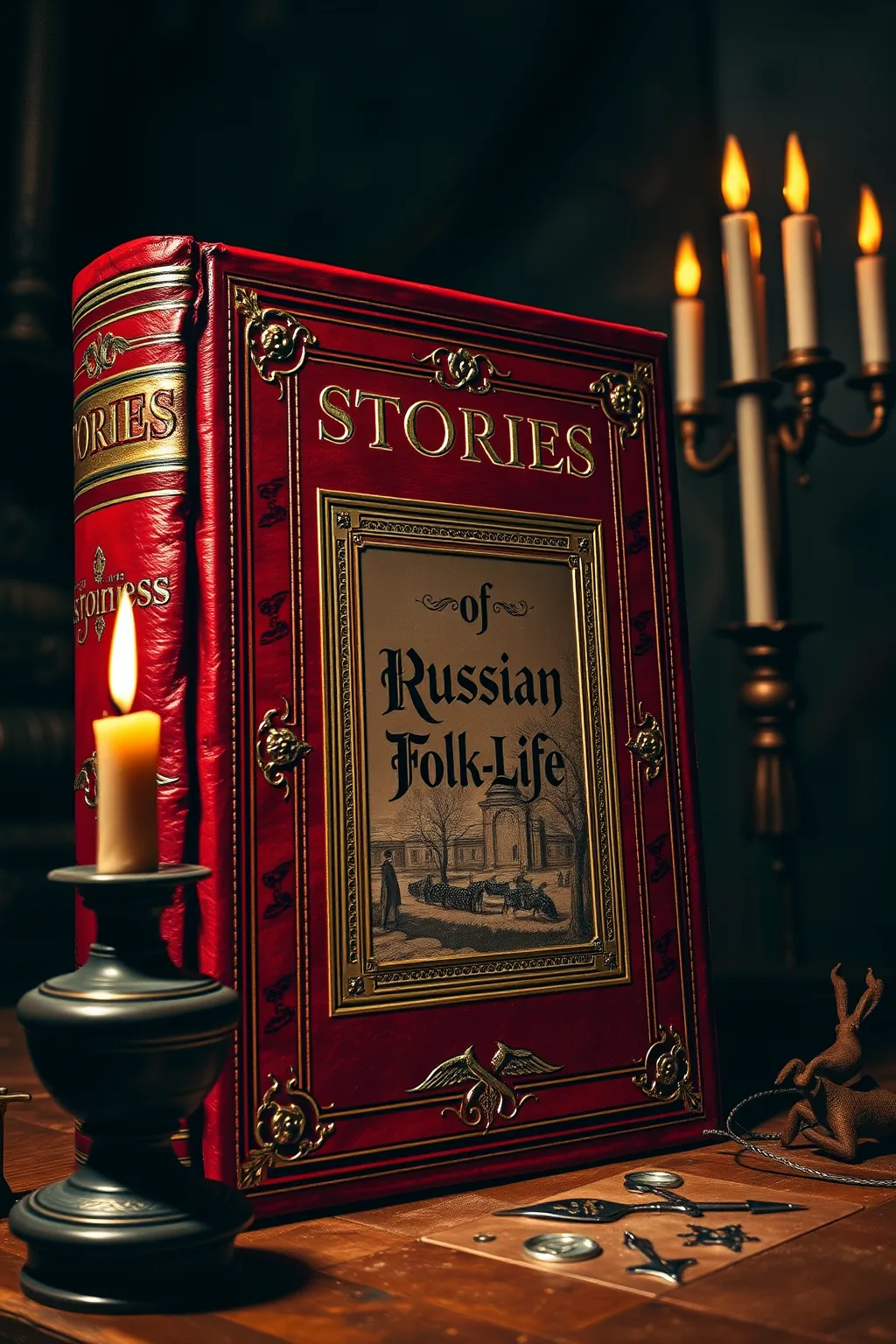
Stories of Russian Folk-Life
 76
76

Stories of Russian Folk-Life


Balthazar Finch (Senior Critic, Occult Philosophy) — Mackenzie's "Stories of Russian Folk-Life" is an indispensable volume for anyone charting the esoteric currents within Slavic culture. Far beyond simple ethnography, these tales resonate with primal energies and hidden knowledge. Mackenzie skillfully deciphers the symbolic language of the Russian psyche, revealing archetypes that echo across mystical traditions. The collection's strength lies in its ability to transmute folk narratives into profound explorations of courage, destiny, and spiritual transformation. It is essential reading for scholars of comparative mythology and practitioners seeking to understand the roots of folk magic and animistic beliefs. A truly illuminating work.
📝 Description
76
Donald Alexander Mackenzie published 'Stories of Russian Folk-Life' in 1916, collecting seven narratives.
Donald Alexander Mackenzie's 1916 book gathers seven Russian folk tales, presenting them as windows into pre-revolutionary Russian life. The collected stories, such as "The Test of War" and "How Little Ivan Became a Tsar," contain symbolic weight and reflect recurring patterns of existence. Mackenzie begins the book with a historical introduction that provides background on the social and spiritual environment from which these legends emerged.
The book aims to connect with readers interested in the deeper cultural and spiritual aspects of folklore. It focuses on the archetypal structures within myths and their influence on human experience. The author's writing style is intended to evoke the atmosphere of a Russia rich in older traditions and spiritual beliefs.
Published in 1916, this collection engages with folklore as a carrier of hidden spiritual and metaphysical currents. Mackenzie's approach suggests that these tales are not mere stories but contain coded wisdom about universal truths and the nature of reality. The book aligns with a broader late 19th and early 20th-century interest in comparative mythology and the esoteric interpretation of cultural traditions, viewing folk narratives as reflections of deeper psychological and spiritual structures.
✍️ Author
Donald Alexander Mackenzie
Donald Alexander Mackenzie was a Scottish folklorist and writer, known for his works on mythology and ancient cultures.
Esoteric Writer
💡 Why Read This Book?
Delve into the mystical heart of Russia, uncovering ancient wisdom and archetypal patterns embedded within captivating folk tales. This book is ideal for seekers of hidden knowledge, scholars of comparative mythology, and practitioners interested in the spiritual roots of folklore. Explore universal themes of destiny, courage, and transformation through evocative storytelling.
⭐ Reader Reviews
Honest opinions from readers who have explored this book.
❓ Frequently Asked Questions
What is the primary focus of "Stories of Russian Folk-Life"?
The book focuses on collecting and interpreting seven Russian folk tales, interwoven with a historical introduction, to reveal the spiritual and cultural underpinnings of pre-revolutionary Russia and its hidden esoteric significance.
Who was Donald Alexander Mackenzie?
Donald Alexander Mackenzie was a Scottish journalist and folklorist known for his extensive research into the myths, legends, and spiritual traditions of various cultures, particularly those of Scotland and Russia.
Are the stories purely fictional, or do they have historical roots?
While presented as folk tales, the stories are deeply rooted in the cultural and historical context of Russia, often reflecting societal beliefs, historical events, and enduring archetypes that resonate with actual life experiences.
What kind of esoteric themes are present in the book?
The book explores themes of destiny, spiritual trials, the power of the human spirit, the interplay of fate and free will, and the subtle presence of the supernatural within everyday life, often veiled in symbolic language.
Is this book suitable for beginners in esoteric studies?
Yes, it is an excellent entry point. The accessible narrative style, combined with rich symbolism, makes it engaging for beginners while offering depth for more experienced researchers of folklore and esoteric traditions.
🔮 Key Themes & Symbolism
Archetypal Journeys and Transformation
Mackenzie masterfully unveils the archetypal journeys embedded within each narrative, mirroring the universal quest for self-discovery and spiritual growth. The protagonists often face trials that test their inner fortitude, symbolizing the alchemical process of transformation from base material to refined essence. These stories serve as allegories for the soul's evolution, demonstrating that true power lies not in external conquest but in internal mastery over fear, doubt, and the ego. The recurring motifs of mentorship, betrayal, and ultimate triumph resonate with ancient wisdom traditions that emphasize the cyclical nature of life and the inherent potential for transcendence within every individual.
The Veil of Folklore and Hidden Knowledge
The collection acts as a conduit to the 'hidden knowledge' often concealed within folklore. Mackenzie presents these tales not as mere entertainment but as repositories of ancestral wisdom, imbued with esoteric symbolism that speaks to deeper truths about the human condition and the cosmos. The 'folk-life' itself is portrayed as a fertile ground for the miraculous, where the mundane is constantly touched by the divine or the chthonic. The author's meticulous approach suggests that by understanding these narratives, one can decipher a forgotten spiritual language, gaining insight into the collective unconscious and the esoteric frameworks that have guided humanity for millennia.
Sovereignty, Destiny, and the Cosmic Order
A pervasive theme is the exploration of sovereignty, both personal and political, intertwined with the concept of destiny. Tales like "How Little Ivan Became a Tsar" and "Tsar Ivan and the Scots Soldiers" look at the dynamics of leadership, the weight of responsibility, and the unseen forces that guide the rise and fall of nations. Mackenzie hints at a cosmic order that operates beyond human comprehension, where fate and free will engage in a perpetual dance. The narratives often explore the consequences of defying this order, as well as the rewards of aligning oneself with its currents, offering profound lessons on the interconnectedness of all things and the subtle workings of karma.
💬 Memorable Quotes
Direct passages from the work, attributed to the author.
“In the heart of the wolf lies the courage of the man.”
— This aphorism suggests that true bravery is not the absence of fear, but the ability to confront and overcome it, often drawing strength from primal instincts or facing one's deepest anxieties.
“The Tsar's crown is heavy, but the peasant's spirit is light.”
— This highlights a contrast between external power and internal freedom, implying that true contentment and resilience can be found in simplicity and a connection to one's inner self, regardless of social standing.
“Whispers of the past echo in the silent forest.”
— This evocative phrase points to the enduring presence of history and ancestral memory within nature, suggesting that the natural world holds ancient secrets and wisdom waiting to be discovered.
“The Kringel seller's bread nourishes more than the body; it feeds the soul.”
— This suggests that simple acts of kindness and sustenance, when performed with genuine intention, can have a profound spiritual impact, offering comfort and nourishment on a deeper, metaphysical level.
💡 Key Ideas
Editorial paraphrase of the work's core concepts — not direct quotes.
The old order and the new are but shadows in the eternal dance of time.
This quote speaks to the cyclical nature of history and societal change, suggesting that apparent shifts in power and structure are merely transient phases within a larger, unchanging cosmic rhythm.
🌙 Esoteric Significance
Tradition
The work draws heavily from Slavic paganism, animism, and proto-Slavic spiritual beliefs, often interpreted through a lens that aligns with broader pan-European esoteric traditions. It taps into the universal archetypes found in shamanic practices and folk magic, suggesting a common thread of spiritual understanding that transcends geographical boundaries. Mackenzie's approach hints at the presence of ancient matriarchal or earth-centered spiritualities that influenced early Slavic culture, providing a foundation for understanding the symbolic language of the land and its people.
Symbolism
Key symbols abound, including the forest as a liminal space between worlds, the wolf representing both primal instinct and protective spirit, and various animal totems embodying specific virtues or challenges. The Tsar figure often symbolizes divine right, cosmic order, or the collective will. Water elements signify emotion and the subconscious, while fire represents transformation and purification. The Kringel (a type of pastry) can symbolize abundance and the cycle of life. These symbols function as keys to unlocking deeper meanings, revealing a collection of spiritual concepts embedded within the everyday fabric of folk life.
Modern Relevance
In an increasingly secular and fragmented world, "Stories of Russian Folk-Life" offers a vital connection to ancestral wisdom and the enduring power of myth. The archetypal narratives provide timeless lessons on resilience, courage, and spiritual growth that remain profoundly relevant. For practitioners, the book serves as a resource for understanding the symbolic language of folk magic and its potential applications. For scholars and seekers, it illuminates the deep psychological and spiritual currents that have shaped human consciousness, reminding us of the interconnectedness of all life and the profound truths that can be found in the seemingly simple stories of the past.
👥 Who Should Read This Book
This collection is a rich source for a diverse readership. **Beginners** in folklore studies or comparative mythology will find Mackenzie's accessible prose and rich narratives an engaging introduction to the spiritual range of Russia. **Scholars** will appreciate the meticulous research and the unique insights into pre-revolutionary cultural and esoteric underpinnings. **Seekers** of hidden knowledge and spiritual wisdom will be drawn to the potent symbolism and archetypal themes that resonate with universal truths. **Practitioners** of folk magic or those interested in animistic traditions will find valuable source material and inspiration within these evocative tales. Anyone curious about the soul of a nation and the enduring power of its stories will find this book deeply rewarding.
📜 Historical Context
Published in 1916, "Stories of Russian Folk-Life" emerged during a period of immense upheaval in Russia, on the cusp of revolution. Donald Alexander Mackenzie, a seasoned journalist, captured a world poised on the brink of radical transformation. The Tsarist autocracy, which had endured for centuries, was crumbling under internal pressures and the strains of World War I. This era was characterized by a deep societal divide, the burgeoning of new ideologies, and a simultaneous yearning for spiritual continuity amidst the chaos. Mackenzie's work, therefore, serves as both a historical document and a evidence of the enduring power of traditional beliefs and folklore. It offers a window into a Russia that was deeply rooted in its past, yet facing an uncertain and tumultuous future, where the old ways and emerging forces were in constant, potent dialogue.
📔 Journal Prompts
Reflect on a personal 'test of war' – an internal or external challenge that significantly shaped your spirit. How did you overcome it?
Consider the 'old order' and 'new order' in your own life. Where have you experienced significant transitions, and what wisdom did you glean from them?
Imagine you are Mikhail, the Kringel Seller. What simple act of nourishment or kindness could you offer to your community that would 'feed the soul'?
How does the symbolism of the wolf resonate with your own inner strength or primal instincts? In what situations have you had to 'fight the wolves' within or around you?
What ancient 'whispers of the past' do you feel echoing in your environment or within your own ancestral heritage?
🗂️ Glossary
Folk-Life
The collective customs, beliefs, stories, and daily practices of a community or nation, often passed down through generations and deeply intertwined with their cultural identity and spiritual worldview.
Archetype
A universal, primordial image, symbol, or pattern of behavior that is part of the collective unconscious, recurring in myths, dreams, and folklore across different cultures and time periods.
Esoteric
Relating to or within a specialized or privileged circle; understood by or meant for only a small number of people with a specialized knowledge or interest, particularly in mystical or spiritual matters.
Animism
The belief that objects, places, and creatures all possess a distinct spiritual essence, often imbued with a soul or consciousness, influencing the natural world and human lives.
Liminal Space
A transitional or in-between state or place, often associated with thresholds, borders, or periods of change, where transformation and spiritual encounters are believed to occur.
This book appears in 1 collection
🔮 Readers Also Liked
Browse all →









More by Donald Alexander Mackenzie
All books →



From the “Transcendental Meditation” Collection
View all →





More Free Esoteric History & Biography Books
View all →