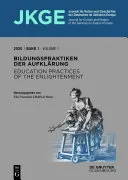
Bildungspraktiken der Aufklärung / Education practices of the Enlightenment
 72
72

Bildungspraktiken der Aufklärung / Education practices of the Enlightenment
The strength of Pasewalck and Weber's collection lies in its deliberate focus on Eastern European educational practices during the Enlightenment, a region often sidelined in broader surveys. It successfully challenges the monolithic view of the Enlightenment by highlighting the complex interplay of local traditions and imported ideas. A particularly compelling aspect is the exploration of 'entangled history' as applied to pedagogy, revealing how educational models were not simply adopted but actively translated and modified. However, the volume's academic rigor, while commendable, can occasionally render its prose dense for readers not already immersed in the historiography of the period. The section discussing the translation of Enlightenment texts into local languages, for instance, offers a granular look at the challenges of semantic transfer, demonstrating how the very meaning of concepts could shift. Ultimately, this is a valuable contribution for specialists seeking a nuanced understanding of Enlightenment education beyond Western European centers.
📝 Description
72
### What It Is Bildungspraktiken der Aufklärung / Education practices of the Enlightenment, edited by Silke Pasewalck and Matthias Weber, offers a focused examination of how educational processes unfolded in the specific, often multicultural and multilingual, regions of Eastern Europe during the Enlightenment. This volume moves beyond singular national narratives to explore the interconnectedness of knowledge dissemination and pedagogical methods across diverse linguistic and cultural landscapes.
### Who It's For This work is intended for academics, researchers, and advanced students specializing in the history of education, Enlightenment studies, and the cultural history of Eastern Europe. It will also appeal to those interested in the methodologies of transnational history and the study of intellectual transfers in early modern and modern periods.
### Historical Context The Enlightenment, broadly spanning the 18th century, was a period characterized by a profound emphasis on reason, individualism, and empirical observation. In Eastern Europe, this era was marked by unique challenges and adaptations, as Enlightenment ideals encountered established social structures, diverse confessional landscapes, and the influence of empires like the Habsburg and Russian. The book situates its inquiry within this dynamic milieu, questioning how universalizing Enlightenment tenets were translated and implemented in specific, often pluricultural, contexts.
### Key Concepts The volume interrogates concepts such as knowledge transfer, translation, entanglement, interference, simultaneity, and ambivalence in the context of education. It probes the tension between rationalist ideals and the practical realities of implementing educational reforms across varied societal strata and geographical areas. The editors and contributors investigate how educational practices became sites for negotiation and adaptation, reflecting both the universal aspirations of the Enlightenment and the particularities of Eastern European societies.
💡 Why Read This Book?
• Gain specific insights into the unique educational challenges and adaptations within the pluricultural regions of Eastern Europe during the Enlightenment, moving beyond generalized narratives. • Understand the application of 'entangled history' to pedagogical practices, revealing how knowledge transfer and translation operated in concrete historical instances during the 18th century. • Explore the tensions between universal Enlightenment rationalism and the specific socio-linguistic contexts of Eastern Europe, as exemplified by the examination of educational processes in these diverse locales.
⭐ Reader Reviews
Honest opinions from readers who have explored this book.
❓ Frequently Asked Questions
What is the primary focus of 'Bildungspraktiken der Aufklärung'?
The book focuses on the specific educational practices and processes of the Enlightenment era in the often multicultural and multilingual regions of Eastern Europe, examining knowledge transfer and translation.
When was 'Education practices of the Enlightenment' originally published?
The original German edition, 'Bildungspraktiken der Aufklärung', was first published on October 12, 2020.
Who are the main editors of this collection?
The collection is edited by Silke Pasewalck and Matthias Weber, who guide the exploration of Enlightenment educational methods in Eastern Europe.
What historical period does the book cover regarding education?
The book specifically examines the Enlightenment period, which largely corresponds to the 18th century, focusing on how its educational ideals were implemented.
What theoretical frameworks are used in the analysis?
The work employs concepts from global Enlightenment research and 'entangled history,' focusing on transfer, translation, networking, and ambivalences in educational practices.
In which geographical area are the educational practices primarily studied?
The primary geographical focus is on the diverse, often pluricultural and multilingual regions of Eastern Europe during the Enlightenment.
🔮 Key Themes & Symbolism
Knowledge Transfer and Translation
The volume meticulously examines how Enlightenment ideas and educational models were transferred and translated across the diverse linguistic and cultural borders of Eastern Europe. It moves beyond simple diffusion, highlighting the complex processes of adaptation, misinterpretation, and re-contextualization that occurred. This theme underscores that educational practices were not static imports but dynamic negotiations shaped by local realities and existing traditions.
Pluricultural and Multilingual Contexts
A central concern is the impact of Eastern Europe's inherent pluricultural and multilingual character on Enlightenment education. The collection investigates how pedagogical approaches had to contend with a multiplicity of languages, religious affiliations, and social customs. This focus reveals how educational systems became arenas for managing diversity and fostering, or sometimes reinforcing, cultural distinctions.
Entangled Histories of Education
Adopting an 'entangled history' approach, the book argues against isolated national narratives of the Enlightenment. It emphasizes the interconnectedness of educational developments, exploring how practices in Eastern Europe were influenced by, and in turn influenced, developments elsewhere. This perspective highlights the simultaneities, interferences, and ambivalences inherent in the transnational spread of educational thought.
Rationality vs. Local Realities
The work probes the inherent tensions between the universalizing, rationalist ideals of the Enlightenment and the specific, often resistant, local realities of Eastern European societies. It questions how abstract pedagogical theories were implemented in practice, considering factors like social stratification, economic constraints, and established power structures, leading to varied and sometimes contradictory outcomes.
💬 Memorable Quotes
“The work asks about the specifics of educational practices and processes during the Enlightenment in often pluricultural and multilingual regions of Eastern Europe.”
— This statement encapsulates the core research question, emphasizing the geographical and cultural specificity that differentiates this study from broader Enlightenment scholarship.
“Questions of transfer, translation, networking, interferences, simultaneities, and ambivalences are foregrounded in the context of a globally oriented Enlightenment research.”
— This highlights the methodological framework, drawing on concepts from global history and 'entangled history' to analyze the complex, non-linear diffusion of educational ideas.
“How do the practices of education position themselves between rationality and...”
— This fragment points to the central analytical tension explored: the negotiation between abstract, universalist Enlightenment ideals of reason and the concrete, often conflicting, realities encountered in practice.
“The collection examines the often pluricultural and multilingual regions of Eastern Europe.”
— This emphasizes the unique socio-linguistic landscape that shaped educational initiatives, moving the focus away from Western European centers.
“The initial publication date is October 12, 2020.”
— This provides a concrete anchor for the work's contemporary scholarly relevance and its place within current academic discourse on the Enlightenment.
🌙 Esoteric Significance
Tradition
While not overtly esoteric, this work touches upon the Enlightenment's foundational shift towards rationalism and human agency, which indirectly influenced later esoteric movements seeking to integrate reason with mystical or occult knowledge. The emphasis on education as a tool for societal and individual 'illumination' mirrors esoteric goals of spiritual development, albeit through secular means. It aligns with Hermetic principles of knowledge acquisition and self-perfection, reinterpreted through a lens of empirical observation and social reform.
Symbolism
The 'Light' of Enlightenment serves as a potent, albeit secularized, symbol akin to esoteric concepts of Gnosis or divine illumination. Reason itself becomes a primary tool for dispelling ignorance, analogous to esoteric practices seeking to unveil hidden truths. The emphasis on 'Bildung' (formation/education) can be seen as a process of inner alchemy, transforming the individual through knowledge and critical thought, a parallel to alchemical pursuits of spiritual refinement.
Modern Relevance
Contemporary scholars and practitioners interested in the history of ideas, particularly the secularization of knowledge and the formation of modern educational systems, find this work invaluable. It informs discussions on critical pedagogy and the challenges of implementing universal educational standards in diverse cultural contexts. Thinkers exploring the legacy of rationalism and its intersection with cultural identity draw upon such analyses to understand the roots of modern intellectual and social structures.
👥 Who Should Read This Book
['• Academic historians specializing in the Enlightenment and Eastern European history: They will find detailed case studies and a nuanced theoretical framework for understanding educational developments beyond traditional centers.', '• Researchers in comparative education and intellectual history: This volume offers crucial context for how pedagogical ideas are translated and adapted across different cultural and linguistic boundaries.', "• Students of transnational history: The focus on 'entangled history' provides concrete examples of interconnectedness in the spread of knowledge during the 18th century."]
📜 Historical Context
The Enlightenment, primarily the 18th century, was a period of immense intellectual ferment across Europe, championing reason, science, and individual liberty. In Eastern Europe, this era presented a complex landscape. Empires like the Habsburg and Russian wielded significant influence, fostering diverse ethnic, linguistic, and religious communities. While figures like Immanuel Kant articulated core Enlightenment principles in Königsberg, the implementation of these ideals in education was far from uniform. This collection engages directly with the specificities of this region, contrasting with the more commonly studied Western European trajectory. Educational reforms often navigated competing loyalties and traditions, influenced by figures such as Maria Theresa’s initiatives in the Habsburg lands. The work's publication in 2020 places it within a contemporary scholarly push to de-center Enlightenment studies and explore its uneven, complex global reception, moving beyond the shadow of figures like Voltaire or Diderot.
📔 Journal Prompts
Educational transfer in Eastern Europe: Analyze the specific challenges posed by pluricultural contexts during the Enlightenment.
The tension between Enlightenment rationality and local realities: How did these manifest in pedagogical practices?
Reflect on the concept of 'entangled history' as applied to the study of education in the 18th century.
Consider the role of translation in shaping the reception of Enlightenment ideas in Eastern Europe.
Examine the ambivalences inherent in the implementation of educational reforms during this period.
🗂️ Glossary
Bildungspraktiken
German term for educational practices, encompassing methods, curricula, and the overall process of formation and learning.
Aufklärung
The German term for the Enlightenment, a philosophical and intellectual movement emphasizing reason, individualism, and skepticism towards tradition.
Plurikulturell
Multicultural; referring to societies or regions characterized by the presence and interaction of diverse cultural groups.
Mehrsprachig
Multilingual; pertaining to the use of multiple languages within a given region or community.
Entangled History
A historical approach that emphasizes the interconnectedness and mutual influence between different societies, cultures, and regions, moving beyond national or isolated narratives.
Wissens transfer
German term for knowledge transfer, the process by which knowledge, ideas, and practices move from one context or group to another.
Interferenzen
Interferences; in this context, refers to the ways different educational influences or traditions interacted and potentially conflicted within a single region.