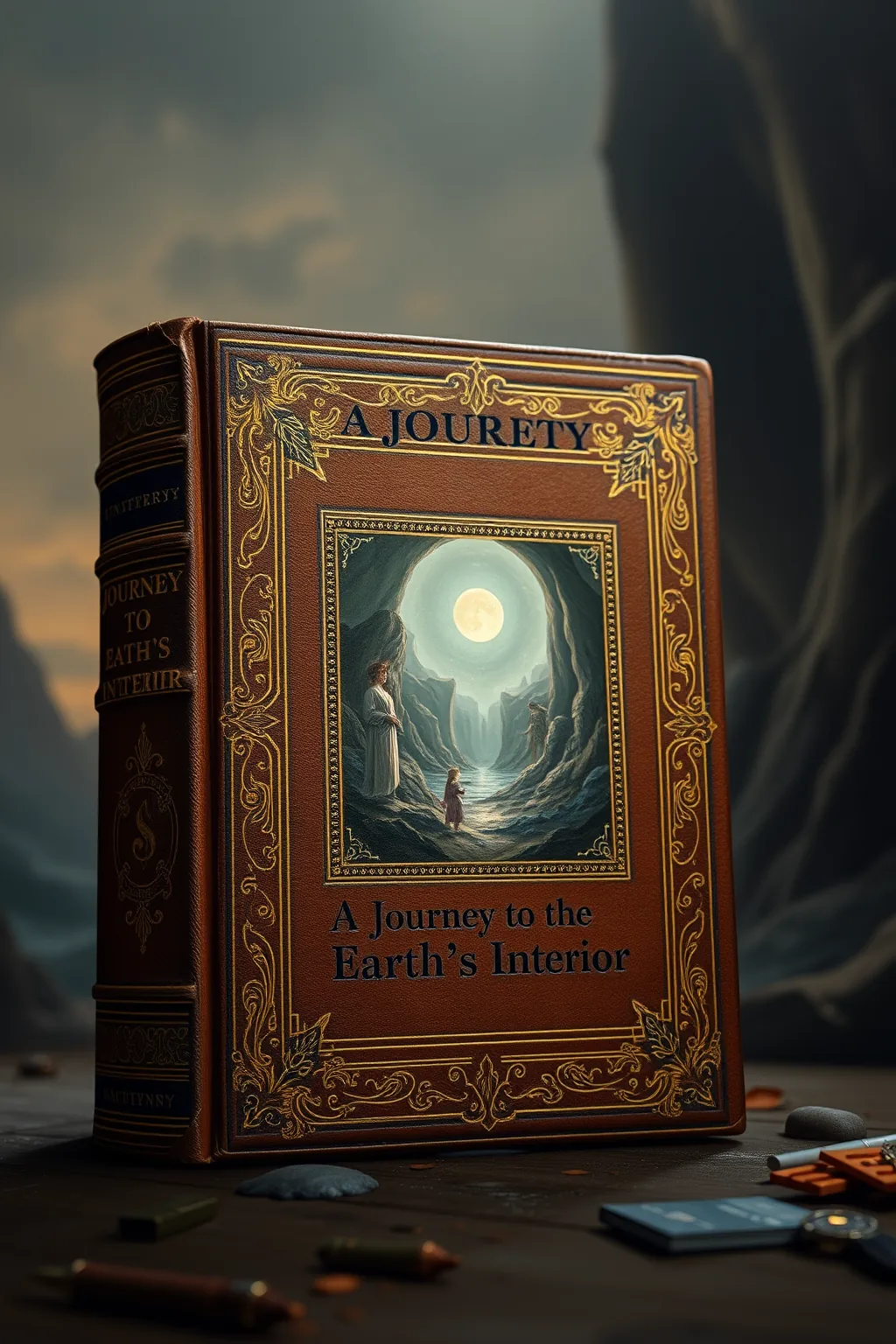
A Journey to the Earth's Interior
 80
80

A Journey to the Earth's Interior



Marcus Thorne, Esoteric Sciences Reviewer: Marshall B. Gardner's "A Journey to the Earth's Interior" stands as a monumental testament to visionary thinking in esoteric literature. Published in 1913, it courageously confronts the prevailing scientific dogma of its time, offering a compelling, albeit unconventional, model of our planet. Gardner's meticulous research and audacious speculation unlock doors to ancient wisdom traditions, suggesting a reality far grander and more complex than commonly perceived. This work is essential for anyone interested in fringe theories, lost civilizations, and the philosophical underpinnings of Earth's hidden geographies. It’s a foundational text for understanding the modern hollow-earth movement.
📝 Description
80
Marshall B. Gardner's 1920 book proposes Earth is hollow with polar openings.
Marshall B. Gardner's "A Journey to the Earth's Interior" challenges standard geographical models. Published in 1920, the book argues that Earth is not a solid sphere but a hollow planet. Gardner theorized that vast openings exist at the North and South Poles, allowing access to this inner world. He suggested this interior realm contains its own sun and is inhabited by advanced civilizations.
The work synthesizes historical records, indigenous folklore, and observations that Gardner felt defied contemporary science. He presents this as more than a geographical idea, framing it as a spiritual exploration of hidden realms and the persistent human search for lost paradises. The book aims to resonate with those questioning established views of our planet and its mysteries.
Gardner's work fits within the tradition of speculative cosmologies that have long questioned conventional scientific understanding of the Earth. This includes earlier ideas about subterranean worlds and hidden continents, often linked to spiritual or mystical traditions. Such theories frequently draw upon ancient myths and apocryphal texts to propose alternative realities existing alongside or beneath our own.
💡 Why Read This Book?
Unearth a radical perspective on our planet's true nature and ancient cosmologies. "A Journey to the Earth's Interior" is for the intrepid seeker who questions established paradigms and yearns to explore the possibility of hidden worlds and forgotten knowledge. Ideal for students of esoteric history, mythologists, and practitioners of earth-based spirituality, this book ignites the imagination and invites profound contemplation.
⭐ Reader Reviews
Honest opinions from readers who have explored this book.
❓ Frequently Asked Questions
What is the central premise of "A Journey to the Earth's Interior"?
The book's core assertion is that the Earth is hollow, with vast openings at the North and South Poles leading to an inner world containing its own sun and inhabitants.
When was the book originally published?
The first edition of "A Journey to the Earth's Interior" was published in 1913.
What kind of evidence does Gardner present?
Gardner compiles historical accounts, indigenous legends, testimonies from sailors and explorers, and interpretations of geological and magnetic anomalies to support his theory.
How does Gardner's work differ from other hollow-earth theories?
Gardner's unique contribution lies in his detailed mapping of potential inner continents and his arguments presented in the context of early 20th-century polar exploration.
Is this book scientifically accepted?
No, Gardner's theory is considered fringe science and is not accepted by mainstream geology or physics. However, it holds significant value within esoteric and alternative historical discourse.
🔮 Key Themes & Symbolism
The Hollow Earth Hypothesis
Gardner meticulously builds the case for a hollow Earth, challenging the prevailing solid-sphere model. He presents a world not as a barren rock, but as a vibrant, concealed realm accessible through polar gateways. This theme studies ancient cosmologies that often depicted a subterranean or inner world, suggesting a cyclical understanding of creation and existence that pre-dates modern scientific paradigms. The allure lies in the possibility of undiscovered lands and civilizations, a persistent human fascination with the unknown and the potential for paradise.
Lost Civilizations and Hidden Wisdom
Central to Gardner's thesis is the idea that advanced civilizations once thrived within the Earth's interior, possessing knowledge lost to the surface world. This theme appeals to Gnostic traditions and ancient myths of a Golden Age or a subterranean Eden. The book acts as a conduit to this forgotten lore, urging readers to consider that humanity's historical narrative might be incomplete, and that profound spiritual and technological insights could lie hidden, waiting to be rediscovered. It speaks to the esoteric quest for primal truths.
Symbolism of Polar Openings
The polar regions, in Gardner's vision, transcend mere geographical locations; they become potent symbols of liminal spaces and portals to other dimensions or states of being. The openings represent thresholds between the known and the unknown, the material and the spiritual. This symbolism aligns with alchemical concepts of transformation and initiation, suggesting that the journey to the Earth's interior is also an inner journey of spiritual awakening. The North and South Poles become mystical gates, guarding secrets of creation and consciousness.
💬 Memorable Quotes
Direct passages from the work, attributed to the author.
“The Earth is a hollow sphere, and the North Pole is the entrance.”
— This concise statement captures Gardner's radical thesis, positioning the geographical North Pole not as a frozen wasteland, but as a mystical gateway to a hidden world.
“Polar explorers have seen wonders, but their accounts are suppressed.”
— Gardner implies a conspiracy or a lack of open-mindedness from the scientific establishment, suggesting that evidence for the hollow Earth exists but is deliberately ignored or hidden.
“The interior of the Earth is a paradise, teeming with life.”
— This evokes a sense of wonder and hope, presenting the hollow Earth not as a void, but as a vibrant, perhaps even utopian, realm in stark contrast to the perceived limitations of the surface world.
“Our maps are incomplete; the true geography lies within.”
— This challenges the reader's fundamental understanding of cartography and reality, suggesting that conventional knowledge is superficial and that deeper truths await exploration beneath the familiar.
💡 Key Ideas
Editorial paraphrase of the work's core concepts — not direct quotes.
Ancient myths speak of a central sun within the Earth.
This quote highlights Gardner's reliance on ancient wisdom and folklore, suggesting that indigenous traditions held truths about Earth's structure that modern science has overlooked.
🌙 Esoteric Significance
Tradition
Gardner's work draws heavily from ancient cosmologies, Gnostic traditions, and indigenous legends that speak of subterranean realms and hidden paradises. It aligns with the perennial philosophy's search for universal truths that transcend cultural and temporal boundaries. The concept of a hollow Earth can be interpreted as a metaphor for the inner self, a hidden spiritual dimension accessible through introspection and esoteric practices, mirroring the journey into the unknown.
Symbolism
The Earth's interior symbolizes the subconscious or the spiritual realm, a place of hidden potential and primal wisdom. The polar openings represent thresholds, portals to higher consciousness or alternative realities, akin to the 'Eye of the Needle' in mystical traditions. The Earth's 'inner sun' can symbolize divine illumination, the source of life and consciousness that sustains this hidden world, mirroring the divine spark within each individual.
Modern Relevance
In an age saturated with data and often disconnected from the natural world, Gardner's radical proposition encourages a re-evaluation of accepted reality and inspires imaginative thinking. It speaks to the modern seeker's desire for deeper meaning, alternative histories, and a more mystical understanding of our planet. The book's enduring appeal lies in its challenge to conventional perceptions and its invitation to explore the boundless potential of human consciousness and the universe.
👥 Who Should Read This Book
This book is a compelling read for curious minds, including seekers of alternative histories, students of esoteric philosophy, and those fascinated by ancient myths and cosmologies. Beginners to esoteric thought will find Gardner's arguments accessible, while scholars of fringe theories and comparative mythology will appreciate its unique contribution. Practitioners of earth-based spirituality or those interested in the symbolism of hidden realms will also find profound inspiration, as the work encourages a holistic and imaginative view of our world and its potential.
📜 Historical Context
Published in 1913, "A Journey to the Earth's Interior" emerged during a period of intense global exploration and burgeoning scientific inquiry. The concurrent era saw significant advancements in technology and a thirst for discovery, particularly in the polar regions. Peary's claim of reaching the North Pole in 1909, though contested, fueled public fascination with these remote frontiers. Gardner's work, however, deliberately diverges from the empirical, offering a speculative, mythologically informed vision. It stands as a evidence of the enduring human impulse to seek meaning beyond the visible, a counter-narrative to the increasingly materialistic and mechanistic worldview gaining traction in the early 20th century. The book tapped into a vein of esoteric thought that sought to reconcile ancient wisdom with modern questions.
📔 Journal Prompts
What personal 'hidden worlds' or undiscovered aspects of yourself do you feel compelled to explore?
How do ancient myths about subterranean realms resonate with your understanding of the Earth or human consciousness?
If the Earth were hollow, what ethical responsibilities might humanity have towards its potential inhabitants?
Consider the concept of 'suppressed knowledge.' What contemporary 'truths' might be overlooked or ignored by mainstream society?
Reflect on the symbolism of polar openings as gateways. What 'thresholds' in your life do you currently face or wish to cross?
🗂️ Glossary
Hollow Earth
The theory that the Earth is not a solid sphere but has a hollow interior, often containing its own sun and inhabitants, accessible through openings at the poles.
Cosmology
The study of the origin, evolution, and eventual fate of the universe. In an esoteric context, it often refers to ancient or mystical models of the cosmos.
Esoteric
Intended for or likely to be understood by only a small number of people with a specialized knowledge or interest; relating to or being secret knowledge.
Perennial Philosophy
The idea that all religions and spiritual traditions share a common core of wisdom and truth, often expressed through symbolic language and myth.
Liminal Space
A transitional or in-between state or place, often associated with significant change, transformation, or crossing thresholds.
This book appears in 1 collection
🔮 Readers Also Liked
Browse all →









From the “Transcendental Meditation” Collection
View all →







More Free Esoteric History & Biography Books
View all →