SYMBOLISM of the TAROT

 75
75

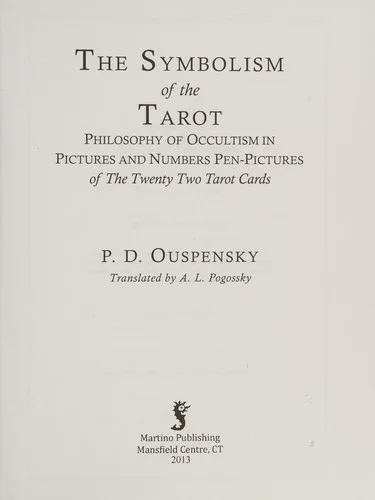
SYMBOLISM of the TAROT
Uspenskiĭ's SYMBOLISM of the TAROT offers a rigorous, almost academic, dissection of the Rider-Waite-Smith deck. His strength lies in meticulously unpacking the visual details, connecting them to esoteric principles with a clarity that avoids sensationalism. The section on the Fool, for instance, is particularly adept at illustrating the concept of the divine spark entering manifestation. However, the sheer density of his symbolic interpretations can occasionally feel overwhelming, demanding considerable prior knowledge. While Uspenskiĭ avoids the pitfalls of modern Tarot sensationalism, his prose can be quite austere. This is not a casual guide, but a dense scholarly analysis. It serves as a valuable, albeit demanding, resource for understanding the deck's symbolic architecture.
📝 Description
75
### What It Is SYMBOLISM of the TAROT presents an in-depth examination of the Rider-Waite-Smith Tarot deck, focusing on its intricate visual language and underlying philosophical currents. Uspenskiĭ, a noted figure in early 20th-century esoteric thought, dissects the symbolism of each card, linking them to broader occult traditions and psychological archetypes.
### Who It's For This work is intended for serious students of Tarot who seek to move beyond superficial divinatory interpretations. It appeals to those interested in the historical development of Tarot as a symbolic system and its connections to comparative mythology, psychology, and Western esotericism. Readers should possess a foundational understanding of Tarot or related symbolic systems.
### Historical Context Published posthumously, this analysis by P.D. Uspenskiĭ emerges from a period of intense interest in esoteric symbolism, particularly in the early to mid-20th century. The work engages with the legacy of figures like Éliphas Lévi and the popularization of the Rider-Waite-Smith deck, which itself was a significant departure from earlier Tarot traditions. Uspenskiĭ's approach reflects the intellectual climate shaped by movements like Theosophy and early analytical psychology, seeking to find universal truths within ancient symbolic forms.
### Key Concepts The book systematically breaks down the Major Arcana and Minor Arcana, exploring not only the traditional imagery but also the numerological and astrological associations that Uspenskiĭ posits. He emphasizes the Tarot as a psychological map and a tool for spiritual development, rather than solely a fortune-telling device. The interrelation between the cards and their potential for forming a coherent philosophical narrative is a central theme.
💡 Why Read This Book?
• Understand the Rider-Waite-Smith deck's visual language beyond divinatory meanings, learning how Uspenskiĭ links each card's iconography to esoteric philosophies, a perspective he elaborates extensively. • Gain insight into the historical esoteric milieu of the early 20th century, particularly how Uspenskiĭ's analysis contextualizes the Tarot within movements like Theosophy. • Develop a deeper appreciation for the Tarot as a psychological and spiritual map, as demonstrated by Uspenskiĭ's systematic breakdown of the Major Arcana's narrative arc.
⭐ Reader Reviews
Honest opinions from readers who have explored this book.
❓ Frequently Asked Questions
What specific Tarot deck does P.D. Uspenskiĭ focus on in SYMBOLISM of the TAROT?
Uspenskiĭ primarily analyzes the Rider-Waite-Smith Tarot deck, appreciating its detailed symbolism as codified by Arthur Edward Waite and illustrated by Pamela Colman Smith, which became influential after its 1909 publication.
Is SYMBOLISM of the TAROT a good starting point for beginners learning Tarot?
While informative, Uspenskiĭ's approach is quite analytical and assumes some familiarity with esoteric concepts. Beginners might benefit from a more introductory text before engaging with this detailed symbolic exploration.
What is P.D. Uspenskiĭ's background relevant to this book?
P.D. Uspenskiĭ (1878-1947) was a Russian esotericist and author known for his work on consciousness, the Fourth Way, and his deep study of symbolism, which he applied to various spiritual traditions including the Tarot.
How does Uspenskiĭ connect Tarot cards to psychology?
Uspenskiĭ interprets the Tarot archetypes as representations of fundamental psychological states and processes, viewing the deck as a symbolic system that mirrors the human psyche's journey and potential for evolution.
When was SYMBOLISM of the TAROT originally published?
While this edition is from 2019, Uspenskiĭ's original writings on the Tarot symbolism were developed and likely presented during the first half of the 20th century, reflecting his active period of esoteric research.
Does the book discuss the Kabbalistic associations of Tarot cards?
Yes, Uspenskiĭ's analysis often incorporates numerological and Kabbalistic correspondences, linking the Tarot's structure and individual cards to Hebrew letters and the Tree of Life.
🔮 Key Themes & Symbolism
Tarot as a Philosophical System
Uspenskiĭ positions the Tarot, particularly the Rider-Waite-Smith deck, not merely as a tool for divination but as a complex philosophical and psychological map. He meticulously examines the sequence of the Major Arcana, interpreting it as a symbolic narrative of spiritual evolution and the human condition. The book argues that understanding the interconnected symbolism across the cards reveals a coherent esoteric worldview, intended for contemplation and self-discovery rather than predictive accuracy.
Visual Symbolism and Esoteric Correspondences
The core of the work lies in its detailed deconstruction of the visual elements within the Rider-Waite-Smith cards. Uspenskiĭ correlates specific symbols, colors, and figures to established esoteric traditions, including numerology and astrology. He highlights how artists like Pamela Colman Smith translated complex occult ideas into accessible imagery, aiming to reveal the hidden meanings embedded within the deck's artwork, which he posits are keys to unlocking deeper spiritual truths.
Psychological Interpretation of Archetypes
Beyond overt occultism, Uspenskiĭ explores the psychological resonance of the Tarot archetypes. He interprets figures and scenes on the cards as representations of universal human experiences, inner states, and stages of consciousness. This perspective aligns with early 20th-century interest in the subconscious and the power of symbols to illuminate the inner life, suggesting the Tarot can serve as a mirror for personal introspection and understanding one's own psyche.
The Rider-Waite-Smith Deck's Significance
The book's specific focus on the Rider-Waite-Smith deck, first published in 1909, is crucial. Uspenskiĭ analyzes why this particular iteration of the Tarot became so influential, attributing its power to the deliberate symbolic encoding by Arthur Edward Waite and the evocative artistry of Smith. He treats this deck as a refined vehicle for transmitting esoteric knowledge, distinct from earlier, often more crudely symbolic, Tarot iterations.
💬 Memorable Quotes
“The Fool represents the beginning of a cycle, the potential for infinite possibility before conscious choice is made.”
— This highlights Uspenskiĭ's view of the Fool not as ignorance, but as pure, unmanifested potential, the primordial state before the ego's involvement, crucial for understanding spiritual progression.
“Each card is a symbol, and the sequence of symbols forms a coherent doctrine.”
— This encapsulates Uspenskiĭ's central thesis: the Tarot is a structured system of knowledge, where the individual symbols gain meaning through their relationship within the larger narrative arc of the deck.
“The imagery on the cards is not arbitrary; it is a language designed to communicate profound truths.”
— This emphasizes Uspenskiĭ's belief in the intentionality behind Tarot design, particularly the Rider-Waite-Smith deck, viewing its visual elements as a deliberate code for esoteric wisdom.
“Understanding the Minor Arcana requires recognizing their connection to the elemental forces and numerical sequences.”
— This points to Uspenskiĭ's method of analyzing the pip cards and court cards through the lens of numerology and elemental correspondences, linking them to broader cosmological principles.
“The Tarot provides a framework for comprehending the relationship between the material world and the spiritual realms.”
— This interpretation suggests Uspenskiĭ sees the Tarot as a bridge, a tool that helps reconcile the seen and unseen, offering a symbolic structure to understand the multi-layered nature of reality.
🌙 Esoteric Significance
Tradition
Uspenskiĭ's work is firmly situated within the Western Esoteric Tradition, drawing heavily from Hermeticism, Kabbalah, and Theosophical interpretations of symbolism prevalent in the early 20th century. He views the Tarot not just as a divinatory tool but as a codified system of spiritual knowledge, akin to other esoteric diagrams like the Tree of Life. His analysis seeks to reveal the underlying structure of consciousness and the cosmos as represented through the cards, aligning with the Hermetic principle of 'As Above, So Below'.
Symbolism
Key symbols Uspenskiĭ examines include the Fool (representing divine potential and the initial spark of creation), the Magician (willpower and manifestation), the High Priestess (hidden knowledge and intuition), and the World (completion and integration). He meticulously breaks down the numerological values of each card (e.g., the 3s representing creativity, the 10s completion) and the elemental attributions of the suits (Wands/Fire, Cups/Water, Swords/Air, Pentacles/Earth), showing how these correspondences form a cohesive symbolic language.
Modern Relevance
Contemporary practitioners of Western Esotericism, particularly those focused on the Rider-Waite-Smith deck, continue to reference Uspenskiĭ's foundational analysis. His emphasis on the Tarot as a psychological map and a system for spiritual development finds echoes in modern Jungian Tarot approaches and various schools of occult philosophy. Thinkers and practitioners seeking a rigorous, historically-grounded interpretation that moves beyond simplistic fortune-telling often turn to his detailed symbolic exegesis.
👥 Who Should Read This Book
• Students of the Rider-Waite-Smith Tarot deck seeking a deeper, symbolic interpretation beyond basic divinatory meanings, as Uspenskiĭ offers a systematic analysis of its visual language. • Practitioners of Western Esotericism interested in how figures like P.D. Uspenskiĭ integrated various symbolic systems (Kabbalah, numerology) into their understanding of Tarot during the early 20th century. • Comparative mythology and religious studies scholars looking to understand the evolution of Tarot symbolism and its connection to archetypal psychology, as explored through Uspenskiĭ's rigorous approach.
📜 Historical Context
P.D. Uspenskiĭ’s analysis of the Tarot emerged during a vibrant period of esoteric exploration in the early to mid-20th century. This era saw a surge of interest in comparative religion, mysticism, and the psychological underpinnings of symbolism, heavily influenced by movements like Theosophy and the nascent field of psychoanalysis. The Rider-Waite-Smith deck, introduced in 1909, represented a significant evolution in Tarot design, consciously imbued with occult symbolism by Arthur Edward Waite and brought to life by Pamela Colman Smith. Uspenskiĭ’s work engaged directly with this specific deck, seeking to decode its intricate visual language and connect it to broader esoteric doctrines. His approach was contemporary with thinkers like Carl Jung, who was also exploring the archetypal significance of symbols, though Uspenskiĭ remained primarily within the Western esoteric tradition. Unlike purely academic analyses, Uspenskiĭ’s perspective was deeply rooted in practical esoteric philosophy and the search for spiritual knowledge.
📔 Journal Prompts
The Fool's leap: Reflect on the concept of unmanifest potential as symbolized by card 0.
Analyze the visual symbolism of The Magician, connecting its elements to Uspenskiĭ's ideas on manifestation.
Consider the sequence of the Major Arcana as a narrative of spiritual evolution.
Explore the numerological significance of the '3' cards within the Minor Arcana, as interpreted by Uspenskiĭ.
How does the imagery of The World card, as described by Uspenskiĭ, represent completion?
🗂️ Glossary
Major Arcana
The set of 22 trump cards in a Tarot deck, numbered 0 to 21, which typically depict archetypal figures and profound spiritual or life lessons.
Minor Arcana
The 56 cards of a Tarot deck, divided into four suits (Wands, Cups, Swords, Pentacles), which represent more mundane events, situations, and energies of daily life.
Rider-Waite-Smith Deck
A highly influential Tarot deck first published in 1909, known for its detailed allegorical illustrations by Pamela Colman Smith, commissioned by Arthur Edward Waite.
Numerology
The study of the mystical or symbolic significance of numbers and their influence on human life and the cosmos.
Kabbalah
A system of Jewish mysticism concerned with the nature of God and the universe, often visualized through diagrams like the Tree of Life, which Uspenskiĭ references.
Archetype
A universal, inherited pattern of thought or imagery derived from the experiences of the human species, as conceptualized by Carl Jung and applied by Uspenskiĭ to Tarot figures.
Esotericism
Beliefs and practices concerning hidden spiritual knowledge or experience, often reserved for a select group or requiring initiation, as applied to Tarot symbolism.