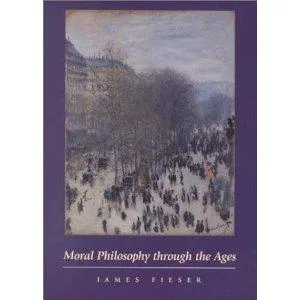
Moral Philosophy through the Ages
 77
77

Moral Philosophy through the Ages
James Fieser’s "Moral Philosophy through the Ages" attempts a broad sweep, charting the lineage of ethical thought from its ancient roots to more contemporary concerns. The book's strength lies in its systematic organization, providing a clear, almost textbook-like progression through major ethical systems. Fieser’s discussion of Kant’s categorical imperative, for instance, is presented with admirable clarity, breaking down a notoriously complex concept. However, the work’s ambition to cover such a vast span means that certain periods and thinkers receive only cursory treatment. The esoteric dimension, while present in the lineage of some ethical thought, feels somewhat secondary to the primary focus on Western academic philosophy. It’s a solid academic survey, but one that doesn't particularly engage with the mystical or occult interpretations of morality that might appeal to a broader Esoteric Library audience.
📝 Description
77
### What It Is 'Moral Philosophy through the Ages' by James Fieser, first published in 2000, presents a comprehensive survey of ethical thought from antiquity to the modern era. The work systematically examines the evolution of moral theories, tracing the development of concepts and arguments across distinct philosophical traditions. It offers a structured approach to understanding the foundational questions of ethics.
### Who It's For This volume is principally for students and scholars of philosophy, particularly those engaged with the history of ethics. It serves as an excellent resource for individuals seeking a detailed, chronological overview of moral reasoning and its historical progression. Those interested in the intellectual underpinnings of societal norms and ethical frameworks will also find value.
### Historical Context The book situates its subject within the broader landscape of philosophical inquiry, acknowledging the enduring impact of figures like Aristotle and Immanuel Kant. Fieser's work emerges in a period following the mid-20th century's linguistic turn in philosophy, which sometimes de-emphasized historical narratives. By re-centering the historical development of moral philosophy, Fieser engages with a tradition that has seen significant debate, particularly concerning the nature of ethical universals versus relativism.
### Key Concepts Central to Fieser's exploration are the concepts of virtue ethics, deontology, and consequentialism. The work dissects various theories of the good, the right, and moral obligation. It tracks the influence of ancient Greek ethics, the Stoic emphasis on reason, medieval theological ethics, and the Enlightenment's focus on individual rights and duties, culminating in contemporary ethical debates.
💡 Why Read This Book?
• Gain a structured understanding of how virtue ethics, as first articulated by Plato and Aristotle, evolved into later deontological and consequentialist frameworks. • Trace the influence of specific historical figures like Immanuel Kant, whose categorical imperative is examined, and understand its impact on modern ethical reasoning. • Appreciate the philosophical underpinnings of Western moral discourse, recognizing how concepts of the 'good' and the 'right' have been debated since antiquity.
⭐ Reader Reviews
Honest opinions from readers who have explored this book.
❓ Frequently Asked Questions
When was 'Moral Philosophy through the Ages' originally published?
James Fieser's 'Moral Philosophy through the Ages' was first published in the year 2000, marking its entry into contemporary philosophical discourse.
What are the primary ethical theories discussed in Fieser's book?
The book primarily discusses virtue ethics, deontology, and consequentialism, tracing their development and key arguments throughout history.
Does the book cover ancient Greek philosophers?
Yes, 'Moral Philosophy through the Ages' begins its survey with ancient Greek ethics, examining foundational concepts from thinkers like Aristotle.
Is the book suitable for beginners in philosophy?
The work is comprehensive and systematically organized, making it a suitable resource for students and those new to the history of moral philosophy.
What is the chronological scope of the book?
The book covers moral philosophy from antiquity, including ancient Greek and Roman thought, through medieval and Enlightenment periods, up to more modern ethical theories.
Who is the author of 'Moral Philosophy through the Ages'?
The author is James Fieser, who first published this survey of ethical thought in 2000.
🔮 Key Themes & Symbolism
Evolution of Virtue Ethics
The work meticulously charts the trajectory of virtue ethics, originating with figures like Plato and Aristotle in ancient Greece. It examines how the concept of cultivating moral character and excellent habits, central to early virtue traditions, was later challenged and reinterpreted through different philosophical lenses, especially during the rise of deontological and consequentialist systems.
Deontological Frameworks
A significant portion of the book is dedicated to deontological ethics, particularly highlighting Immanuel Kant's categorical imperative. This theme explores the idea of duty-based morality, where actions are judged right or wrong based on adherence to rules or obligations, irrespective of their consequences. The work traces the philosophical lineage of such rule-based systems.
Consequentialist Reasoning
The book also addresses consequentialist theories, where the morality of an action is determined by its outcome or consequences. It examines various forms of utilitarianism and other teleological approaches, showing how the focus shifts from inherent rightness to the greatest good for the greatest number, a distinct departure from earlier ethical paradigms.
Historical Development of Moral Concepts
Fieser's text emphasizes the historical contingency and development of core moral concepts. It demonstrates how ideas about justice, the good life, and ethical obligation have been shaped by specific philosophical movements and intellectual climates, from the Stoics' emphasis on reason to the theological ethics of the medieval period.
💬 Memorable Quotes
“The book explores how ancient Greek philosophers like Aristotle grounded morality in the cultivation of character.”
— This highlights the foundational role of virtue ethics, emphasizing that moral goodness is achieved through developing excellent personal traits and habits rather than solely adhering to external rules.
“Fieser examines Immanuel Kant's categorical imperative as a cornerstone of deontological thought.”
— This points to Kant's influential concept that moral actions are those that can be universalized into a law, focusing on duty and rationality as the basis for ethical judgment.
“The work contrasts rule-based ethics with those focused on the results of actions.”
— This paraphrases the fundamental distinction between deontology (duty-based) and consequentialism (outcome-based) ethical theories, a key analytical tool used throughout the book.
“The historical survey traces ethical ideas from antiquity through the Enlightenment.”
— This indicates the book's broad chronological scope, showing how moral philosophy evolved over centuries, influenced by different cultural and intellectual eras.
“The text discusses the Stoic emphasis on reason and natural law.”
— This refers to a specific philosophical school whose ideas about living in accordance with nature and employing reason significantly shaped ethical thought in the ancient world.
🌙 Esoteric Significance
Tradition
While not explicitly an esoteric text, 'Moral Philosophy through the Ages' can be seen as providing the foundational philosophical context for many esoteric traditions. Esoteric thought often draws on ancient Greek philosophies (like Platonism and Neoplatonism) and medieval scholasticism, both of which are covered in Fieser's historical survey. Understanding these philosophical roots helps illuminate the ethical frameworks implicitly or explicitly present in Hermeticism, Gnosticism, and later Western Esoteric movements.
Symbolism
The book's focus on ethics itself can be viewed through an esoteric lens. Concepts like 'virtue' and 'the good life' in Platonic and Aristotelian thought, for instance, often carry symbolic weight in esoteric traditions, representing stages of spiritual ascent or the attainment of higher consciousness. The Stoic emphasis on inner control and living in accordance with cosmic reason also resonates with esoteric principles of self-mastery and alignment with universal laws.
Modern Relevance
Contemporary esoteric practitioners often grapple with ethical questions related to their practices, such as the responsible use of occult knowledge or the cultivation of inner virtues. Fieser's work provides a historical and philosophical grounding for these discussions, enabling a deeper understanding of how enduring ethical concepts have been shaped. Thinkers in fields like Integral Spirituality or those exploring comparative ethics within esoteric studies can find valuable context here.
👥 Who Should Read This Book
• Students of Western philosophy seeking a chronological overview of ethical thought, from Aristotle to Kant and beyond. • Comparative religion scholars interested in the philosophical underpinnings of moral systems that influence various spiritual traditions. • Individuals curious about the historical development of concepts like virtue, duty, and justice in Western intellectual history.
📜 Historical Context
First published in 2000, James Fieser's 'Moral Philosophy through the Ages' entered a philosophical landscape still shaped by the analytical traditions of the 20th century. While figures like Aristotle and Immanuel Kant were never absent from academic discourse, the mid-to-late 20th century saw increasing emphasis on meta-ethics and linguistic analysis. Fieser’s work counters this by offering a robust historical narrative, tracing the lineage of ethical theories. It appeared during a period when scholars like Alasdair MacIntyre were also re-examining virtue ethics and its historical development, prompting renewed interest in classical moral philosophy. The book implicitly engages with the ongoing debate between universalist and relativist ethical stances, a discussion prominent since the post-war era, and provides a structured counterpoint to more fragmented approaches to moral theory.
📔 Journal Prompts
Aristotle's concept of virtue as a mean.
Kant's categorical imperative and its implications.
The historical shift from virtue ethics to deontology.
Stoic ideals of living in accordance with nature.
The influence of theological ethics in the medieval period.
🗂️ Glossary
Virtue Ethics
A moral philosophy that emphasizes the character of the moral agent rather than specific actions or duties. It focuses on cultivating virtues, such as courage, temperance, and justice, as the basis for ethical behavior.
Deontology
An ethical theory that judges the morality of an action based on adherence to rules or duties. Actions are considered right or wrong in themselves, regardless of their consequences. Immanuel Kant is a key proponent.
Consequentialism
A family of ethical theories that determine the morality of an action based on its outcomes or consequences. Utilitarianism, which seeks the greatest good for the greatest number, is a prominent example.
Categorical Imperative
A central concept in Kantian ethics, representing a moral command that is unconditional or absolute. It dictates that one should act only according to that maxim whereby you can at the same time will that it should become a universal law.
Virtue as a Mean
A concept, most notably associated with Aristotle, suggesting that virtue lies in finding a middle ground between two extremes of vice (one of excess, one of deficiency).
Stoicism
An ancient Greek school of philosophy founded by Zeno of Citium. Stoics emphasized virtue, reason, and living in accordance with nature, advocating for emotional resilience and self-control.
Enlightenment Ethics
Moral philosophy developed during the Age of Enlightenment (roughly 17th-18th centuries), characterized by a focus on reason, individual rights, and secularization of ethics, with figures like Kant being prominent.