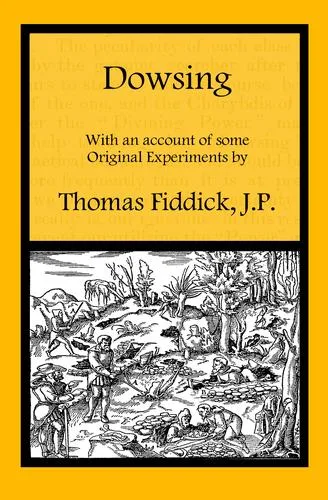
Dowsing
 76
76

Dowsing
Thomas Fiddick's "Dowsing" offers a refreshing, unadorned look at a practice often shrouded in New Age jargon. Its strength lies in its straightforward, almost scientific approach for its time, presenting observations and theories without excessive embellishment. Fiddick meticulously details the mechanics of using the rod and the mental disposition required, grounding the practice in observable phenomena. However, the limitation is its inherent reliance on anecdotal evidence and pre-modern scientific understanding, which may leave contemporary readers seeking more robust, independently verifiable explanations. A particularly illuminating section discusses the dowser's 'magnetism' and its supposed sympathetic connection to subterranean water sources, a concept that bridges physical and subtle realms. "Dowsing" provides a valuable historical snapshot for those investigating the roots of geomantic practices.
📝 Description
76
### What It Is Dowsing, by Thomas Fiddick, first published in 1913, is an early exploration into the practice and theory of dowsing. It examines the phenomenon of finding underground water, minerals, or other hidden objects through the use of a divining rod or pendulum. The work predates many modern scientific dismissals, approaching the subject with a blend of empirical observation and an open mind to subtle energies.
### Who It's For This volume is directed towards individuals seeking a foundational understanding of dowsing as it was conceptualized at the turn of the 20th century. It appeals to those interested in the history of psychical research, early parapsychology, and the practical application of intuitive sensing. Students of earth energies, geomancy, and alternative divinatory practices will find its historical perspective valuable.
### Historical Context Published during an era of intense interest in spiritualism, Theosophy, and the burgeoning field of psychical research, Fiddick's work emerged when many scholars and laypeople were exploring phenomena that challenged conventional scientific paradigms. The Society for Psychical Research, founded in 1882, was actively investigating telepathy, clairvoyance, and other psychic abilities. Dowsing, with its seemingly inexplicable results, fit squarely within this milieu of inquiry into the unseen forces of nature and the human mind.
### Key Concepts The book delves into the mechanics and perceived principles behind the dowsing rod's movement, exploring theories related to subtle vibrations, magnetic forces, and psychic attunement. It discusses the importance of the dowser's mental state, the influence of the environment, and the characteristics of successful dowsing sites. Fiddick also touches upon the historical prevalence of dowsing across different cultures and time periods.
✍️ Author
Thomas Fiddick
Gareth Jones is a British film and television director and screenwriter. He is the owner and joint CEO, with Fiona Howe, of the independent production company Scenario Films.
💡 Why Read This Book?
• Gain a historical perspective on dowsing, understanding its conceptualization in the early 20th century, a period rife with psychical research, which differs from modern interpretations. • Learn about Fiddick's specific theories regarding the 'magnetic' properties and subtle energies believed to influence the divining rod's motion. • Discover practical techniques and mental preparations for dowsing as described in 1913, offering a direct glimpse into early practitioner methods.
⭐ Reader Reviews
Honest opinions from readers who have explored this book.
❓ Frequently Asked Questions
When was Thomas Fiddick's Dowsing first published?
Thomas Fiddick's "Dowsing" was first published in 1913, placing it within a significant period of early 20th-century psychical research and spiritualist inquiry.
What is the primary focus of the book Dowsing by Thomas Fiddick?
The book primarily focuses on the practice and theory of dowsing, specifically the use of a divining rod or pendulum to locate underground water, minerals, or other hidden objects.
Who might benefit from reading Fiddick's Dowsing?
Individuals interested in the history of parapsychology, early geomancy, earth energies, and the evolution of divinatory practices will find this book particularly beneficial.
Does the book offer scientific explanations for dowsing?
While Fiddick's work adopts an empirical tone for its era, it explores theories involving subtle energies and magnetism, which predate modern scientific validations and are often viewed through a more metaphysical lens today.
Is Dowsing by Thomas Fiddick considered a foundational text?
Yes, "Dowsing" is considered a foundational text for understanding the historical development of dowsing practices and theories from the early 20th century, before extensive modern scientific scrutiny.
What historical movements influenced the writing of Dowsing in 1913?
The book was influenced by the era's burgeoning interest in spiritualism, Theosophy, and the activities of the Society for Psychical Research, which explored phenomena beyond conventional scientific understanding.
🔮 Key Themes & Symbolism
The Divining Rod's Mechanism
Fiddick's work investigates the physical and energetic principles attributed to the divining rod's movement. It explores how the operator's subtle energies, combined with environmental factors, are believed to interact with subterranean water or mineral veins. The text delves into the concept of sympathetic resonance, suggesting the rod acts as a sensitive indicator of these unseen connections, rather than a mere mechanical device responding to physical force.
Operator's Mental State
Central to Fiddick's thesis is the critical role of the dowser's mental disposition. He emphasizes the necessity of a receptive, non-analytical state, often described as a form of passive attention or 'attunement.' The book posits that a calm, focused mind, free from doubt or expectation, is essential for accurately sensing and translating subtle energetic signals into rod movements.
Historical and Cultural Prevalence
The book contextualizes dowsing not as a novel invention but as an ancient practice with deep historical roots. Fiddick references its presence across various cultures and eras, suggesting a universal human capacity or a natural phenomenon that has been recognized and utilized for centuries. This broad historical sweep aims to lend credence to the practice by demonstrating its enduring nature.
Subtle Energies and Magnetism
Fiddick explores dowsing through the lens of subtle energies and magnetic forces, concepts prevalent in early 20th-century esoteric and scientific thought. The work suggests that the earth possesses a natural magnetism and that water, in particular, emits a 'vital' emanation that can be detected by a sensitive operator and indicated by a responsive rod.
💬 Memorable Quotes
“The operator's mind must be in a state of passive attention.”
— This highlights the crucial role of the dowser's mental state, suggesting that active thought or forceful will can impede the intuitive sensing required for successful dowsing.
“The divining rod is a sensitive indicator of subtle emanations.”
— This statement defines the tool not as a source of power, but as a responsive instrument that amplifies faint, unseen energies or vibrations emanating from the target.
“Water possesses a peculiar magnetism which influences the rod.”
— This interpretation points to a core theory within the book, positing that water emits a specific energetic signature, akin to magnetism, that directly interacts with the dowsing rod.
“Dowsing has been practiced across diverse cultures for centuries.”
— This concept underscores the historical depth and cross-cultural presence of dowsing, framing it as a long-standing human practice rather than a modern fad.
“The operator's own subtle magnetism plays a role in detection.”
— This idea suggests a reciprocal energetic relationship, where the dowser's internal energetic field is as crucial as the target's emanations in the dowsing process.
🌙 Esoteric Significance
Tradition
Fiddick's work aligns with the burgeoning esoteric interest in subtle energies and natural forces prevalent in the early 20th century, influenced by movements like Theosophy and vitalism. It doesn't strictly adhere to a single lineage like Hermeticism or Kabbalah but reflects a broader fascination with the hidden potentials of nature and human perception that characterized the era's occult revival.
Symbolism
The primary symbol is the divining rod itself, representing an extension of the dowser's intuitive faculty and a conduit for subtle energies. Water is also a potent symbol, signifying life force, the subconscious, and hidden depths. The earth's magnetic field, as discussed, symbolizes the unseen energetic structure of the planet that can be accessed and interpreted.
Modern Relevance
Contemporary practitioners of geomancy, dowsing, and earth energy work often reference historical texts like Fiddick's to understand the foundational theories and historical context of their practices. It informs modern discussions on geobiology and the potential for humans to interact with and sense subtle environmental energies.
👥 Who Should Read This Book
• Aspiring dowsers seeking to understand the historical underpinnings and early theoretical frameworks of the practice. • Researchers of parapsychology and the history of psychical research interested in early 20th-century approaches to unexplained phenomena. • Individuals exploring geomancy and earth energies who wish to connect with the roots of practices aimed at sensing the terrestrial environment.
📜 Historical Context
Thomas Fiddick's "Dowsing" emerged in 1913, a period of fervent exploration into the unseen and unexplained. The era was marked by the widespread influence of spiritualism and the formal establishment of psychical research societies, such as the Society for Psychical Research (founded 1882), which actively investigated phenomena like telepathy and clairvoyance. Dowsing, with its seemingly paranormal results, fit neatly into this milieu. Competing schools of thought ranged from purely materialistic explanations to Theosophical interpretations of subtle energies. While Fiddick's work might not have garnered specific widespread academic citation or condemnation, it contributed to a broader discourse on psychic abilities and natural forces being explored by contemporaries like Sir Arthur Conan Doyle, who was a prominent advocate for spiritualism.
📔 Journal Prompts
The operator's passive attention, as described by Fiddick, and its role in sensing subtle emanations.
Fiddick's concept of the divining rod as an indicator of 'peculiar magnetism' in water.
Reflect on the historical prevalence of dowsing before its widespread scientific skepticism.
The role of the dowser's 'subtle magnetism' in detecting hidden objects.
Compare Fiddick's 1913 theories with contemporary understandings of dowsing.
🗂️ Glossary
Dowsing
The practice of using a divining rod, pendulum, or similar instrument to detect underground water, minerals, or other hidden objects.
Divining Rod
A Y-shaped or L-shaped rod, traditionally made of wood, used by dowsers. It is believed to move or dip when held over a target substance.
Pendulum
A weight suspended from a string or chain, used in dowsing to indicate direction or presence through its swing or rotation.
Subtle Emanations
Faint, unseen energies or vibrations believed to be emitted by water, minerals, or other substances, detectable by a sensitive dowser.
Passive Attention
A mental state described by Fiddick as crucial for dowsing, characterized by a lack of active concentration or forceful will, allowing for intuitive reception.
Vital Magnetism
A term used in early 20th-century esoteric thought, suggesting a life-force or specific energetic property, particularly attributed to water, that influences dowsing instruments.
Psychical Research
The study of alleged psychic phenomena, such as telepathy, clairvoyance, and dowsing, often conducted by societies established in the late 19th and early 20th centuries.