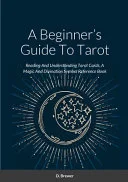
A Beginner's Guide to Tarot
 81
81

A Beginner's Guide to Tarot
D. Brewer’s *A Beginner's Guide to Tarot* tackles the often-intimidating world of cartomancy with a commendable directness. The 2023 publication avoids sensationalism, focusing instead on practical instruction. Its strength lies in demystifying the process of laying out spreads and understanding card placement, a crucial step often glossed over in more advanced texts. The section on positional meanings, for instance, offers clear guidance on how a card’s significance shifts depending on its location in the spread. However, the book’s brevity sometimes leads to a surface-level exploration of deeper esoteric concepts. While it introduces the spiritual guidance each card offers, the interpretations, particularly for the Minor Arcana, can feel somewhat generalized. For instance, the discussion around the suit of Wands tends to focus heavily on action without fully exploring its connection to creative spark and Will. Ultimately, Brewer provides a solid, no-nonsense foundation for the absolute novice, though seasoned practitioners may find it lacks the depth for sustained engagement.
📝 Description
81
### What It Is
A Beginner's Guide to Tarot by D. Brewer, first published in 2023, serves as an accessible entry point into the practice of tarot card reading. It moves beyond simple memorization of card meanings, aiming to equip readers with the foundational knowledge necessary for interpreting spreads and understanding the spiritual significance of individual cards. The work outlines various layout techniques and the positional meanings within a reading, facilitating a more nuanced approach to divination.
### Who It's For
This guide is principally designed for individuals new to the tarot, those who feel drawn to its divinatory potential but find the existing literature overwhelming. It caters to the curious beginner seeking a structured pathway into understanding the Major and Minor Arcana. The book addresses the common confusion arising from the multiplicity of interpretations, offering clarity for those embarking on their personal tarot journey.
### Historical Context
While D. Brewer's guide is a contemporary work from 2023, it enters a field with a rich history. Tarot's origins are debated, but its use for divination solidified in the late 18th century, particularly influenced by figures like Antoine Court de Gébelin. By the early 20th century, the Rider-Waite-Smith deck, illustrated by Pamela Colman Smith, became a standard, influencing countless subsequent decks and interpretations. Brewer's work builds upon this legacy, offering a modern distillation of foundational tarot principles for a new generation of practitioners.
### Key Concepts
The book introduces core concepts essential for tarot comprehension. These include the distinction between the Major Arcana, representing significant life events and spiritual lessons, and the Minor Arcana, detailing daily occurrences and personal circumstances. Understanding the 'spread'—the arrangement of cards—and the 'positional meaning' within that spread are central. The guide also emphasizes the spiritual guidance each card offers, moving beyond mere prediction to explore personal growth and insight.
💡 Why Read This Book?
• Gain a practical understanding of tarot spreads and positional meanings, moving beyond rote memorization of individual card interpretations as outlined in the book's sections on laying different types of spreads. • Uncover the spiritual guidance inherent in each card, enabling you to interpret tarot not just for prediction but for personal growth, as emphasized in the book's approach to the Major and Minor Arcana. • Acquire foundational knowledge that simplifies the often-confusing landscape of tarot meanings, empowering you to start your own readings with confidence, a benefit directly addressed by the guide's 2023 publication date and beginner-focused intent.
⭐ Reader Reviews
Honest opinions from readers who have explored this book.
❓ Frequently Asked Questions
What are the main components of a tarot deck as explained in A Beginner's Guide to Tarot?
The book details the two primary components: the Major Arcana, comprising 22 cards representing significant life lessons and spiritual themes, and the Minor Arcana, consisting of 56 cards divided into four suits (Wands, Cups, Swords, Pentacles) that reflect everyday experiences.
How does A Beginner's Guide to Tarot explain the importance of card spreads?
It emphasizes that the arrangement of cards, or 'spread,' is crucial for interpretation. Different spreads, like a simple three-card draw or more complex layouts, focus the reading on specific questions or areas of life, with each position holding distinct meaning.
What is the significance of positional meanings in tarot readings according to D. Brewer?
The book explains that a card's meaning is influenced by where it falls within a spread. For example, a card in the 'past' position will offer a different perspective than the same card in the 'future' position.
Can A Beginner's Guide to Tarot help with understanding yes/no tarot questions?
Yes, the guide touches upon brief interpretations, including how certain cards or spread positions can lend themselves to straightforward 'yes' or 'no' answers, alongside more nuanced readings.
Is A Beginner's Guide to Tarot suitable for someone completely new to divination?
Absolutely. Published in 2023, it's designed specifically for beginners, addressing common points of confusion and providing a structured approach to learning tarot interpretation and practice.
What kind of spiritual guidance can one expect from the tarot cards, as per the book?
The book suggests that each card offers spiritual guidance by highlighting lessons, potential challenges, or opportunities for personal growth. It encourages readers to look beyond simple prediction to deeper self-understanding.
🔮 Key Themes & Symbolism
Foundation in Tarot Interpretation
This guide establishes the fundamental building blocks for understanding tarot. It systematically breaks down the structure of a tarot deck into the Major and Minor Arcana, explaining their distinct roles. Crucially, it moves beyond mere card meanings to explore the mechanics of reading, such as constructing various spreads and assigning significance based on card positions. This approach offers a practical framework for beginners, aiming to demystify a practice often perceived as arcane and complex, making it approachable for anyone drawn to divination.
Spiritual Guidance and Self-Reflection
Beyond prediction, the book emphasizes the tarot's capacity for offering spiritual guidance and fostering self-reflection. Each card is presented not just as an indicator of future events, but as a symbol carrying profound lessons and insights applicable to personal growth. The guide encourages readers to engage with the cards as tools for introspection, helping them to understand underlying energies, challenges, and potentials within their lives. This perspective elevates tarot from a mere fortune-telling device to a philosophical aid.
Practical Application of Spreads
A significant focus is placed on the practical application of different tarot spreads. The book guides readers through the process of laying out cards in various configurations, illustrating how the structure of a spread influences the narrative of a reading. Understanding the meaning attributed to each position within a spread is presented as key to unlocking deeper interpretations. This hands-on approach aims to equip novices with the ability to conduct their own readings effectively, moving from passive observation to active engagement.
Demystifying Divination
The core aim of this work is to demystify the practice of tarot divination. It acknowledges the confusion often associated with interpreting the numerous symbols and meanings within a deck. By providing clear explanations and structured learning paths, Brewer seeks to make tarot accessible to newcomers. The guide addresses common hurdles, such as varied interpretations and the perceived complexity of the cards, offering a straightforward entry point for those curious about cartomancy and its potential for insight.
💬 Memorable Quotes
“Understanding the many interpretations of the mysterious tarot cards can be confusing.”
— This statement directly addresses a common barrier for aspiring tarot readers. It validates the beginner's experience of feeling overwhelmed by the sheer volume of information and diverse schools of thought surrounding tarot card meanings.
“This beginners guide will show the how to lay different types of spreads.”
— This highlights the practical, instructional nature of the book. It promises concrete skills development, focusing on the physical act of arranging cards for a reading, which is a fundamental technique for any practitioner.
“the meanings of the positions of the cards”
— This phrase points to a critical element of tarot interpretation beyond just the card's inherent meaning. It signifies the book's focus on context, explaining how a card's role changes based on its placement within a spread.
“the important spiritual guidance that each card offers you.”
— This emphasizes the book's perspective on tarot as a tool for personal and spiritual development, rather than solely predictive. It suggests an exploration of deeper, more introspective meanings within the cards.
“From brief yes/no interpretations to more insightful predictions”
— This indicates the book's scope, catering to a range of reading needs. It suggests that readers will learn techniques for both quick, definitive answers and more complex, nuanced divinatory insights.
🌙 Esoteric Significance
Tradition
This work primarily engages with the Western esoteric tradition of cartomancy, which evolved significantly from its 18th-century esoteric interpretations. While not explicitly tied to a single lineage like Hermeticism or Kabbalah, it draws implicitly from the symbolic language developed within these traditions, particularly as popularized by figures like A.E. Waite. The guide functions as an introductory text, presenting established symbolic correspondences and divinatory practices that have become standard within modern tarot communities.
Symbolism
Key symbols explored include the Major Arcana archetypes (e.g., The Fool, The Magician, The High Priestess), representing fundamental spiritual lessons and stages of the human journey. The four suits of the Minor Arcana—Wands (action, creativity), Cups (emotions, relationships), Swords (intellect, conflict), and Pentacles (material world, finances)—also serve as core symbolic systems, representing different facets of human experience and interaction with the world.
Modern Relevance
In contemporary practice, Brewer's guide resonates with the widespread interest in mindfulness, self-discovery, and practical spirituality. It aligns with modern approaches that view tarot not just as fortune-telling but as a psychological or spiritual tool. Thinkers and practitioners focusing on accessible divination, personal growth coaching through symbolic systems, and digital esoteric education often draw upon the foundational knowledge presented in such beginner-friendly texts.
👥 Who Should Read This Book
• Aspiring tarot readers seeking a clear, structured introduction to card meanings, spreads, and interpretation techniques, moving beyond anecdotal advice. • Individuals curious about divination and spirituality who feel intimidated by the complexity of existing tarot literature and require a foundational, accessible starting point. • Self-help practitioners looking for tools to enhance introspection and personal growth, using the tarot as a symbolic language for self-discovery and reflection.
📜 Historical Context
D. Brewer's *A Beginner's Guide to Tarot*, published in 2023, enters a field with centuries of history. While its exact origins are debated, tarot's use for divination gained significant traction in the late 18th century, influenced by esotericists like Antoine Court de Gébelin who linked the cards to ancient Egyptian wisdom. By the early 20th century, the Rider-Waite-Smith deck, designed by Arthur Edward Waite and illustrated by Pamela Colman Smith, became a dominant force, standardizing imagery and interpretations for many practitioners. This deck's widespread adoption shaped subsequent approaches to tarot reading, moving it further into popular occultism. Brewer's work, appearing nearly a century after the Rider-Waite-Smith's initial publication in 1909, represents a contemporary effort to distill these established principles for a modern audience, amidst a resurgence of interest in divination and self-help spirituality.
📔 Journal Prompts
Reflect on the symbolism of The Fool's journey as introduced in the guide.
Consider how the suit of Cups might manifest in your daily emotional landscape.
Analyze the positional meanings of a simple three-card spread for a past, present, future query.
Explore the spiritual guidance offered by a Major Arcana card you feel drawn to.
Document your initial understanding of the difference between Major and Minor Arcana.
🗂️ Glossary
Major Arcana
The set of 22 trump cards in a tarot deck, numbered 0 to 21, representing significant life events, spiritual lessons, and archetypal themes.
Minor Arcana
The 56 cards in a tarot deck, divided into four suits (Wands, Cups, Swords, Pentacles), which typically represent everyday occurrences, challenges, and circumstances.
Spread
The specific arrangement or layout of tarot cards used in a reading, designed to address particular questions or areas of focus.
Positional Meaning
The significance attributed to a card based on where it is placed within a particular tarot spread. Each position holds a distinct interpretation relevant to the reading's structure.
Divination
The practice of seeking knowledge or insight into the future or the unknown by supernatural means, often using tools like tarot cards.
Cartomancy
The practice of fortune-telling or divination using a deck of cards, most commonly referring to tarot.
Wands
One of the four suits in the Minor Arcana, typically associated with energy, action, creativity, passion, and inspiration.