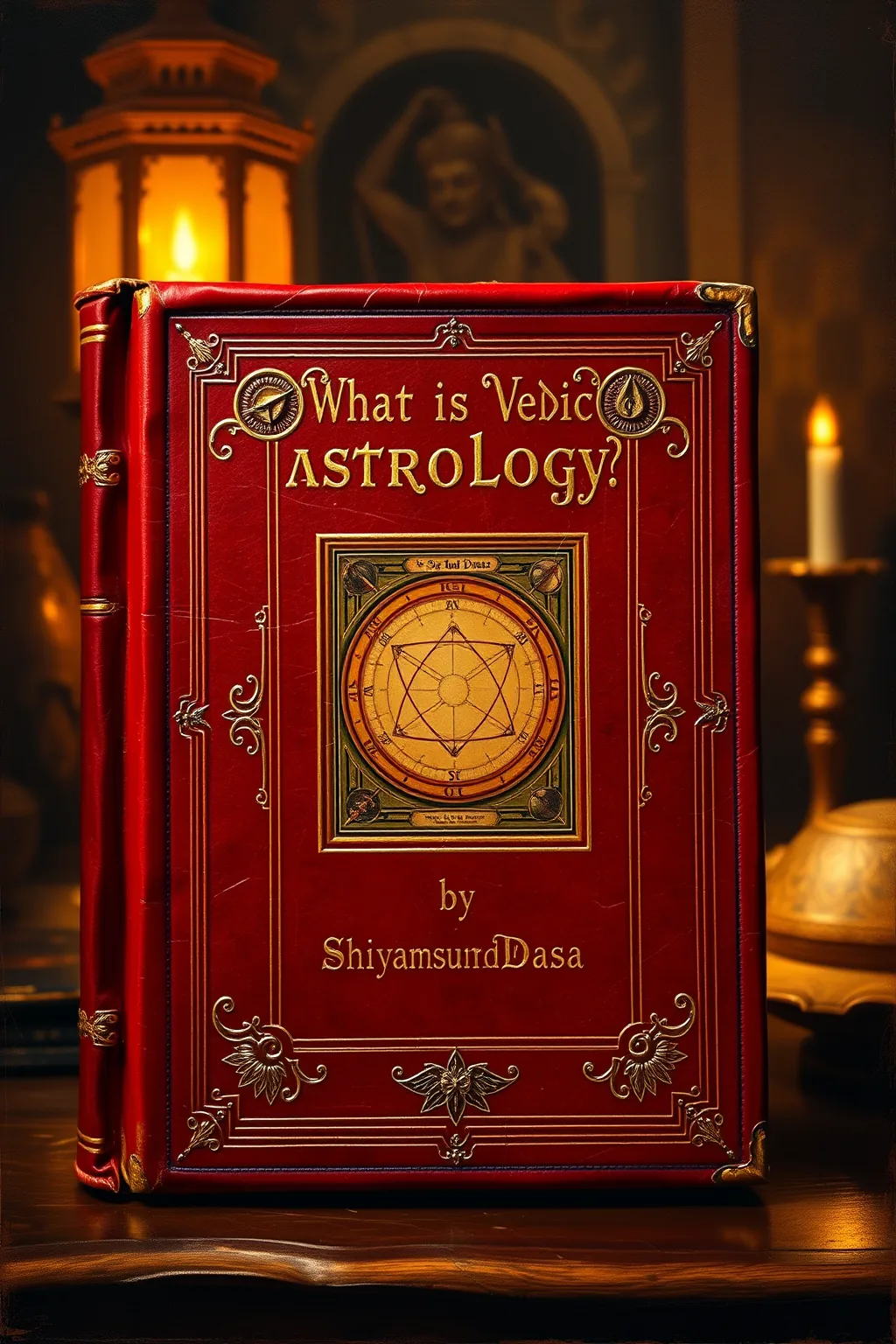
What is Vedic astrology?
 61
61

What is Vedic astrology?


Isolde Whitaker, Sacred Texts Editor, commends Shyamasundara Dasa's 'What is Vedic Astrology?' as a masterful exposition of Jyotisha. This authoritative work transcends superficial horoscopes, offering a deep dive into the philosophical and spiritual dimensions of Hindu astrology. Dasa skillfully illuminates the esoteric principles, revealing the intricate karma woven into the celestial fabric. Its strength lies in demystifying complex concepts for both neophytes and seasoned practitioners, providing a sacred lens through which to view life's journey. An essential read for anyone seeking a profound understanding of cosmic influences and their impact on the soul's evolution.
📝 Description
61
Shyamasundara Dasa's 1992 book defines Vedic astrology for a modern audience.
This text explains the principles of Jyotisha, also known as Vedic astrology. It covers the philosophical basis of this system, which originates from ancient India. The book discusses how planetary positions are understood to relate to an individual's life and spiritual path.
It goes beyond simple forecasting to examine the deeper meanings behind astrological configurations. The author details concepts such as the symbolic language of planets and the connection between karma and destiny. The work is written for those interested in self-understanding and spiritual development through astrological study.
The book aims to present Vedic astrology as a framework for interpreting life's events and personal growth. It describes the system as a cosmic map that can guide individuals.
Vedic astrology, or Jyotisha, is one of the six auxiliary sciences (Vedangas) of the Vedas, ancient Indian scriptures. Its practice is rooted in a spiritual worldview that sees the cosmos as a manifestation of divine consciousness. The system operates on principles of karma, reincarnation, and the belief that celestial bodies influence earthly events and individual lives. Unlike Western astrology, which often uses the tropical zodiac, Jyotisha typically uses the sidereal zodiac. This astronomical difference leads to distinct interpretations and calculations.
💡 Why Read This Book?
Delve into the ancient, sacred art of Vedic astrology and unlock the hidden blueprints of your life. This book offers a profound exploration of Jyotisha's philosophical depths and mystical symbolism, guiding you towards self-discovery and spiritual insight. Ideal for sincere seekers, dedicated practitioners, and curious scholars yearning to comprehend the cosmic forces that shape our existence.
⭐ Reader Reviews
Honest opinions from readers who have explored this book.
❓ Frequently Asked Questions
What distinguishes Vedic astrology from Western astrology?
Vedic astrology, or Jyotisha, utilizes the sidereal zodiac, which aligns with the actual constellations, unlike the tropical zodiac of Western astrology. It also places a greater emphasis on karma, dharma, and spiritual evolution as central tenets.
Is Vedic astrology primarily for prediction?
While Vedic astrology can offer predictive insights, its core purpose is to illuminate the soul's journey, understand karmic patterns, and guide individuals towards fulfilling their spiritual potential and dharma.
Can beginners understand Vedic astrology from this book?
Yes, this book is designed to be accessible to beginners, laying a solid foundation in the fundamental principles and philosophy of Vedic astrology without overwhelming the reader.
What is the role of karma in Vedic astrology?
Karma is a central concept, viewed as the accumulated actions and consequences from past lives that manifest in the present birth. The birth chart is seen as a map of one's karma.
Is this book suitable for spiritual seekers?
Absolutely. It offers profound spiritual insights and a framework for understanding the divine order, making it an invaluable resource for those on a path of spiritual growth and self-realization.
🔮 Key Themes & Symbolism
Jyotisha: The Science of Light
Explore Jyotisha as more than mere fortune-telling, but as the 'Science of Light.' This theme examines its Vedic origins, its philosophical underpinnings rooted in the Vedas, and its purpose as a divine tool for understanding the soul's journey. Discover how the celestial bodies are seen as emanations of divine consciousness, and how their movements offer useful insights into the principles of karma, dharma, and moksha.
The Karmic Blueprint
Uncover the profound connection between the birth chart and karma. This theme elucidates how Vedic astrology serves as a cosmic map of one's karmic inheritance – the consequences of past actions that shape present circumstances and future potentials. It explores the concept of destiny versus free will, and how understanding one's karmic patterns can empower individuals to navigate challenges and consciously create their future.
Symbolism and Sacred Geometry
Dive into the rich symbolic language of Vedic astrology, where planets, houses, and signs are imbued with deep esoteric meaning. This theme deciphers the sacred geometry of the zodiac, the archetypal energies of the planets, and the universal lessons held within each astrological house. Understand how these celestial symbols act as keys to unlocking the hidden potentials and challenges inherent in the human experience.
💬 Memorable Quotes
Direct passages from the work, attributed to the author.
“Jyotisha is the language of the soul's unfolding.”
— This emphasizes the spiritual dimension of Vedic astrology, positioning it as a means to understand one's inner journey and purpose.
“Each planet is a divine messenger.”
— This elevates the planets beyond mere celestial bodies, presenting them as conduits of divine wisdom and cosmic influence.
“The birth chart is a sacred covenant.”
— This profound statement frames the astrological chart as a divinely ordained contract, representing the soul's agreement with the universe for its earthly experience.
💡 Key Ideas
Editorial paraphrase of the work's core concepts — not direct quotes.
The stars do not compel; they reveal.
This quote highlights the deterministic versus indicative nature of Vedic astrology, suggesting it offers a map of potentials rather than an inescapable fate.
Wisdom lies not in knowing the future, but in understanding the present.
This quote redirects the focus from mere prediction to self-awareness and present-moment understanding, a core tenet of spiritual astrology.
🌙 Esoteric Significance
Tradition
Vedic astrology is deeply rooted in the esoteric traditions of Vedic Hinduism, particularly within the framework of Vedanta and Yoga philosophy. It is considered a Vedanga, one of the six auxiliary disciplines for understanding the Vedas. Its esoteric nature lies in its understanding of the universe as a manifestation of divine consciousness, and the celestial bodies as expressions of cosmic energies that influence the soul's journey through cycles of karma and reincarnation.
Symbolism
The symbolism in Vedic astrology is rich and multi-layered. Planets represent archetypal forces and divine energies, houses symbolize different spheres of life experience, and zodiac signs embody distinct qualities and karmic tendencies. The constellations themselves hold ancient mythological narratives. These symbols are not merely abstract representations but are seen as living, dynamic forces that interact and shape individual destinies, offering a profound symbolic language for self-understanding and cosmic connection.
Modern Relevance
In the modern era, Vedic astrology offers a powerful antidote to a purely materialistic worldview. It provides a framework for understanding life's challenges as opportunities for spiritual growth and karmic resolution. Its emphasis on dharma (purpose) and karma encourages individuals to live more consciously and ethically. For seekers, it offers profound self-insight and guidance on their spiritual path, while for practitioners, it provides a sophisticated system for working through the complexities of life with greater wisdom and equanimity.
👥 Who Should Read This Book
This book is an indispensable guide for anyone seeking a deeper connection to the cosmos and their own life path. Beginners will find a clear and accessible introduction to the foundational principles and philosophical depth of Vedic astrology. Spiritual seekers will discover a sacred map for self-discovery and understanding their karmic journey. Practicing astrologers, both Vedic and Western, will find invaluable insights that enrich their understanding and practice. Scholars interested in ancient wisdom traditions will appreciate its historical and philosophical context.
📜 Historical Context
Vedic astrology, or Jyotisha, emerged from the ancient Vedic civilization of India, deeply intertwined with the Vedas, the oldest scriptures of Hinduism. Its development spans millennia, evolving alongside advancements in astronomy and philosophy. During the Gupta Empire (4th-6th centuries CE), a period often considered a golden age for Indian arts and sciences, Jyotisha flourished, with scholars like Varahamihira codifying its principles in seminal works such as the Brihat Samhita and Panchasiddhantika. Its influence extended far beyond India, impacting astrological systems in neighboring regions and later, through trade and cultural exchange, even subtly shaping Western astrological thought. Jyotisha was never merely a predictive tool; it was an integral part of a holistic worldview, guiding spiritual practices, auspicious timings for rituals and life events, and offering useful insights into the cosmic order.
📔 Journal Prompts
Reflect on a significant planetary influence in your birth chart and how it manifests in your life.
Consider the concept of dharma as revealed through Vedic astrology. What is your unique dharma?
How does understanding karma, as presented in Vedic astrology, influence your perspective on life's challenges?
Explore the symbolic meaning of one of the Navagrahas (nine planets) and its personal resonance.
What steps can you take to align your actions with the wisdom offered by your Vedic astrological chart?
🗂️ Glossary
Jyotisha
The Sanskrit term for Vedic astrology, meaning 'the science of light' or 'the study of celestial phenomena.' It is considered one of the Vedangas, auxiliary disciplines for understanding the Vedas.
Graha
Literally 'seizer' or 'planet.' In Vedic astrology, the nine main Grahas are the Sun, Moon, Mars, Mercury, Jupiter, Venus, Saturn, Rahu, and Ketu. They represent cosmic forces influencing life.
Rashi
The Sanskrit term for zodiac sign. Vedic astrology uses the sidereal zodiac, comprising twelve Rashis, each representing a specific segment of the celestial belt.
Bhava
The Sanskrit term for astrological house. There are twelve Bhavas, each representing a different area of life experience, such as self, wealth, siblings, and spirituality.
Dharma
A fundamental concept in Hinduism, often translated as 'duty,' 'righteousness,' or 'purpose.' In Vedic astrology, it refers to one's innate spiritual path and life mission.
This book appears in 2 collections
🔮 Readers Also Liked
Browse all →









From the “Astrology” Collection
View all →









More Free Astrology & Cosmology Books
View all →