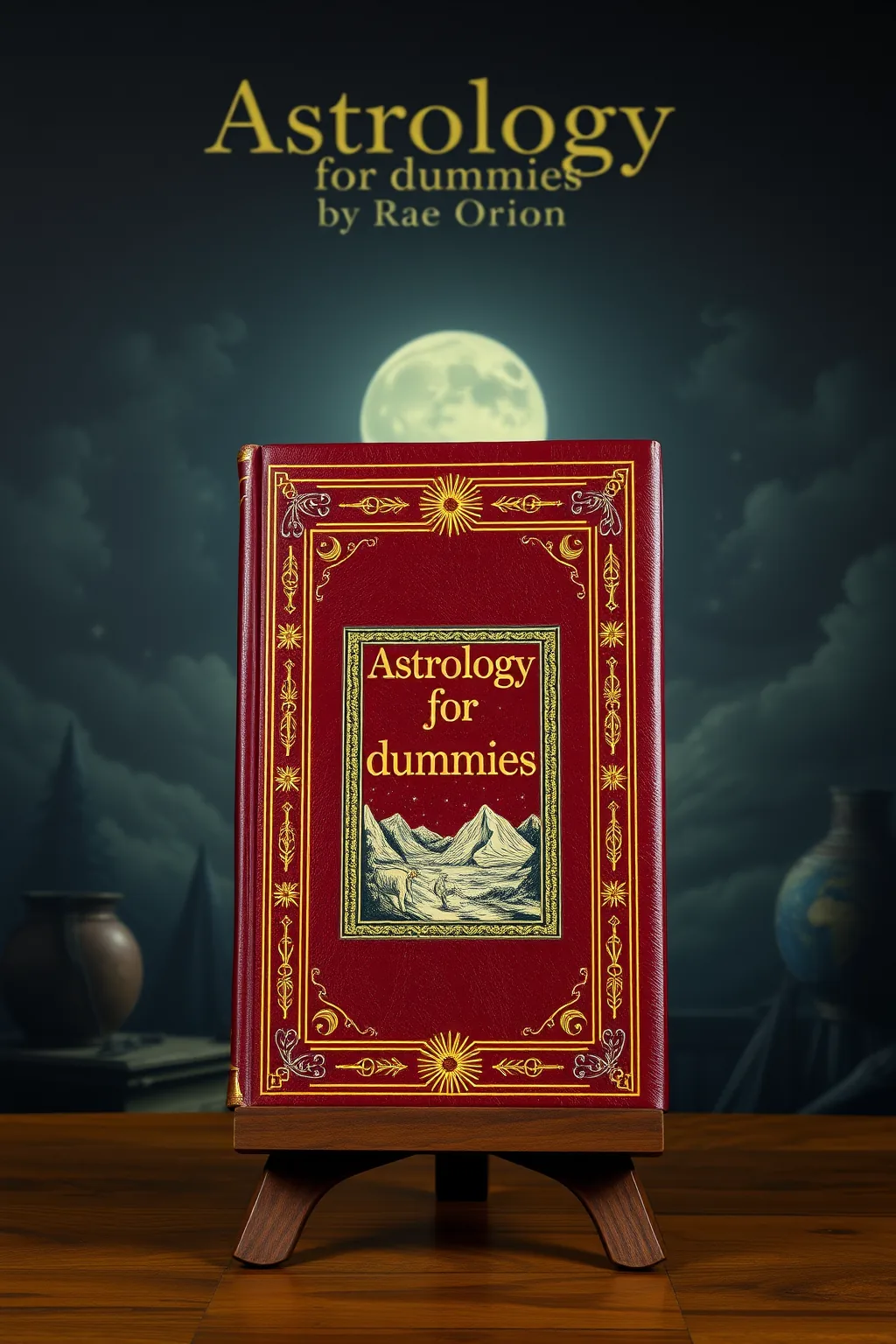
Astrology For Dummies
 81
81

Astrology For Dummies
Rae Orion’s Astrology For Dummies, Second Edition, succeeds where many introductory texts falter: clarity without condescension. Orion manages to unpack the intricate system of birth chart interpretation with a pragmatism that feels genuinely helpful. The strength lies in its methodical approach to deciphering planetary placements and house rulerships, making the act of constructing one's own chart a manageable, even exciting, task. However, the book’s commitment to simplicity occasionally leads to generalizations. For instance, while it explains the basic significations of Mercury, it stops short of exploring the nuanced psychological dynamics that Mercury can represent in more complex psychological astrology, a space explored by Dane Rudhyar. The section on aspects, though present, could benefit from more detailed examples of how challenging configurations might manifest constructively. Despite these minor limitations, for the uninitiated seeking a solid, practical entry point into natal astrology, this book provides a competent and encouraging foundation.
📝 Description
81
Rae Orion's Astrology For Dummies, second edition, was published in 2011.
This book serves as a straightforward introduction to astrological concepts for those new to the subject. It breaks down the language of the stars into understandable terms, focusing on how to create and read a personal birth chart. The author explains the basic building blocks, including zodiac signs, planets, and houses, and how they combine to form an individual's astrological profile.
The text is written for anyone curious about astrology who finds the topic initially daunting. It offers a clear, step-by-step method for understanding chart interpretation and the influence of planetary positions. Readers interested in using astrology for personal insight will find this guide helpful.
Astrology For Dummies, second edition, covers the twelve zodiac signs with their associated elements and modes. It explains the roles of the Sun and Moon in a natal chart, the meanings of the seven traditional planets plus Chiron, and the significance of the Ascendant and the twelve Houses. The book shows how these components work together to map out an individual's unique astrological makeup.
Published in 2011, this edition reflects a period of renewed public interest in astrology. While it does not engage in deep psychological archetypes as seen in the work of Dane Rudhyar or Liz Greene, it connects with an ancient tradition. The book presents core astrological components in a way that is accessible, distinguishing it from more academic or specialized approaches within the broader esoteric study of celestial influences.
💡 Why Read This Book?
• Gain a practical framework for understanding your unique birth chart, moving beyond vague sun-sign horoscopes to analyze the positions of the Sun, Moon, and planets at your birth, as detailed in the 'Key Concepts' section. • Learn to interpret the twelve Houses, understanding how different areas of life, from career to relationships, are represented astrologically, a core element discussed throughout the book. • Decode the basic meanings of the zodiac signs and their associated planetary rulers, enabling a deeper comprehension of personality traits and potential, as outlined in the introductory chapters.
⭐ Reader Reviews
Honest opinions from readers who have explored this book.
❓ Frequently Asked Questions
What is a birth chart and how does Astrology For Dummies explain it?
A birth chart, or natal chart, is a snapshot of the sky at the moment of your birth. This book guides you through constructing your chart and interpreting its core components like zodiac signs, planets, and houses.
Does this book explain the meaning of the twelve zodiac signs?
Yes, Astrology For Dummies provides explanations for all twelve zodiac signs, including their elemental and modal classifications, offering a foundational understanding of their characteristics.
Can I learn to interpret astrological symbols using this book?
Absolutely. The book is designed to help you decipher astrological symbols, focusing on the planets, signs, and houses, and how they form a cohesive natal chart.
How does Astrology For Dummies explain the influence of planets?
It details the traditional meanings and significations of the Sun, Moon, and the seven classical planets, explaining their roles and energies within your birth chart.
Is this book suitable for someone with no prior knowledge of astrology?
Yes, it's specifically written for beginners. The language is clear, and the concepts are broken down step-by-step, making it an ideal starting point for absolute novices.
What is the 'Rising Sign' and does the book cover it?
The Rising Sign, or Ascendant, is the zodiac sign that was on the eastern horizon at your birth. This book explains its significance and how to identify it in your chart.
🔮 Key Themes & Symbolism
Natal Chart Construction
The book centers on the practical construction and interpretation of a natal chart, the astrological blueprint of an individual's life. It guides readers through identifying the positions of the Sun, Moon, planets, and Ascendant within the zodiac signs and twelve Houses at the precise moment of birth. This focus empowers individuals to move beyond generalized horoscopes towards a personalized understanding of their inherent potentials and challenges, grounded in their unique celestial data.
Planetary and Sign Symbolism
Central to understanding astrology is the symbolism attributed to the planets and zodiac signs. Orion systematically breaks down the archetypal meanings of each of the twelve signs and the traditional seven planets, plus Chiron. This exploration allows readers to grasp how these celestial bodies influence personality, motivations, and life experiences, forming the core language of astrological interpretation presented in the text.
The Twelve Houses
The twelve Houses represent different spheres of life and experience. This book explains how the houses are activated by planetary placements and zodiacal energies, providing insights into areas such as career, relationships, finances, and personal growth. Understanding the houses is crucial for a comprehensive reading of the birth chart, offering a framework for how astrological energies manifest in the practical world.
Lunar Phases and Cycles
While the blurb mentions lunar phases, the primary focus remains on natal chart interpretation. The book touches upon the Moon's significance within the birth chart, representing emotional nature and inner world. A deeper exploration of lunar cycles beyond their influence on the natal chart might be found in more specialized works, but here, the Moon serves as a key component for personal insight.
💬 Memorable Quotes
Direct passages from the work, attributed to the author.
“Identify the signs of the zodiac.”
— This directive underscores the foundational nature of the zodiac. It implies that understanding the twelve archetypal energies is the first step in comprehending the astrological map of an individual.
“Understand the Sun, the Moon, the planets, the rising sign, and the 12 houses.”
— This expresses the core curriculum of natal astrology. It highlights the essential celestial bodies and chart divisions that form the building blocks for any personal astrological reading.
“Benefit from the phases of the moon.”
— This suggests that astrological knowledge, particularly concerning lunar cycles, can offer practical advantages and insights that can be applied to daily life or personal understanding.
“Construct your birth chart.”
— This points to the active, practical element of learning astrology. The book aims to equip readers with the skills to create their own astrological portrait, fostering a hands-on approach to the subject.
“Interpret its component parts.”
— Beyond mere construction, this emphasizes the analytical aspect. Readers are encouraged to understand the meaning and interplay of the various elements within their unique astrological chart.
🌙 Esoteric Significance
Tradition
This work operates within the broad tradition of Western astrology, which has Hermetic and Neoplatonic roots, though it primarily focuses on the practical application rather than deep philosophical underpinnings. It serves as an entry point to a system that has historically been intertwined with esoteric practices, offering a modern, secularized version of celestial interpretation stripped of overt mystical dogma.
Symbolism
Key symbols include the twelve zodiac signs, representing archetypal human drives and personalities (e.g., Aries as the initiator, Cancer as the nurturer), and the seven classical planets (Sun, Moon, Mercury, Venus, Mars, Jupiter, Saturn), each embodying distinct energies and functions within the psyche and life. The Houses symbolize the distinct domains of human experience where these energies play out.
Modern Relevance
Contemporary practitioners of psychological astrology and self-help oriented astrologers frequently draw upon the foundational principles laid out in accessible guides like this. It provides a common language and framework for understanding personal charts, which is often the first step for individuals exploring modern therapeutic astrology or even those interested in witchcraft and modern paganism who incorporate astrological elements.
👥 Who Should Read This Book
['• Absolute beginners curious about their birth chart, seeking a clear, step-by-step guide to understanding the basics of planetary and sign placements without overwhelming technical jargon.', '• Individuals interested in self-discovery and personal growth who want to explore a new framework for understanding their personality, strengths, and challenges through astrological principles.', '• Those who have encountered astrology casually but desire a more structured and comprehensive introduction to constructing and interpreting a natal chart beyond simple sun-sign descriptions.']
📜 Historical Context
Published in 2011, Astrology For Dummies, Second Edition, entered a landscape where astrology enjoyed a resurgence in mainstream popularity, often fueled by online platforms and a general interest in self-discovery. This era saw a bifurcation in astrological discourse: on one hand, pop astrology dominated headlines, while on the other, more psychologically oriented astrologers like Liz Greene continued to explore depth psychology through archetypal lenses. Rae Orion’s work positions itself firmly in the accessible, introductory camp, aiming to explain what could otherwise seem arcane. It builds upon the legacy of popularizers like Carroll Righter and the 'for Dummies' series' own history of making complex subjects digestible. While not directly engaging with academic critiques of astrology, its existence signifies the ongoing public demand for astrological knowledge, distinct from both esoteric traditions and scientific scrutiny.
📔 Journal Prompts
The Sun in my birth chart, located in the sign of ____, suggests ____.
Reflect on the potential influence of the Moon in ____, as described in the text.
My Ascendant sign is ____; how does this align with my self-perception?
Identify one planet ruling a house in my chart and consider its meaning.
How might the element associated with my Sun sign (e.g., Fire, Earth, Air, Water) manifest in my daily life?
🗂️ Glossary
Natal Chart
A personalized astrological chart representing the positions of celestial bodies at the exact time and location of an individual's birth, used for interpretation.
Zodiac Signs
The twelve divisions of the celestial ecliptic, each associated with specific archetypal characteristics and energies (e.g., Aries, Taurus, Gemini).
Planets
Celestial bodies (Sun, Moon, Mercury, Venus, Mars, Jupiter, Saturn, Uranus, Neptune, Pluto) whose positions and movements are interpreted astrologically for their symbolic meanings.
Ascendant (Rising Sign)
The zodiac sign that was rising on the eastern horizon at the moment of birth, often considered to represent outward personality and appearance.
Houses
The twelve divisions of the astrological chart, each representing a different area or sphere of life experience (e.g., career, relationships, home).
Aspects
The angular relationships between planets in a birth chart, which are believed to indicate how the energies of those planets interact.
Ruler
The planet that traditionally governs a specific zodiac sign; its placement in the chart influences the expression of that sign's energy.




![Bayer, George ( 1935) Biblical Astrology [ 10 P.]](/img/thumb/bayer-george-1935-biblical-astrology-10-p.webp)