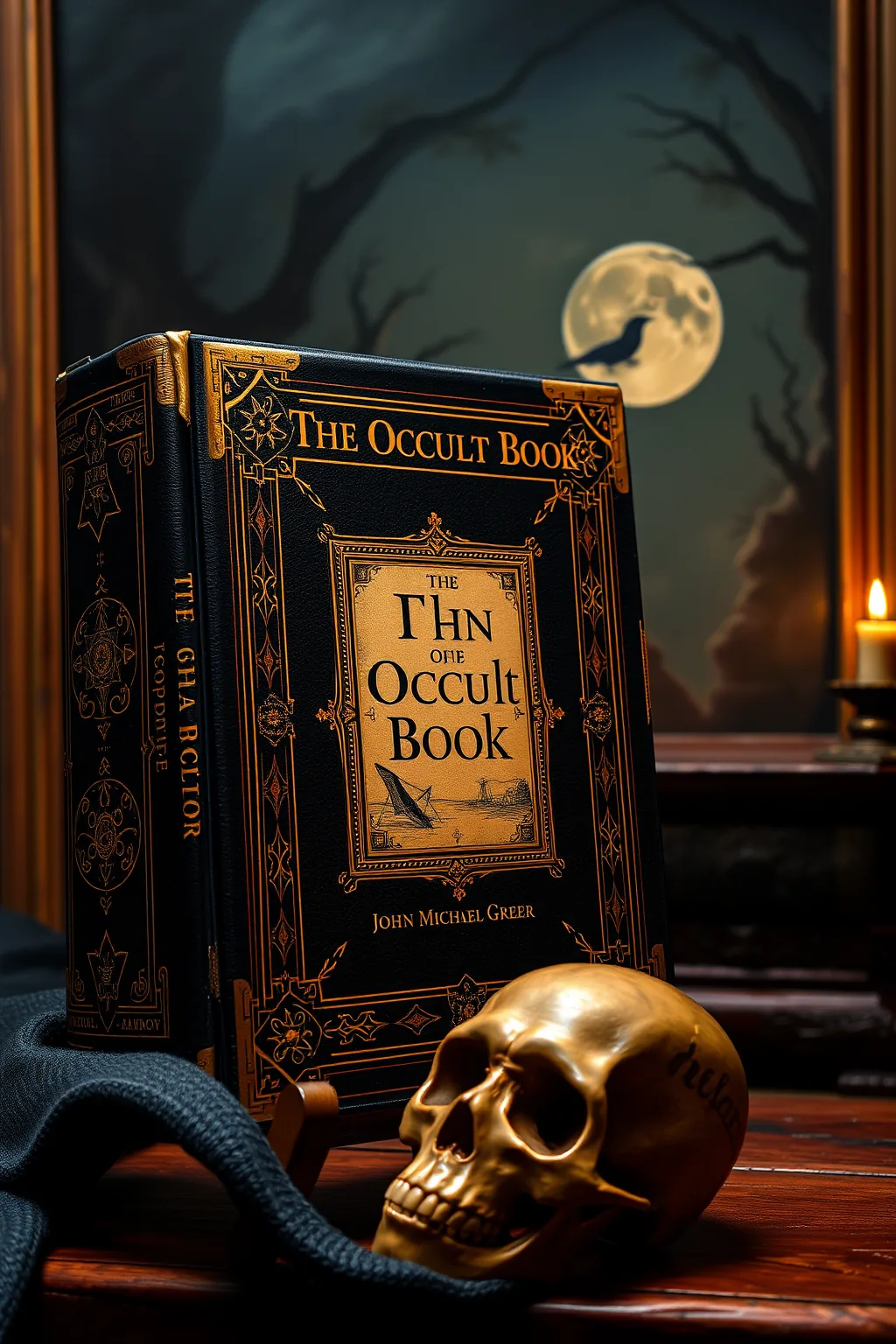
The Occult Book
 82
82

The Occult Book
John Michael Greer’s The Occult Book presents a disciplined cartography of Western esotericism, a welcome antidote to the often sensationalized or fragmented presentations common in the genre. Greer’s strength lies in his ability to connect disparate threads—from Neoplatonism to ceremonial magic—into a discernible intellectual lineage. He successfully frames occultism not as a collection of superstitions, but as a philosophical system with its own internal logic and epistemological framework. One particularly effective section discusses the concept of the "astral light," explaining its historical interpretations and its function as a medium for magical influence. However, the book’s academic rigor, while commendable, occasionally leads to a dryness that might deter readers seeking more experiential accounts. The 2017 publication date means it doesn't engage with the most recent wave of digital occultism, a minor but noticeable omission. Nevertheless, Greer provides a solid foundation for understanding the intellectual architecture of the Western magical tradition.
📝 Description
82
John Michael Greer published The Occult Book in 2017, a survey of Western esoteric traditions.
This book examines the Western esoteric tradition, moving beyond simple history to structure an understanding of magical theory and practice through a philosophical lens. Greer traces the foundational ideas and movements that shaped occult thought from ancient times to its modern forms. The work presents a cohesive overview for students serious about the subject. It is written for those seeking a systematic introduction to the varied field of Western occultism. Readers who have encountered scattered pieces of esoteric knowledge will find a more organized framework here. Those interested in comparative religion, the philosophy of mind, or the history of spiritual paths outside the mainstream will find substantial material. The book suits readers who prefer an academic approach to mystical topics.
The work enters the discussion on Western esotericism at a time of considerable academic interest. Published in 2017, it reflects a period where scholarship on Hermeticism, Kabbalah, and ceremonial magic was well established. The book addresses questions about the definition and scope of 'occultism' itself. It distinguishes itself from purely devotional or purely historical accounts by focusing on philosophical underpinnings. This approach is suitable for those who appreciate a reasoned examination of esoteric subjects.
Greer's book engages with the Western esoteric tradition, a field with a long history of philosophical and magical inquiry. Influenced by scholars like Frances Yates and Antoine Faivre, the study of Hermeticism, Kabbalah, and ceremonial magic has seen significant academic attention. The Occult Book appears within this scholarly context, offering a synthesis of ideas that define the boundaries and core concepts of occultism. It seeks to provide a structured philosophical framework for understanding these traditions, distinguishing itself from purely historical or devotional studies.
💡 Why Read This Book?
• Gain a structured understanding of Western esoteric thought, moving from its ancient roots to its modern forms, by exploring Greer's analysis of Hermeticism and its historical evolution since antiquity. • Learn to identify and interpret core occult principles, such as the Law of Correspondence, as presented in chapters dedicated to magical theory, enabling a deeper appreciation of esoteric symbolism. • Develop a nuanced perspective on magical practice by examining its philosophical underpinnings, as detailed in Greer's discussion of ritual and consciousness, offering insights beyond simplistic spellcasting.
⭐ Reader Reviews
Honest opinions from readers who have explored this book.
❓ Frequently Asked Questions
When was John Michael Greer's The Occult Book first published?
The Occult Book by John Michael Greer was first published in 2017, placing it within contemporary scholarship on Western esotericism.
What historical periods does The Occult Book cover?
The book covers a vast sweep of history, tracing occult traditions from ancient philosophical schools through to their development in later centuries.
Is The Occult Book suitable for beginners in occult studies?
Yes, the book is designed as a systematic introduction, offering a structured overview that benefits both newcomers and those with some prior exposure to esoteric subjects.
Does John Michael Greer discuss specific magical practices?
Yes, Greer examines various practices like ritual and meditation, but always within their broader philosophical and theoretical context.
What is the primary focus of The Occult Book?
Its primary focus is on the philosophical and theoretical underpinnings of Western occultism, providing a coherent framework for understanding its diverse elements.
Does the book reference specific esoteric traditions like Hermeticism?
Indeed, the work explores foundational traditions such as Hermeticism, Kabbalah, and ceremonial magic, detailing their core tenets and historical trajectories.
🔮 Key Themes & Symbolism
Philosophical Foundations of Magic
Greer meticulously reconstructs the philosophical underpinnings of Western magic, moving beyond popular notions of spellcasting. He demonstrates how concepts derived from Neoplatonism, Hermeticism, and Gnosticism provided the intellectual scaffolding for magical theory. The work emphasizes the role of consciousness and subtle energies, positing a worldview where the universe is imbued with intelligence and interconnectedness, allowing for intentional influence through symbolic action and ritual. This philosophical grounding is presented as essential for any serious practitioner seeking to understand the 'why' behind the 'how' of occult practices.
The Western Esoteric Tradition
This theme involves mapping the historical currents and lineages that constitute Western esotericism. Greer traces the transmission of ideas through various historical periods and movements, including alchemy, astrology, and ceremonial magic. He highlights the cyclical nature of esoteric development, noting periods of flourishing and suppression. The book frames these diverse traditions not as isolated phenomena but as interconnected parts of a larger, evolving body of knowledge concerned with spiritual development and the exploration of hidden realities. The 2017 publication situates this overview within contemporary academic discussions.
Consciousness and Subtle Realities
A central tenet explored is the nature of consciousness and its relationship to subtle planes of existence. Greer discusses how esoteric traditions posit realities beyond the purely physical, accessible through altered states of consciousness or specific meditative and ritualistic techniques. Concepts like the astral body and the akashic records are presented not as mere fantasy, but as integral components of an esoteric cosmology that seeks to explain the totality of being. This exploration challenges materialistic viewpoints by asserting the primacy or at least the equal validity of non-ordinary states of awareness.
Symbolism and Correspondence
The principle of "As Above, So Below" is a recurring motif. Greer studies how symbols, rituals, and correspondences function as a language for interacting with the hidden order of the cosmos. He explains how specific objects, gestures, words, and celestial alignments are believed to resonate with particular forces or intelligences. This symbolic framework is presented as a key tool for magicians and mystics to effect change, gain knowledge, and achieve spiritual transformation by aligning their will with the perceived patterns of the universe.
💬 Memorable Quotes
Direct passages from the work, attributed to the author.
“Magic is not merely a collection of tricks, but a philosophical system.”
— This highlights Greer's approach, framing occultism as a coherent intellectual discipline with its own principles and worldview, rather than a series of disconnected supernatural acts.
“The principles of correspondence link the macrocosm and the microcosm.”
— This captures the Hermetic axiom 'As Above, So Below,' emphasizing the interconnectedness of all things and the belief that understanding one level of reality can reveal truths about others.
“Consciousness is not a mere byproduct of the brain, but a fundamental aspect of reality.”
— This interpretation underscores the esoteric view of consciousness as primary or at least co-equal with matter, suggesting it can interact with and shape subtle energies and realities.
“Ritual provides a framework for focused intention and symbolic action.”
— This emphasizes the functional aspect of ritual within occultism, presenting it as a structured method for directing mental energy and engaging with symbolic archetypes to achieve desired effects.
“The history of esotericism is a history of continuous adaptation and reinterpretation.”
— This suggests that occult traditions are not static but dynamic, evolving over time as they encounter new philosophical currents and cultural contexts, a key theme in Greer's historical overview.
🌙 Esoteric Significance
Tradition
The Occult Book sits firmly within the Western Esoteric Tradition, drawing heavily from Hermeticism, Neoplatonism, and ceremonial magic. It aligns with the philosophical approach to magic found in movements like the Hermetic Order of the Golden Dawn and later magical revivalists. Greer's work positions occultism as a distinct philosophical and spiritual path, separate from both mainstream religion and purely materialistic science, emphasizing its unique cosmology and epistemology. It acts as a bridge, connecting ancient philosophical ideas to their manifestations in later magical and mystical practices.
Symbolism
Central to the book is the exploration of symbolic language as a means of understanding and interacting with the cosmos. The concept of the Macrocosm and Microcosm, often symbolized by the Pentagram or Hexagram, illustrates the principle of correspondence – that the patterns of the universe are reflected in the individual and vice versa. Another key motif is the 'astral light' or 'subtle body,' representing the invisible medium through which consciousness and magical forces operate, often visualized as a luminous, ethereal substance connecting all things.
Modern Relevance
Greer's work remains relevant for contemporary practitioners and scholars seeking a structured understanding of the foundational principles behind modern occultism. Thinkers and groups involved in ceremonial magic, esoteric philosophy, and comparative mysticism can utilize his framework. His emphasis on a philosophical approach to magic speaks to those seeking to move beyond rote ritual and engage with the underlying principles. The book serves as a valuable reference for understanding the intellectual lineage that informs current esoteric discourse and practice, particularly in Western magical circles.
👥 Who Should Read This Book
• Students of Western Esotericism: Those beginning their formal study of Hermeticism, Kabbalah, alchemy, or ceremonial magic will find a clear, philosophical introduction that provides essential context and theoretical grounding. • Philosophy and Religion Scholars: Researchers interested in comparative religion or the history of philosophy will gain insight into a significant, often overlooked, intellectual tradition and its historical development. • Aspiring Magicians and Mystics: Individuals seeking to understand the theoretical framework behind magical practices will benefit from Greer's systematic explanation of principles like correspondence and the nature of consciousness.
📜 Historical Context
Published in 2017, John Michael Greer’s The Occult Book emerges within a robust academic landscape dedicated to the study of Western esotericism, a field significantly shaped by scholars like Frances Yates and Antoine Faivre. The era saw a proliferation of works attempting to synthesize complex historical and philosophical threads of occultism for both academic and popular audiences. Greer's contribution implicitly engages with ongoing scholarly debates regarding the definition and categorization of 'occultism,' differentiating it from broader New Age movements or purely historical accounts. The book navigates the intellectual currents stemming from Hermeticism, Kabbalah, Rosicrucianism, and ceremonial magic, presenting them as interconnected elements of a continuous tradition. Its publication occurred in a period where interest in these subjects was high, yet accessible, philosophically grounded overviews remained a valuable commodity, distinguishing it from more practice-focused or narrowly historical texts.
📔 Journal Prompts
The concept of the Astral Light as a connective medium.
Reflections on the principle of correspondence between different levels of reality.
The role of ritual in focusing consciousness and intent.
How philosophical underpinnings shape magical practice.
Tracing the lineage of Hermetic ideas through historical movements.
🗂️ Glossary
Hermeticism
An esoteric tradition based on writings attributed to Hermes Trismegistus, emphasizing divine wisdom, magic, astrology, and alchemy. Key tenets include the principle of correspondence ('As Above, So Below').
Neoplatonism
A school of philosophy originating in the 3rd century CE, heavily influenced by Plato, which posits a hierarchical structure of reality emanating from a single, transcendent source (The One).
Ceremonial Magic
A form of ritual magic involving elaborate ceremonies, often drawing upon complex symbolism, invocations, and specific timing, aimed at achieving spiritual transformation or influencing reality.
Law of Correspondence
The Hermetic principle stating that there is a harmony between different planes of existence (e.g., spiritual, mental, physical), often summarized as 'As Above, So Below.'
Astral Light
In esoteric traditions, a subtle, luminous medium believed to permeate the universe, acting as a vehicle for consciousness, energy, and subtle influences.
Macrocosm and Microcosm
The concept that the universe (Macrocosm) and the individual human being (Microcosm) are analogous structures, reflecting each other in their patterns and principles.
Esotericism
Teachings or practices concerned with hidden knowledge, often involving spiritual or mystical insights, intended for initiates or those with a particular disposition.
🔮 Readers Also Liked
Browse all →








More by John Michael Greer
All books →




More Free Alchemy & Hermeticism Books
View all →