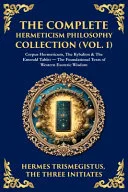
The Complete Hermeticism Philosophy Collection (Vol. 1)
 74
74

The Complete Hermeticism Philosophy Collection (Vol. 1)
The presentation of the *Corpus Hermeticum* and the teachings of The Three Initiates in a single volume addresses a long-standing need for accessible primary Hermetic sources. The clarity of the modern formatting is a definite asset, particularly for readers encountering these dense texts for the first time. However, the compilation’s primary strength – its consolidation – also presents a potential limitation: it assumes a level of familiarity with the esoteric context that may not be present in all new readers. The discussion around the "Seven Principles" in the teachings of The Three Initiates, for instance, while fundamental, requires careful consideration of their symbolic rather than literal application. The work, in its aspiration for clarity, sometimes simplifies the nuanced allegorical language inherent to these ancient doctrines. It offers a solid entry point, but sustained study will necessitate engagement with scholarly commentaries.
📝 Description
74
First published in the early 20th century, The Three Initiates' teachings are collected alongside older Hermetic texts.
This volume collects foundational esoteric writings attributed to Hermes Trismegistus, alongside the early 20th-century systematizations by The Three Initiates. It makes these influential works accessible for contemporary study. The Hermetic tradition originates in Hellenistic Egypt, merging Greek philosophy with Egyptian religious thought. Texts like the Corpus Hermeticum resurfaced during the Renaissance, impacting figures such as Marsilio Ficino. The Three Initiates later presented these principles in a structured manner for a modern audience.
The collection covers key Hermetic ideas. These include the axiom "As Above, So Below," the relationship between the divine and the cosmos, the soul's development, and methods for spiritual attainment. The texts describe a worldview where everything is interconnected.
The Hermetic tradition traces its lineage to Hellenistic Egypt, where Greek philosophical concepts merged with Egyptian religious ideas. The writings attributed to Hermes Trismegistus, particularly the Corpus Hermeticum, were rediscovered in Renaissance Europe and significantly influenced Renaissance humanism and esoteric thought. The Three Initiates' work, published in the early 20th century, represents a modern distillation and systematic presentation of these ancient principles, aiming to make Hermetic philosophy understandable for contemporary spiritual seekers.
💡 Why Read This Book?
• Gain a foundational grasp of the Hermetic axiom "As Above, So Below," understanding its implications for macrocosmic and microcosmic correspondences as presented in the *Corpus Hermeticum*. • Explore the Seven Principles outlined by The Three Initiates, such as Mentalism and Correspondence, to understand their practical application in spiritual development. • Connect with the historical lineage of Western esotericism by engaging directly with texts that influenced Renaissance thinkers and continue to inform modern spiritual movements.
⭐ Reader Reviews
Honest opinions from readers who have explored this book.
❓ Frequently Asked Questions
What are the main texts included in The Complete Hermeticism Philosophy Collection (Vol. 1)?
This collection primarily features the *Corpus Hermeticum*, a series of philosophical and religious dialogues attributed to Hermes Trismegistus, and the teachings of The Three Initiates, which systematically present Hermetic principles.
Who was Hermes Trismegistus?
Hermes Trismegistus is a legendary, syncretic figure combining the Greek god Hermes and the Egyptian god Thoth. He is considered the author of the Hermetic texts, revered as a prophet and a wise teacher in esoteric traditions.
When were the teachings of The Three Initiates first published?
The teachings of The Three Initiates, presented in a series of books, were first published in the early 20th century, beginning in 1908.
Is this book suitable for beginners in Hermeticism?
Yes, the collection is designed for accessibility. It aims to present complex philosophical ideas in a clear format, making it a suitable starting point for those new to Hermetic studies.
What is the core philosophy presented in these texts?
The core philosophy revolves around the idea of universal laws governing the cosmos, the interconnectedness of all things, the power of the mind, and the path to spiritual enlightenment through self-knowledge and wisdom.
Are the texts in this collection considered historical fact or philosophical allegory?
The Hermetic texts are generally viewed as philosophical and spiritual allegories, developed over centuries, rather than literal historical accounts. Their value lies in the wisdom and principles they convey.
🔮 Key Themes & Symbolism
The Principle of Correspondence
Central to Hermetic thought is the axiom "As Above, So Below," a core tenet explored extensively in the *Corpus Hermeticum*. This principle posits a fundamental relationship and mirroring between the macrocosm (the universe) and the microcosm (humanity). The collection presents this not merely as a philosophical observation but as a practical key to understanding the hidden order of reality and influencing one's own existence by aligning with universal laws. It suggests that by studying the greater, one can understand the lesser, and vice versa, offering a framework for divination, alchemy, and spiritual transformation.
The Nature of Divinity and Creation
Hermetic philosophy grapples with the ultimate source of all things, often referred to as the One Mind or God. The texts describe a process of emanation or creation where the divine manifests through various levels of existence. The *Corpus Hermeticum* depicts dialogues where divine knowledge is revealed, outlining the creation of the cosmos and humanity's place within it. The collection illuminates this complex cosmology, presenting a view of a structured, intelligent universe originating from a singular, transcendent source, and the subsequent descent of spirit into matter.
Spiritual Alchemy and Transformation
Beyond its literal interpretation, alchemy in Hermeticism represents a profound process of inner transformation. The collection implicitly and explicitly discusses the 'Great Work' – not just the transmutation of metals, but the purification and elevation of the human soul. The Seven Principles articulated by The Three Initiates provide a structured approach to this inner alchemy, guiding the practitioner toward self-mastery and spiritual illumination. This theme emphasizes the potential for human beings to evolve consciously, shedding limitations and realizing their divine potential.
The Power of the Mind
A recurring theme is the supreme power of the mind or consciousness. Hermeticism asserts that the mental plane is as real as the physical plane and holds dominion over it. The principle of Mentalism, emphasized by The Three Initiates, states that "The All is Mind; The Universe is Mental." This implies that reality itself is a manifestation of thought, and by understanding and controlling one's own mind, individuals can shape their experiences and manifest their desires. The texts encourage the cultivation of mental discipline and focused intention.
💬 Memorable Quotes
Direct passages from the work, attributed to the author.
“All realities are subject to the Law of Vibration.”
— This statement from The Three Initiates highlights the fundamental energetic nature of existence. It suggests that everything, from physical objects to abstract thoughts, is in constant motion and possesses a unique frequency, implying that understanding these vibrations is key to understanding the universe.
“The knowledge of the ancients was a science of symbols.”
— This interpretation points to the symbolic language used in Hermetic texts like the *Corpus Hermeticum*. It suggests that the true meaning lies not in the literal words but in the deeper allegorical and symbolic representations of universal truths.
“The difference between the various planes of existence is merely a difference in vibration.”
— This concept, central to the teachings of The Three Initiates, explains the hierarchy of the universe through the lens of energetic frequencies. It implies that what appears as distinct realms are simply different states of the same underlying substance, differentiated by their rate of oscillation.
💡 Key Ideas
Editorial paraphrase of the work's core concepts — not direct quotes.
In every soul an immortal spirit dwells.
This quote speaks to the divine spark within each individual, a core belief in Hermeticism. It suggests an inherent spiritual essence that transcends the physical body and the limitations of earthly existence, pointing towards the potential for spiritual realization.
The universe is change; our life is what our thoughts make it.
This paraphrase captures the Hermetic emphasis on the dynamic nature of reality and the creative power of the mind. It suggests that while external circumstances are fluid, our internal mental state is the primary determinant of our lived experience.
🌙 Esoteric Significance
Tradition
This collection is a core part of the Western Esoteric Tradition, specifically Hermeticism. It serves as a foundational text, bridging ancient Egyptian and Hellenistic thought with later mystical and occult developments. Hermeticism, as presented here, offers a philosophical cosmology that underpins many subsequent esoteric systems, including Renaissance magic, Rosicrucianism, and aspects of Freemasonry, emphasizing divine wisdom and the interconnectedness of all creation.
Symbolism
Key symbols include the Caduceus of Hermes, representing balance, duality, and the flow of energy, often associated with the spinal column in esoteric interpretations. The Emerald Tablet, a legendary Hermetic text, expresses the core principles, notably "As Above, So Below." The concept of the Alchemical Wedding symbolizes the union of opposites – spirit and matter, masculine and feminine – leading to spiritual enlightenment and the realization of the divine within.
Modern Relevance
Contemporary thinkers and practitioners in fields such as New Age spirituality, modern occultism, and comparative religion continue to draw heavily from Hermetic principles. Concepts like the Law of Attraction, mindfulness, and the exploration of consciousness echo themes found in these ancient texts. Modern Hermetic orders and independent students alike utilize the *Corpus Hermeticum* and the teachings of The Three Initiates for personal growth, spiritual development, and understanding the underlying unity of existence.
👥 Who Should Read This Book
• Aspiring practitioners of Western Esotericism seeking primary source material on Hermetic philosophy and its core tenets. • Students of comparative religion and philosophy interested in the historical development of mystical thought and its influence on Western culture. • Individuals on a spiritual path looking for frameworks that explore the nature of reality, consciousness, and the potential for inner transformation.
📜 Historical Context
The Hermetic tradition emerged from the Hellenistic milieu of Ptolemaic Egypt, a fertile ground for the syncretism of Greek philosophy and Egyptian religion. The texts attributed to Hermes Trismegistus, compiled primarily in the *Corpus Hermeticum* and the *Asclepius*, gained significant prominence during the Renaissance after their rediscovery and translation by Marsilio Ficino in the 15th century. This revival placed Hermeticism alongside Neoplatonism and Kabbalah as a pillar of Renaissance esotericism, profoundly influencing figures like Pico della Mirandola and Giordano Bruno. While these ancient texts offered a path to divine knowledge, they coexisted with competing intellectual currents, including Aristotelian scholasticism, which often viewed such mystical traditions with skepticism. The early 20th-century teachings of The Three Initiates represent a modern systematization, seeking to codify these ancient principles for a new era, making them accessible to a broader audience than the original philosophical schools.
📔 Journal Prompts
The principle of Correspondence: How does observing the natural world reflect inner states?
Reflect on the concept of the 'One Mind' and its implications for personal reality.
Analyze the symbolic meaning of the Caduceus in relation to balance in your life.
Consider the Hermetic view of the universe as mental; how does this alter perception?
Meditate on the idea of 'As Above, So Below' in relation to your personal goals.
🗂️ Glossary
Corpus Hermeticum
A collection of twenty-one philosophical and religious treatises attributed to Hermes Trismegistus, written in Greek in the 2nd and 3rd centuries AD. It forms the primary source for ancient Hermetic philosophy.
Hermes Trismegistus
A legendary, syncretic figure combining the Greek god Hermes and the Egyptian god Thoth. He is regarded as the author of the Hermetic texts and a revealer of divine wisdom.
The Three Initiates
The anonymous authors of a series of books published in the early 20th century that present a systematic interpretation of Hermetic philosophy, notably emphasizing the Seven Principles.
As Above, So Below
A fundamental Hermetic axiom stating that the principles governing the macrocosm (universe) are mirrored in the microcosm (humanity and the material world), signifying universal interconnectedness.
Mentalism
The first of the Seven Principles as taught by The Three Initiates, positing that "The All is Mind; The Universe is Mental," meaning reality is fundamentally mental or spiritual in nature.
Vibration
In Hermeticism, this refers to the principle that everything in the universe is in motion and possesses a unique frequency. Differences in vibration account for the distinct states and planes of existence.
The Great Work
The ultimate goal in Hermeticism, often associated with alchemy. It signifies the process of spiritual purification, self-mastery, and the attainment of enlightenment or union with the divine.