MENTAL ALCHEMY
 79
79

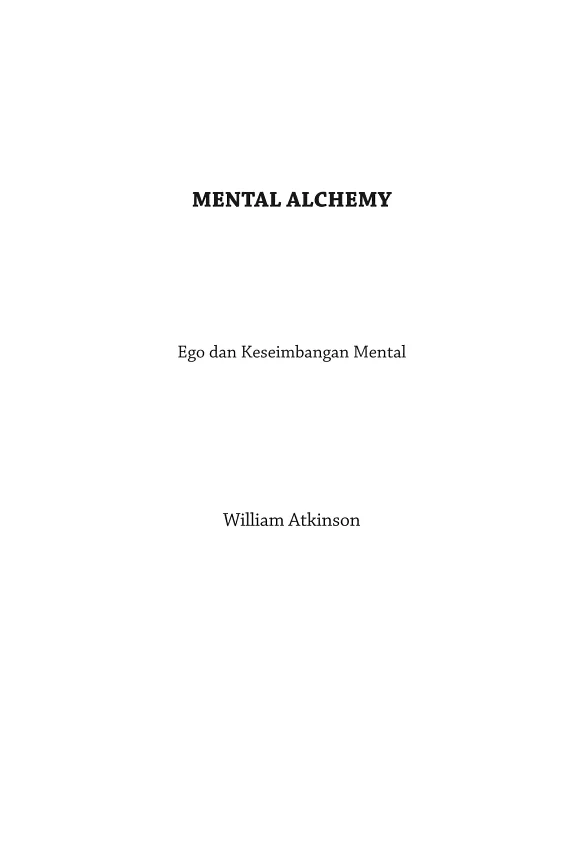
MENTAL ALCHEMY
Atkinson's MENTAL ALCHEMY offers a compelling framework for understanding the self not as a fixed entity but as a dynamic nexus of consciousness and will. The distinction drawn between the subjective "I" and the objective "garments" of emotion is particularly lucid, providing a practical lens for self-observation. The work's strength lies in its systematic deconstruction of identity, moving beyond mere platitudes to suggest tangible methods for disentangling oneself from reactive emotional states. However, the prose, while clear, can sometimes lean towards abstract pronouncements without sufficient grounding in experiential examples, a common trait of texts from its milieu. A passage detailing the "masks of character" offers a potent, albeit brief, illustration of this concept. It serves as a solid, if somewhat dated, primer on mind-body separation for the dedicated student.
📝 Description
79
William Atkinson's MENTAL ALCHEMY (circa 1900) describes consciousness as a malleable construct.
This book presents a structured method for understanding and influencing consciousness, seen through the lens of esoteric philosophy. Atkinson argues that what he calls "Ego-Consciousness" is not a fixed self but something that can be comprehended and, to a degree, directed. He separates the subjective "I" from objective emotions and feelings, describing the latter as temporary "garments." This idea challenges standard views of identity, suggesting our mental states and emotional responses are separate from our essential being.
Atkinson wrote MENTAL ALCHEMY during a period of significant interest in mental science and spiritualism in the early 20th century. This era saw many authors blending Eastern philosophies with Western occult traditions, seeking to explain the mind's power in ways distinct from emerging materialistic psychological theories. The book is for individuals who want a deeper grasp of their inner mental world and the self. It will appeal to those interested in contemplation, philosophy, or spiritual growth, especially those who like detailed explanations of mental processes from a non-materialist perspective. Its principles are aimed at personal transformation.
Published during the early 20th century, MENTAL ALCHEMY is a product of the New Thought and esoteric movements. Atkinson, a prolific writer in this vein, placed his work alongside contemporary explorations of mental science and spiritualism. This period saw a confluence of Eastern philosophical ideas and Western hermetic traditions, often presented as a means for individual empowerment and self-mastery. The book distinguishes itself from purely materialistic psychological frameworks by focusing on the subjective experience and the potential for conscious direction of one's inner life.
💡 Why Read This Book?
• Gain a framework for understanding your subjective "I" as distinct from transient emotional states, a concept elaborated in the "garments of consciousness" sections. • Learn to view emotions and feelings as objective phenomena that can be observed and managed, drawing parallels to the "masks of character" discussed by Atkinson. • Explore the fundamental nature of "Will" as the core of the "Ego-Consciousness," as presented in the work's early chapters, to better direct your inner life.
⭐ Reader Reviews
Honest opinions from readers who have explored this book.
❓ Frequently Asked Questions
What is the core philosophy behind William Atkinson's MENTAL ALCHEMY?
The core philosophy posits that "Ego-Consciousness" allows the "I" to recognize its essence as Will, differentiating the subjective self from objective emotions and feelings, which are seen as transient "garments."
When was MENTAL ALCHEMY first published, and what is its historical context?
MENTAL ALCHEMY was first published in 2020, though it reflects the esoteric and New Thought movements of the early 20th century, a period of significant exploration into mental science and consciousness.
How does MENTAL ALCHEMY suggest one can achieve self-mastery?
Self-mastery is achieved by understanding emotions and feelings as "garments" or "masks" external to the true self, allowing for objective observation and a reduction in identification with transient mental states.
Is MENTAL ALCHEMY suitable for beginners in esoteric studies?
Yes, it provides a foundational perspective on consciousness and identity, making it accessible for beginners interested in psychological and spiritual self-exploration from an esoteric viewpoint.
What is the relationship between "Will" and "Ego-Consciousness" in this book?
The book defines "Ego-Consciousness" as the stage where the "I" realizes its intrinsic nature is "Will," suggesting Will is the fundamental driving force behind the conscious self.
Are there practical exercises or techniques in MENTAL ALCHEMY?
While not always presented as explicit step-by-step exercises, the book offers a conceptual framework for practice, encouraging readers to observe their mental states and emotional "garments" with detachment.
🔮 Key Themes & Symbolism
Consciousness as Garments
The central theme posits that our experiences of emotion and feeling are not intrinsic to our core identity but are akin to "garments" that the subjective "I" can wear or shed. This concept allows for a detached observation of mental states, fostering a sense of agency over one's internal world. The work meticulously dissects the "Ego-Consciousness" to reveal this separation, suggesting that true selfhood lies beyond these transient overlays, enabling a more stable and directed inner life.
The Primacy of Will
Atkinson emphasizes "Will" as the fundamental nature of the "I" once "Ego-Consciousness" reaches a certain level of realization. This perspective elevates Will from a mere faculty to the essence of one's being. By recognizing this, the individual can understand that their subjective self is not passively shaped by external circumstances or internal emotional flux but is fundamentally an expression of Will, capable of directed intention and choice.
Objective Self-Observation
The text advocates for cultivating an objective viewpoint towards one's own mental and emotional phenomena. By seeing these as "garments" or "masks," the practitioner can move from being identified with these states to merely observing them. This practice is crucial for disengaging from negative thought patterns and emotional reactivity, promoting a disciplined and centered state of mind essential for spiritual development and practical application of esoteric principles.
Identity Beyond Emotion
MENTAL ALCHEMY challenges the conventional understanding of identity, which is often conflated with one's feelings and emotional responses. It proposes that the true "I" is distinct from these subjective experiences. This separation is key to achieving inner freedom, as it liberates the individual from the tyranny of fluctuating moods and perceptions, allowing for a stable sense of self grounded in the underlying principle of Will.
💬 Memorable Quotes
Direct passages from the work, attributed to the author.
“He sees them as garments that can be worn and removed, for they suit his fancy or interest.”
— This metaphor illustrates the flexibility and impermanence of emotional states. It implies that one has the power to choose which feelings to engage with and when to disengage, fostering a sense of control over one's inner experience.
“He sees them as so many character masks that can be worn.”
— This interpretation extends the "garment" metaphor to include personality traits and roles. It suggests that the self can adopt various personas, emphasizing the constructed nature of identity and the potential for conscious self-presentation.
“When the Ego-Consciousness is obtained at a certain grade, the "I" realizes that it is in its deepest nature not other than Will.”
— This statement defines the ultimate realization of self-awareness within the book's framework. It equates the core identity of the "I" with "Will" once a specific level of consciousness is achieved, positioning Will as the fundamental essence.
“The "I" realizes that it is in its deepest nature not other than Will.”
— This foundational concept posits that the ultimate truth of the self, upon attaining a higher level of "Ego-Consciousness," is found to be "Will." This perspective reorients the understanding of identity away from transient experiences towards a core, dynamic principle.
💡 Key Ideas
Editorial paraphrase of the work's core concepts — not direct quotes.
The "I" realizes that the Opposite of Emotion and Feeling is merely its own possession, but not itself.
This quote highlights the core idea that emotions are external attributes, not the fundamental self. It suggests a cognitive shift where feelings are recognized as objects of awareness rather than the subject experiencing them.
🌙 Esoteric Significance
Tradition
MENTAL ALCHEMY aligns with the Western Esoteric tradition, particularly its Hermetic and New Thought branches. It echoes Hermetic principles of "As Above, So Below" by focusing on the inner microcosm (mind) as a reflection and shaper of the outer world. The emphasis on Will and consciousness aligns with Neo-Platonic and Gnostic ideas concerning the divine spark within and the potential for self-realization, while the New Thought aspect champions the mind's power to manifest reality.
Symbolism
The central symbols are "garments" and "masks," representing transient emotional states and personality roles. These are not mere metaphors but symbolic representations of how the subjective "I" interacts with objective phenomena. By understanding these as external coverings, the practitioner can achieve detachment, akin to a mystic shedding worldly attachments to reveal the divine essence within. The "Ego-Consciousness" itself functions as a symbolic stage of awakening.
Modern Relevance
Contemporary practices in mindfulness, cognitive behavioral therapy (CBT), and even certain branches of positive psychology resonate with Atkinson's ideas on observing thoughts and emotions objectively. Modern spiritual teachers and self-help authors who advocate for detaching from emotional reactivity and cultivating intentionality draw implicitly or explicitly on the principles articulated in works like MENTAL ALCHEMY, showing its enduring influence on personal development discourse.
👥 Who Should Read This Book
• Students of early 20th-century esoteric thought seeking primary source material on mental science and consciousness. • Individuals interested in the philosophical underpinnings of New Thought and its practical applications for self-understanding and control. • Seekers of spiritual development who wish to explore the nature of identity beyond conventional psychological definitions and emotional identification.
📜 Historical Context
William Atkinson was a significant figure in the New Thought movement, publishing prolifically under various pseudonyms in the early 20th century. MENTAL ALCHEMY, though its first known publication is dated 2020, belongs intellectually to this era. This period saw a confluence of spiritualism, Theosophy, and the burgeoning field of psychology, creating fertile ground for works exploring the mind's potential. Atkinson’s writings, like those of contemporaries such as Prentice Mulford or early Wallace Wattles, offered accessible yet useful insights into self-transformation through mental discipline. This body of work stood in contrast to the more academic, often materialistic, psychological theories gaining traction with figures like Freud and Jung, offering a spiritual and metaphysical alternative that emphasized personal agency and inner power.
📔 Journal Prompts
The "garments" of emotion: What feelings did you "wear" today, and which felt most like a chosen attire?
Reflect on the distinction between your subjective "I" and the "masks" of character you presented in social interactions.
Consider your "Ego-Consciousness": At what grade do you perceive your "I" aligns most closely with pure "Will"?
Analyze a recent emotional reaction: Was it an intrinsic part of your "I" or a "garment" you identified with too strongly?
Meditate on the nature of "Will" as your deepest essence, independent of external circumstances or internal states.
🗂️ Glossary
Ego-Consciousness
A specific stage of awareness where the individual "I" recognizes its fundamental nature and its relationship to the surrounding phenomena.
I
The subjective, core self or consciousness that perceives and experiences phenomena, understood to be fundamentally Will.
Will
The fundamental essence or driving force of the subjective "I," realized at advanced stages of Ego-Consciousness.
Garments
Metaphorical term for emotions and feelings, viewed as external coverings that the "I" can wear or shed, distinct from the true self.
Masks
Similar to "garments," these represent character traits or personas that the subjective self can adopt or display.
Objective
Pertaining to phenomena that can be observed and analyzed from a detached perspective, as opposed to subjective experience.
Subjective
Pertaining to the inner, personal experience of the "I," characterized by perception, feeling, and consciousness.
This book appears in 1 collection
🔮 Readers Also Liked
Browse all →









From the “Mental Alchemy” Collection
View all →








More Free Alchemy & Hermeticism Books
View all →