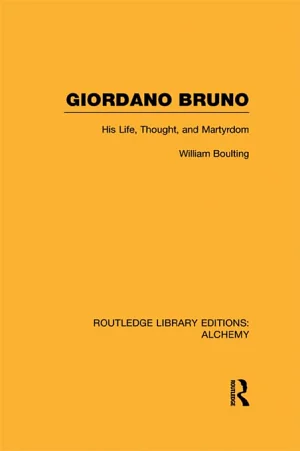
Giordano Bruno
 75
75

Giordano Bruno
Boulting's "Giordano Bruno" provides a necessary, if somewhat dry, account of a thinker whose ideas outpaced his era. The author successfully situates Bruno within the complex intellectual landscape of the late Renaissance, highlighting the philosophical and occult currents that shaped his worldview. A particular strength lies in the detailed exploration of Bruno's cosmological heresies, such as his assertion of an infinite universe, which directly contradicted prevailing Aristotelian and Christian doctrines. While the narrative is meticulously researched, the prose occasionally lacks the dynamism one might associate with Bruno's own fiery intellect. The section detailing Bruno's trial and execution, however, is handled with commendable clarity, underscoring the tragic clash between his philosophical daring and the rigid authority of the Inquisition. Boulting's work serves as a valuable reference for understanding a pivotal, albeit controversial, figure in Western thought.
📝 Description
75
William Boulting's 1914 study examines Giordano Bruno, a 16th-century philosopher executed for his radical cosmology.
William Boulting's "Giordano Bruno" reconstructs the life and thought of the 16th-century philosopher. The book details Bruno's cosmological theories, which proposed an infinite universe and challenged Aristotelian physics and Catholic doctrine. Boulting traces Bruno's intellectual path, from his Dominican education to his travels across Europe, where he engaged with various philosophical and occult traditions.
The work is for readers interested in Renaissance intellectual history, particularly the connections between philosophy, magic, and cosmology. Students of early modern thought and those curious about thinkers who questioned accepted knowledge will find this study valuable. It also provides historical context for esoteric traditions and ideas that influenced later movements like Theosophy.
Giordano Bruno operated within the late 16th century's intellectual ferment, a time when Neoplatonism, Hermeticism, and Kabbalah flourished alongside early scientific inquiry. His own ideas, heavily influenced by Hermetic texts and Nicholas of Cusa, proposed a universe without bounds, a concept far removed from the prevailing geocentric model. This radical departure from established cosmology, coupled with his philosophical system, placed him at odds with both religious and scientific orthodoxy of his day, ultimately leading to his condemnation and execution.
💡 Why Read This Book?
• Understand the philosophical context of Giordano Bruno's belief in an infinite universe, a concept that challenged the Aristotelian cosmology prevalent in the 16th century. • Grasp Bruno's pantheistic philosophy, where God is seen as immanent within nature, offering a different perspective on divinity than traditional dogma. • Explore the intellectual currents of the Renaissance, including Neoplatonism and Hermeticism, and how they informed Bruno's radical ideas on cosmology and metaphysics.
⭐ Reader Reviews
Honest opinions from readers who have explored this book.
❓ Frequently Asked Questions
What was Giordano Bruno's most significant cosmological idea?
Giordano Bruno's most significant cosmological idea was his assertion of an infinite universe containing innumerable worlds. This concept directly contradicted the prevailing geocentric and finite universe model supported by Aristotelian physics and Church doctrine.
What philosophical traditions influenced Giordano Bruno?
Bruno was significantly influenced by Neoplatonism, Hermeticism, and the ideas of Nicholas of Cusa. These traditions provided him with frameworks for developing his pantheistic views and his conception of an infinite cosmos.
Why was Giordano Bruno condemned by the Inquisition?
Bruno was condemned by the Roman Inquisition for his heretical theological and philosophical views, which included his belief in an infinite universe, metempsychosis (reincarnation), and a pantheistic conception of God that challenged Catholic dogma.
When was Giordano Bruno executed?
Giordano Bruno was executed by burning at the stake in the Campo de' Fiori in Rome on February 17, 1600, after a lengthy trial by the Roman Inquisition.
How did Bruno's ideas differ from contemporary astronomers?
While Bruno was influenced by Copernicus's heliocentric model, his concept of an infinite universe and countless worlds was more philosophical and metaphysical than the empirical astronomical inquiries of contemporaries like Tycho Brahe or Johannes Kepler.
What is pantheism, as related to Bruno's philosophy?
In Bruno's philosophy, pantheism is the belief that God is identical with the universe and is immanent in all of nature. This contrasts with theistic views where God is seen as transcendent and separate from creation.
🔮 Key Themes & Symbolism
The Infinite Universe
The work meticulously details Giordano Bruno's revolutionary concept of an infinite universe, populated by countless worlds. This idea was a radical departure from the finite, geocentric cosmology that dominated the era, heavily influenced by Aristotelian physics and Ptolemaic astronomy. Boulting explains how Bruno's vision, informed by Hermetic and Neoplatonic thought, posited a cosmos unbound by earthly limitations, a concept that profoundly challenged established religious and scientific paradigms and contributed to his eventual condemnation.
Pantheism and Divine Immanence
A central theme is Bruno's pantheistic philosophy, which posits that God is not a transcendent creator separate from the world, but rather an immanent force within all of nature. The book explores how this belief system, where the universe itself is divine, allowed Bruno to reconcile his cosmological views with a form of spirituality. This perspective challenged orthodox Christian doctrines of God's transcendence and separation from creation, making his theological positions highly controversial.
Memory Arts and Philosophical Dialogue
Boulting examines Bruno's engagement with the art of memory, a significant intellectual pursuit in the Renaissance. The work discusses how Bruno utilized mnemonic techniques and developed his own complex systems, often presented through his philosophical dialogues. These dialogues, such as 'The Ash Wednesday Supper,' served as vehicles for his heterodox ideas on cosmology, theology, and the nature of reality, showcasing his unique method of philosophical inquiry and dissemination.
Renaissance Occultism and Philosophy
The book situates Bruno within the broader context of Renaissance intellectual life, characterized by a resurgence of interest in Hermeticism, Neoplatonism, and Kabbalah. Boulting illustrates how Bruno synthesized these esoteric traditions with his philosophical investigations, creating a unique worldview. This fusion of occult philosophy and speculative cosmology set him apart from more empirical thinkers and contributed to his reputation as a magician and philosopher wrestling with hidden cosmic truths.
💬 Memorable Quotes
Direct passages from the work, attributed to the author.
“The universe is infinite, and therefore God is also infinite.”
— This statement expresses Bruno's core cosmological and theological assertion: if the universe has no boundaries, then the divine power that created and sustains it must also be without limit. It links his concept of cosmic infinitude directly to the nature of God.
“The Earth moves.”
— While often attributed to Galileo, Bruno also ardently promoted the heliocentric view and the mobility of the Earth, extending it to the idea that all celestial bodies are in motion. This was a fundamental challenge to the static, Earth-centered universe.
“God is the soul of the world.”
— This expresses Bruno's pantheistic belief, suggesting that the divine is not external but is the intrinsic animating principle of the entire universe, permeating every aspect of existence.
“Memory is the treasure of the soul.”
— Reflecting his interest in mnemonic arts, this signifies Bruno's view of memory not just as a faculty, but as a vital repository of knowledge and experience, essential for philosophical and spiritual development.
💡 Key Ideas
Editorial paraphrase of the work's core concepts — not direct quotes.
An infinite universe implies infinite possibilities and infinite worlds.
This paraphrased concept highlights Bruno's logical extension from an infinite cosmos to the existence of numerous other inhabited worlds, a notion far removed from the singular creation narrative prevalent at the time.
🌙 Esoteric Significance
Tradition
Bruno's work sits at a complex intersection of Renaissance Hermeticism, Neoplatonism, and speculative philosophy. While not strictly adhering to a single esoteric lineage, he drew heavily from Hermetic texts and Kabbalistic ideas regarding the interconnectedness of all things and the divine immanence within nature. His pantheistic universe, teeming with life and divine spirit, speaks to Gnostic concepts of a pervasive divinity, though his approach was more philosophical than mystical in the traditional sense.
Symbolism
The concept of the 'infinite universe and worlds' itself functions as a potent symbol, representing boundless potential and the divine presence extending beyond human comprehension or terrestrial limitations. The 'sun' and 'stars' in Bruno's cosmology are not mere celestial bodies but divine emanations or centers of divine life, symbolizing a decentralized, immanent divine order. His emphasis on the 'unity of all things' symbolizes the interconnectedness of the macrocosm and microcosm, a fundamental tenet in many esoteric traditions.
Modern Relevance
Bruno's ideas continue to inspire thinkers exploring the nature of consciousness, cosmology, and spirituality. His concept of an infinite, interconnected universe finds echoes in modern scientific theories like the multiverse and in spiritual movements emphasizing cosmic consciousness and the divine immanence in all existence. Philosophers and writers interested in the historical roots of panpsychism or the philosophical implications of modern cosmology often revisit Bruno's challenging ideas about reality and divinity.
👥 Who Should Read This Book
• Students of Renaissance intellectual history seeking to understand the philosophical and cosmological debates of the era. • Readers interested in the historical development of ideas about the infinite universe and the concept of multiple worlds. • Those exploring the intersections of philosophy, theology, and esoteric traditions in Western thought.
📜 Historical Context
Giordano Bruno's intellectual life unfolded during the tumultuous late 16th century, a period marked by the Italian Renaissance and the nascent stages of the Scientific Revolution. This era saw a revival of ancient philosophies, including Neoplatonism and Hermeticism, which deeply influenced Bruno. He engaged with the Copernican system but extended it to a radical vision of an infinite universe with countless worlds, a concept that clashed fundamentally with the Aristotelian cosmology then dominant in universities and the Catholic Church. Contemporaries like Tycho Brahe pursued observational astronomy, while Bruno's approach was more speculative and metaphysical. His heterodox views on theology, cosmology, and the nature of God led to his denunciation by the Roman Inquisition. After a seven-year trial, he was burned at the stake in Rome on February 17, 1600, becoming a martyr for philosophical freedom.
📔 Journal Prompts
Giordano Bruno's infinite universe: how does this concept challenge your perception of place and scale?
The idea of divine immanence: reflect on instances where you've felt the divine present within nature.
Bruno's condemnation: consider the tension between radical ideas and established authority.
The art of memory: how might structured memory techniques enhance your understanding of complex philosophical concepts?
The concept of 'infinite worlds': explore the philosophical implications of existence beyond our known reality.
🗂️ Glossary
Infinite Universe
Giordano Bruno's cosmological theory positing a universe without spatial boundaries, containing an endless number of stars and potentially inhabited worlds, contrary to the finite, geocentric models of his time.
Pantheism
The philosophical or religious belief that the universe is identical with divinity, or that all things are aspects of a single, immanent God. Bruno's view saw God as the soul or animating principle of the universe.
Neoplatonism
A philosophical system originating in late antiquity, based on Plato's philosophy, emphasizing the concept of 'The One' from which all reality emanates. It influenced Renaissance thought, including Bruno's.
Hermeticism
A religious, philosophical, and esoteric tradition based primarily upon writings attributed to Hermes Trismegistus. It often deals with alchemy, astrology, and the divine nature of reality.
Aristotelian Physics
The physical theories developed by Aristotle, which included a finite, geocentric universe with distinct celestial and terrestrial realms, and a system of motion based on natural place and motive powers.
Inquisition
Institutions within the Catholic Church tasked with combating heresy. The Roman Inquisition played a significant role in the trial and condemnation of Giordano Bruno in 1600.
Mnemonic Arts
Techniques used to improve memory, particularly for recalling large amounts of information. Bruno was deeply interested in and developed complex systems of memory arts.
🔮 Readers Also Liked
Browse all →




![The Widow Ching Pirate [5 stories]](/img/thumb/the-widow-ching-pirate-5-stories-jorge-luis-borges.webp)




More by William Boulting
All books →
More Free Alchemy & Hermeticism Books
View all →