Joyce Higginbotham, River Higginbotham
Joyce and River Higginbotham are authors associated with the town of Thurso, Scotland.
Joyce Higginbotham and River Higginbotham are authors whose work is linked to Thurso, a town situated on the northern coast of Scotland. Thurso itself boasts a rich history, having served as a significant Norse port and later engaging in trade across northern Europe until the 19th century. The town was historically known for its linen production and tanning industries, and continues to be a fishing center. Its geographical position is notable, being the northernmost town on the island of Great Britain, located further north than the southernmost point of Norway and at a significant distance from London. The town's etymology is rooted in Celtic and Norse influences, with its name evolving from terms related to 'bull water' or 'bull river' to a name associated with the Norse deity Thor. The area has evidence of ancient activity, including Neolithic burial sites dating back approximately 5,000 years.
Historical and Economic Significance
Thurso has a long history, dating back to Norse rule in Caithness. It functioned as an important port and maintained trade connections with various northern European ports until the 19th century. Economically, the town was historically recognized for its linen cloth manufacturing and tanning operations. Fishing has consistently been a vital part of the local economy. The nearby port of Scrabster remains significant for the white fish industry. In more recent times, the Dounreay nuclear research establishment, established in the mid-20th century, significantly boosted the town's population and economy, although it is now mostly decommissioned. The town's development includes planned 19th-century expansions and the establishment of educational institutions like North Highland College and Thurso High School, the northernmost secondary school on the British mainland.
Geographical and Cultural Context
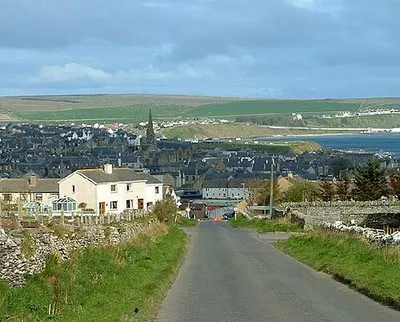
Located on the northernmost coast of Great Britain, Thurso overlooks the Orkney Islands. It serves as the northern terminus for the A9 road, a primary route connecting Caithness to southern Scotland. The town is situated at the confluence of the A9 and A836 roads and is bisected by the River Thurso, which flows into Thurso Bay and the Pentland Firth. The river estuary functions as a small harbor. Thurso's geographical position places it at a latitude further north than certain Scandinavian capitals and the Alaskan capital. Culturally, Thurso hosted the National Mòd in 2010, a festival celebrating Gaelic language and culture, marking its northernmost occurrence.
Ancient Roots and Name Origins
The origins of Thurso's name are traced back to its Celtic past, where it was known as 'tarvodubron,' meaning 'bull water' or 'bull river.' This Celtic nomenclature also influenced nearby geographical features. Subsequently, Norse settlers adapted the name, which evolved through 'Thjorsá' and 'Thorsá' to its present form, linking it to the Norse god Thor and signifying a location on 'Thor's River.' Archaeological evidence, such as Neolithic horned cairns found on Shebster Hill, points to ritualistic and burial practices in the area dating back approximately 5,000 years, indicating a deep historical presence preceding Norse influence.