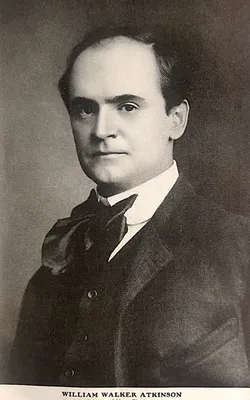
William Walker Atkinson Yogi Ramacharaka
William Walker Atkinson was a prolific New Thought author and publisher, known for using pseudonyms like Yogi Ramacharaka.
William Walker Atkinson (1862-1932) was a pivotal figure in the New Thought movement, known for his extensive authorship and role as a publisher. After a career as an attorney that led to a breakdown, he found healing through New Thought principles. This experience spurred his prolific writing career, during which he authored around 100 books in the last three decades of his life.
Atkinson became deeply involved with Dr. Herbert A. Parkyn's Chicago School of Psychology and its associated magazine, Suggestion. He contributed significantly to the magazine, helping to integrate metaphysical interpretations into its content and extending the application of suggestive therapeutics beyond clinical settings. He also co-founded and edited New Thought magazine and was instrumental in the establishment of various publishing ventures, often utilizing pseudonyms such as Yogi Ramacharaka and Theron Q. Dumont.
Early Life and New Thought Awakening
Born in Baltimore in 1862, William Walker Atkinson began his career in business before becoming an attorney in Pennsylvania in 1894. Despite achieving material success, the demands of his legal career led to a severe physical and mental breakdown, accompanied by financial ruin. Seeking recovery, Atkinson discovered suggestive therapeutics around 1900 and credited the principles of New Thought with restoring his health, mental clarity, and financial stability. This transformative experience marked the beginning of his deep engagement with the New Thought movement.
Collaboration with Dr. Parkyn and Suggestion Magazine
In 1900, Atkinson sought treatment at Dr. Herbert A. Parkyn's Chicago School of Psychology for nervous prostration. After a six-week period of care, he relocated to Chicago and began studying directly under Parkyn. Atkinson's background in law, coupled with his writing and organizational skills, led Parkyn to invite him to contribute to the magazine Suggestion. Atkinson's unsigned editorial pieces gradually introduced a more metaphysical perspective, blending Parkyn's concepts of suggestive therapeutics with his own developing ideas. This collaboration shaped Atkinson's future writings and cemented his role as a prominent protégé of Parkyn.
Foundations in New Thought and Publishing
Atkinson's first published work on New Thought, 'The Law of Mental Control,' appeared in Suggestion in December 1900. This series of articles, later expanded into the book 'A Series of Lessons in Personal Magnetism, Psychic Influence, Thought-Force, Concentration, Will-Power and Practical Mental Science,' laid the groundwork for his career. He aimed to apply Parkyn's Law of Suggestion to self-culture and psychic phenomena, translating suggestive therapeutics into accessible New Thought terminology. In 1901, he became the first instructor at Parkyn's University of Psychic Science, developing material that was compiled into his first book, 'A Series of Lessons in Personal Magnetism.'
Pseudonymous Authorship and Publishing Ventures
Atkinson was a prolific writer who employed numerous pseudonyms, including Yogi Ramacharaka and Theron Q. Dumont. He was involved in editing several influential magazines such as Suggestion, New Thought, and Advanced Thought. His publishing activities often involved companies with shared addresses and a common roster of authors, many of whom were his own pseudonymous creations. This strategy allowed him to distribute his extensive body of work across various platforms and reach a wide audience interested in metaphysical and New Thought topics.
Key Ideas
- New Thought principles as a path to healing and prosperity
- Suggestive therapeutics and the Law of Suggestion
- Mental control, personal magnetism, and thought-force
- The power of will and concentration
- Metaphysical interpretations of mental sciences
Books by William Walker Atkinson Yogi Ramacharaka
0 free public domain books · Read online or download
