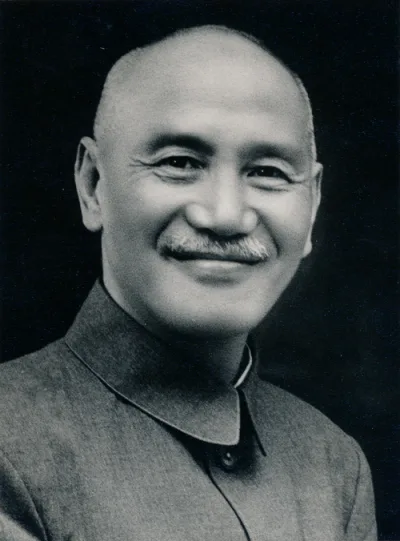
Wei Chieh Young
Chiang Kai-shek was a Chinese political and military leader who led the Republic of China for decades.
Chiang Kai-shek (1887–1975) was a prominent Chinese military commander, revolutionary, and statesman who played a central role in the Republic of China's history. He led the nation from 1928 until his death, initially governing mainland China. Following the Chinese Civil War, his government retreated to Taiwan in 1949, where he continued to lead the Republic of China.
Educated in China and Japan, Chiang joined revolutionary movements early on and became a key figure in the Kuomintang. He led military campaigns, including the Northern Expedition, which aimed to unify China under Nationalist rule. His leadership was marked by significant events like the purge of Communists, the Second Sino-Japanese War, and the eventual retreat to Taiwan. On Taiwan, he governed under martial law for many years and oversaw periods of economic growth and land reform, while also facing international challenges regarding China's representation.
Chiang remains a complex and debated historical figure. Supporters highlight his role in national unification, resistance against Japan, and the preservation of Chinese culture. Critics point to his authoritarian rule, suppression of dissent, and controversial decisions during his long tenure. His life and leadership left a lasting impact on modern Chinese history.
Early Life and Revolutionary Beginnings
Born in Zhejiang province in 1887, Chiang Kai-shek came from a merchant family. His early life was marked by the death of his father and his mother's strong influence, which he later described as instilling in him an "indomitable spirit to fight for justice." He received military education in both China and Japan, a period during which he developed strong nationalistic sentiments and a desire to overthrow the Qing dynasty. In 1908, he joined Sun Yat-sen's revolutionary organization. A notable act of defiance during his youth was cutting off his queue, the traditional hairstyle mandated by the Qing government, signaling his break from the old order.
Rise to Power and National Unification
After the 1911 Revolution, Chiang became a founding member of the Kuomintang (KMT). He gained significant influence as the commandant of the Whampoa Military Academy from 1924. Following Sun Yat-sen's death, Chiang consolidated his power within the party and the military. He led the Northern Expedition from 1926 to 1928, a military campaign that largely unified China under a Nationalist government based in Nanjing. This period also saw his decision to purge Communist members, which fractured the KMT and led to the outbreak of the Chinese Civil War. During the Nanjing decade, he focused on modernization while prioritizing internal stability and suppressing the Communists.
Wartime Leadership and Retreat to Taiwan
Chiang's leadership faced immense challenges, including Japan's invasion of Manchuria. In 1936, the Xi'an Incident compelled him to form a united front with the Communists against Japan. He led China through the Second Sino-Japanese War (1937–1945), often from the wartime capital of Chongqing. After World War II concluded, the Chinese Civil War resumed, resulting in the KMT's defeat by Mao Zedong's Communist Party in 1949. Chiang and his government retreated to Taiwan, where he continued to lead the Republic of China. He imposed martial law and oversaw economic development, remaining president until his death in 1975.
Legacy and Historical Perspective
Chiang Kai-shek is remembered as a controversial figure. His supporters credit him with unifying China, leading the fight against Japanese aggression, and preserving Chinese culture. They also note his role in safeguarding cultural treasures, many of which are now housed in Taiwan's National Palace Museum. Conversely, critics fault him for authoritarian rule, corruption, and early appeasement policies towards Japan. His legacy is debated, encompassing his efforts to modernize China and maintain its sovereignty against formidable internal and external pressures.
Notable Quotes
“As you all know I was an orphan boy in a poor family. Deprived of any protection after the death of her husband, my mother was exposed to the most ruthless exploitation by neighbouring ruffians and the local gentry. The efforts she made in fighting against the intrigues of these family intruders certainly endowed her child, brought up in such an environment, with an indomitable spirit to fight for justice. I felt throughout my childhood that my mother and I were fighting a helpless lone war. We were alone in a desert, with no available or possible assistance could we look forward to. But our determination was never shaken, nor was hope abandoned.”
Books by Wei Chieh Young
0 free public domain books · Read online or download
