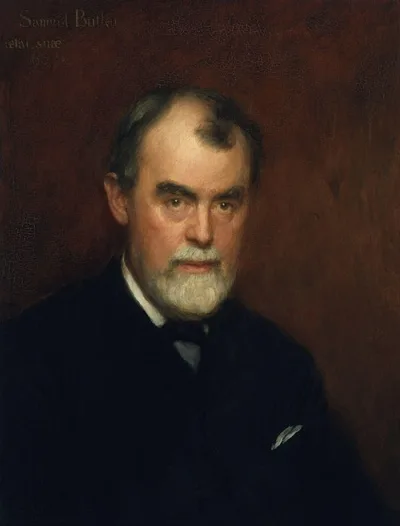
Walter Ernest Butler
Samuel Butler was an English novelist and critic known for 'Erewhon' and 'The Way of All Flesh', exploring themes of evolution and societal critique.
Samuel Butler (1835-1902) was an English writer recognized for his satirical novels, particularly 'Erewhon' and 'The Way of All Flesh'. Born into a clerical family, his early life was marked by a strained relationship with his parents and a challenging education, which influenced his later writings.
Butler's career path deviated from his family's expectations. After studying Classics at Cambridge, he emigrated to New Zealand, where he worked as a sheep farmer and began developing ideas that would form the basis of 'Erewhon'. His time there also saw him engage with Darwin's theories of evolution, a topic he later critiqued. Upon returning to England, he established himself as a writer, though his most famous works were published later in his life or posthumously. His writings often examined societal norms, religious orthodoxy, and philosophical concepts, remaining influential for their critical perspectives.
Literary Works and Themes
Samuel Butler is primarily celebrated for his novels 'Erewhon' (1872) and 'The Way of All Flesh' (published posthumously in 1903). 'Erewhon' is a satirical utopian novel that explores societal structures and critiques contemporary thought, notably engaging with Darwinian theories of evolution. Butler famously published a letter titled 'Darwin among the Machines' in a New Zealand newspaper, foreshadowing concepts related to the evolution of technology and the potential for machines to surpass human intelligence. His other significant work, 'The Way of All Flesh,' is a semi-autobiographical novel that offered a sharp critique of Victorian morality and family life. Butler also produced prose translations of Homer's epics and wrote on Italian art and culture.
Early Life and Influences
Born in 1835, Samuel Butler's upbringing was deeply influenced by his family's strong clerical background. His father and grandfather were both Anglican clergymen, and Butler was initially steered towards a similar path. However, his early education, including his time at Shrewsbury School and Cambridge, was fraught with difficulty and personal conflict. He experienced an oppressive home environment, detailing antagonistic relationships with his parents, particularly his father, in his writings. This challenging domestic and educational background significantly shaped his critical perspective on societal institutions and personal freedom, themes that would later permeate his literary output.
Emigration and Intellectual Development
Seeking distance from his family and societal pressures, Butler emigrated to New Zealand in 1859. During his time there as a sheep farmer, he continued to develop his intellectual interests, including a critical engagement with Charles Darwin's theories of evolution. His experiences and observations in New Zealand provided fertile ground for his literary endeavors, particularly for the ideas that would culminate in 'Erewhon.' This period of self-imposed exile allowed him to refine his unique philosophical and critical viewpoints, away from the conventional expectations of his English background. He returned to England in 1864, having laid the groundwork for his most significant literary contributions.
Key Ideas
- Critique of Victorian morality and institutions
- Exploration of Darwinian evolution and its implications
- The potential evolution and supremacy of machines
- Satirical examination of societal norms and religious orthodoxy
Books by Walter Ernest Butler
11 free public domain books · Read online or download