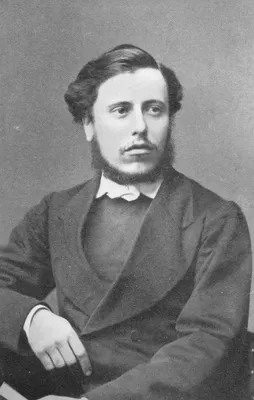
W Robertson Smith
W. Robertson Smith was a Scottish scholar whose critical approach to the Bible and ancient Near Eastern religions influenced comparative religious studies.
William Robertson Smith (1846–1894) was a Scottish academic, minister, and scholar of Oriental studies and the Old Testament. He gained significant recognition, and controversy, for his scholarly work that applied critical historical methods to biblical texts. His early career included a professorship at the Free Church College in Aberdeen, but his views, particularly those expressed in articles for the Encyclopædia Britannica, led to heresy trials and his dismissal.
Following his academic censure, Smith moved to the University of Cambridge, where he held positions including University Librarian and Professor of Arabic. During his time in Cambridge, he authored influential works that explored ancient religious practices and biblical scholarship. His approach emphasized understanding religious texts within their historical and cultural contexts, often utilizing sociological analysis. This methodology, though groundbreaking, challenged traditional interpretations and generated considerable debate within religious and academic circles of his time.
Academic Career and Controversy
Born in Scotland, William Robertson Smith displayed exceptional intellect from a young age, pursuing studies at Aberdeen University and New College, Edinburgh. He was appointed to a Hebrew professorship at the Aberdeen Free Church College in 1870. Smith's scholarly contributions extended to editing and writing for the Encyclopædia Britannica, where his articles, including one on the "Bible," began to apply critical historical analysis to religious texts. This approach, which did not assume literal truth, sparked a major controversy within the Free Church of Scotland and drew criticism from conservative American circles. The ensuing heresy trial resulted in his dismissal from his Aberdeen position in 1881.
Cambridge Scholarship and Comparative Religion
After leaving Aberdeen, Smith secured a position at the University of Cambridge, initially as a reader in Arabic, and later rising to become the University Librarian and the Sir Thomas Adams Professor of Arabic. It was during his Cambridge tenure that he produced seminal works such as "The Old Testament in the Jewish Church" (1881) and "The Prophets of Israel" (1882), intended for a broader audience, and his most significant work, "The Religion of the Semites" (1889). This latter book is particularly noted for pioneering the use of sociology in analyzing religious phenomena and is considered a foundational text in the comparative study of religion, examining ancient Jewish religious life within its broader ancient Near Eastern context.
Methodology and Approach to Texts
Smith advocated for a rigorous historical-critical method in examining ancient texts. He argued that texts preserved from antiquity, often through imperfect copies and editorial interventions, require careful critical analysis to discern their original meaning and character. His approach involved questioning received views, purifying texts of interpolations, and exposing forgeries, all with the aim of revealing the genuine historical truth. Smith believed that truly valuable ancient works would withstand such critical scrutiny, with the critic's labor ultimately serving to clarify and strengthen their authority.
Key Ideas
- Application of historical-critical methods to biblical texts.
- Use of sociology in the comparative study of religion.
- Understanding ancient religious texts within their historical and cultural contexts.
- Emphasis on textual criticism to reveal original meaning and authenticity.
Notable Quotes
“Ancient books coming down to us from a period many centuries before the invention of printing have necessarily undergone many vicissitudes. Some of them are preserved only in imperfect copies made by an ignorant scribe of the dark ages. Others have been disfigured by editors, who mixed up foreign matter with the original text. Very often an important book fell altogether out of sight for a long time, and when it came to light again all knowledge of its origin was gone; for old books did not generally have title-pages and prefaces. And, when such a nameless roll was again brought into notice, some half-informed reader or transcriber was not unlikely to give it a new title of his own devising, which was handed down thereafter as if it had been original. Or again, the true meaning and purpose of a book often became obscure in the lapse of centuries, and led to false interpretations. Once more, antiquity has handed down to us many writings which are sheer forgeries, like some of the Apocryphal books, or the Sibylline oracles, or those famous Epistles of Phalaris which formed the subject of Bentley's great critical essay. In all such cases the historical critic must destroy the received view, in order to establish the truth. He must review doubtful titles, purge out interpolations, expose forgeries; but he does so only to manifest the truth, and exhibit the genuine remains of antiquity in their real character. A book that is really old and really valuable has nothing to fear from the critic, whose labours can only put its worth in a clearer light, and establish its authority on a surer basis.”
Books by W Robertson Smith
0 free public domain books · Read online or download
