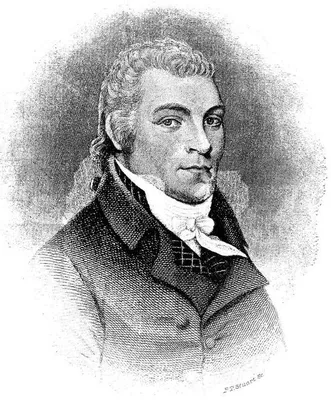
Thomas Smith Webb
Thomas Smith Webb authored a pivotal Masonic text and was a foundational figure in American Masonic organizations, particularly the York Rite.
Thomas Smith Webb (1771-1819) was a significant figure in the development of Masonic ritual and organization in America. Born in Boston to English immigrants, he learned the printing trade and was initiated into Masonry in New Hampshire before moving to Albany, New York. There, he published his influential work, "The Freemason's Monitor or Illustrations of Masonry," in 1797. This book, which underwent numerous expanded editions, played a crucial role in standardizing Masonic ritual, especially within the York Rite.
Webb was instrumental in establishing key Masonic governing bodies. He presided over conventions that led to the formation of the General Grand Chapter of Royal Arch Masons and the Grand Encampment of the United States. His efforts earned him the title "Founding Father of the York or American Rite." Beyond his Masonic work, Webb was also recognized for his musical talents, serving as the first president of the Psallonian Society and co-founding the Handel and Haydn Society in Boston.
The Freemason's Monitor and Masonic Ritual
Thomas Smith Webb's most enduring contribution is "The Freemason's Monitor or Illustrations of Masonry," first published in 1797. This seminal work significantly shaped Masonic ritual in America, with a particular impact on the York Rite. The book was not a static publication; it saw continuous revision and expansion through multiple editions during Webb's lifetime and after his death, indicating its ongoing importance and adaptation. The second part of the original volume included an account of "Ineffable Degrees of Masonry" and original Masonic songs, highlighting Webb's multifaceted involvement in the fraternity.
Architect of American Masonic Governance
Webb's influence extended beyond ritual to the very structure of Masonic bodies in the United States. He was a driving force behind the creation of overarching organizations. In 1797, he helped form a General Grand Chapter for Royal Arch Masons, and later, in 1799, he presented a constitution that contributed to the establishment of the Grand Encampment of the United States. His leadership in these foundational efforts led to him being recognized as the "Founding Father of the York or American Rite," a testament to his pivotal role in organizing and promoting these Masonic branches.
Musical Pursuits and Civic Engagement
Beyond his deep involvement in Freemasonry, Thomas Smith Webb possessed considerable musical abilities. He was the inaugural president of the Psallonian Society, an organization dedicated to enhancing its members' skills in sacred music. Further demonstrating his passion for music, Webb was a co-founder of the Handel and Haydn Society in Boston in 1815, also serving as its first president. This engagement in musical societies showcases a broader dimension to his public life, complementing his significant Masonic contributions.
Key Ideas
- Standardization and development of Masonic ritual in America
- Foundational organizational principles for American Masonic bodies
- Promotion and establishment of the York or American Rite
Books by Thomas Smith Webb
3 free public domain books · Read online or download