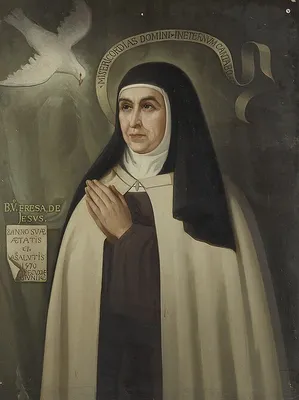
Teresa of Avila, E. Allison Peers
Teresa of Ávila was a Spanish mystic, reformer, and Doctor of the Church, known for her writings on prayer and the soul's journey to God.
Teresa of Ávila, born Teresa Sánchez de Cepeda Dávila y Ahumada in 1515, was a pivotal figure in the Counter-Reformation, renowned as a Spanish Carmelite nun, mystic, and religious reformer. She initiated a movement of spiritual renewal within the Carmelite Orders, later collaborating with Saint John of the Cross to establish the Discalced Carmelites. Her profound spiritual experiences and teachings are documented in her influential works, including her autobiography, 'The Life of Teresa of Jesus,' 'The Interior Castle,' and 'The Way of Perfection.' These writings explore Christian mysticism and meditation, detailing the soul's progression toward divine union.
Her life was marked by intense spiritual experiences, including visions and ecstasies, which she meticulously recorded. These accounts, alongside her reform efforts, led to her canonization in 1622 and her proclamation as the first female Doctor of the Church in 1970. Teresa's legacy lies in her deep insights into the contemplative life and her role in revitalizing religious orders, offering a rich spiritual guide for seekers throughout centuries.
Mystical Experiences and Writings
Teresa of Ávila experienced profound mystical states, including religious ecstasies and visions. Her autobiography, 'The Life of Teresa of Jesus,' details her spiritual journey and defense of these experiences, outlining four stages of the soul's ascent to God: mental prayer, the prayer of quiet, absorption-in-God, and ecstatic consciousness. Her seminal work, 'The Interior Castle,' serves as a spiritual guide for Carmelite sisters, using the metaphor of seven mansions within the soul to illustrate different states of spiritual development. Another key text, 'The Way of Perfection,' also offers guidance on contemplative practice. These writings are central to the study of Christian mysticism and meditation.
Monastic Reform and the Discalced Carmelites
Dissatisfied with the spiritual laxity she observed in her convent, Teresa embarked on a mission to reform the Carmelite Order. Supported by figures like Peter of Alcantara, she founded the first reformed convent, St. Joseph's, in 1562, emphasizing absolute poverty and renunciation of property. This initiative, which included stricter observance of monastic rules and practices like ceremonial flagellation and discalceation, faced initial opposition but eventually gained papal sanction. Her reform movement, later joined by Saint John of the Cross, led to the formal establishment of the Discalced Carmelites, a distinct branch of the order, following a papal decree in 1580.
Spiritual Legacy and Recognition
Teresa's intense spiritual life, including phenomena such as her famous transverberation vision where an angel pierced her heart with a fiery lance, has been a source of inspiration and study. Her writings provide an invaluable record of 16th-century contemplative practice, with some scholars speculating about potential neurological underpinnings for her experiences. Forty years after her death, she was canonized by Pope Gregory XV in 1622. In recognition of her enduring spiritual influence on Catholicism, Pope Paul VI declared her the first female Doctor of the Church in 1970.
Key Ideas
- The ascent of the soul to God through stages of prayer
- The soul as a castle with seven mansions representing spiritual states
- The importance of contemplative prayer and spiritual self-concentration
- Monastic reform emphasizing poverty and stricter observance
Notable Quotes
“I saw in his hand a long spear of gold, and at the point there seemed to be a little fire. He appeared to me to be thrusting it at times into my heart, and to pierce my very entrails; when he drew it out, he seemed to draw them out also, and to leave me all on fire with a great love of God. The pain was so great, that it made me moan; and yet so surpassing was the sweetness of this excessive pain, that I could not wish to be rid of it ...”
“Lord, either let me suffer or let me die.”
Books by Teresa of Avila, E. Allison Peers
2 free public domain books · Read online or download
![Camino de perfección [por] Santa Teresa de Jesús](/img/thumb/camino-de-perfección-por-santa-teresa-de-jesús-teresa-of-avila-256416.webp)


![Camino de perfección [por] Santa Teresa de Jesús](/img/thumb/camino-de-perfección-por-santa-teresa-de-jesús-teresa-of-avila-574018.webp)