Swami Saradananda
Swami Vivekananda was a key figure in introducing Vedanta and Yoga to the West, advocating for interfaith dialogue and Hindu philosophy.
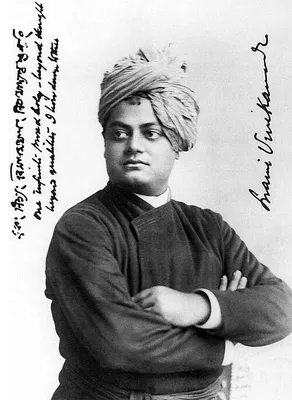
Born Narendranath Datta, Swami Vivekananda was an influential Indian Hindu monk and philosopher, renowned as the chief disciple of mystic Ramakrishna. He played a pivotal role in bringing Vedanta and Yoga philosophies to Western audiences, significantly contributing to the global recognition of Hinduism. Vivekananda’s early life was marked by intellectual curiosity and a spiritual inclination, leading him to seek a direct experience of the divine. His encounters with various philosophical and religious movements, including the Brahmo Samaj, shaped his understanding before his pivotal meeting with Ramakrishna.
Following Ramakrishna’s passing, Vivekananda embarked on extensive travels across India, witnessing the hardships faced by the populace. This experience fueled his desire to establish social service initiatives. His journey to the United States in 1893 for the Parliament of the World's Religions proved transformative. His address, beginning with "Sisters and brothers of America...", resonated deeply, promoting religious tolerance and universal acceptance, and establishing him as a prominent orator and a leading voice for Hindu thought. He subsequently lectured in Europe and founded Vedanta Societies in the US, laying the groundwork for their expansion.
Early Life and Education
Narendranath Datta, later known as Swami Vivekananda, was born into an aristocratic Bengali family in Calcutta on January 12, 1863. From a young age, he displayed a keen interest in spirituality, meditating and exploring religious texts. His education was rigorous, encompassing a broad range of subjects including Western philosophy, logic, and history at institutions like the General Assembly's Institution. He excelled academically, demonstrating a remarkable intellect and memory, impressing his professors with his potential. His father's progressive outlook and his mother's devout nature influenced his developing personality. He was also trained in Indian classical music and engaged in physical activities.
Spiritual Quest and Influences
Vivekananda's spiritual journey involved exploring various philosophical and religious currents of his time. He joined the Nava Vidhan and the Sadharan Brahmo Samaj, movements that sought a rationalized, monotheistic interpretation of Hinduism, influenced by Western thought and unitarianism. He grappled with questions about the direct experience of God, seeking answers from prominent figures. While the Brahmo Samaj provided a framework for his intellectual quest, his encounter with Ramakrishna marked a profound turning point, shifting his focus towards a more direct, experiential understanding of spirituality, even as some scholars suggest a significant influence from Western esotericism via the Brahmo Samaj.
Meeting Ramakrishna and Discipleship
Narendra first encountered Ramakrishna in 1881, an event that became central to his spiritual development, particularly after his father's death in 1884. Initially skeptical of Ramakrishna's ecstatic states and teachings, Narendra was drawn to his charismatic presence and visited him frequently at Dakshineshwar. This period marked a crucial transition in his life, moving from intellectual philosophical inquiry towards a deeper spiritual commitment under Ramakrishna's guidance. He eventually took vows as a sannyasin, becoming Swami Vivekananda.
Introduction of Vedanta and Yoga to the West
Following Ramakrishna's death, Swami Vivekananda traveled extensively across India, gaining firsthand knowledge of the struggles of the common people. This motivated him to seek ways to alleviate their suffering. His pivotal journey to the United States in 1893 led him to the Parliament of the World's Religions in Chicago. His impactful speech, commencing with "Sisters and brothers of America...", introduced Hindu philosophy, particularly Vedanta, to a global audience, advocating for religious harmony and mutual respect. This success led to extensive lecturing tours in the US and Europe, where he disseminated the core principles of Hindu thought and established Vedanta Societies, which became foundational for the spread of Vedanta in the West.
Key Ideas
- Introduction of Vedanta and Yoga to the West
- Advocacy for interfaith awareness and religious tolerance
- Elevation of Hinduism as a major world religion
- Establishment of social service and monastic orders (Ramakrishna Mission and Math)
Notable Quotes
“Sisters and brothers of America...”
Books by Swami Saradananda
2 free public domain books · Read online or download