Sir Walter Scott
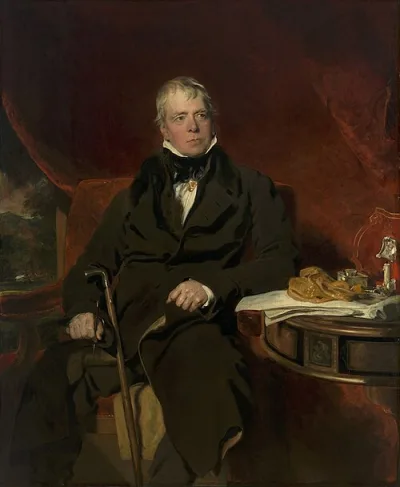
Thomas Lawrence painted a celebrated portrait of Sir Walter Scott, Britain's most famous living author and antiquarian.
This text describes a significant portrait of Sir Walter Scott, painted by English artist Thomas Lawrence. The work, initiated in 1820 and finished by 1826, was displayed at the Royal Academy in 1827. Lawrence, renowned for his portraits of elite society during the Regency period, was commissioned by King George IV to create this depiction of Scott. The King, a consistent patron of Lawrence, had previously acquired various paintings from the artist for the Waterloo Chamber.
At the time of the portrait, Walter Scott was recognized as Britain's preeminent living writer. His Waverley novels achieved widespread acclaim across Europe and America, establishing his popular historical fiction, which included works like Ivanhoe and Rob Roy, as a major influence on various art forms. Beyond his literary achievements, Scott was also a prominent antiquarian. He played a crucial role in organizing King George IV's 1822 visit to Scotland, having rediscovered the Scottish Crown Jewels four years prior. The portrait captures Scott as a writer, holding a pen and with writing materials nearby. A reviewer from the Morning Post lauded the painting for its fidelity to nature. The artwork is part of the Royal Collection and was later adapted into a mezzotint print. Another portrait of Scott by Scottish painter Henry Raeburn from the early 1820s is also noted.
Literary and Antiquarian Significance
Sir Walter Scott was at the zenith of his fame when depicted by Thomas Lawrence, recognized as Britain's most celebrated living author. His Waverley novels garnered international acclaim, cementing his reputation for influential romantic historical fiction, with titles such as Ivanhoe and Rob Roy demonstrating a broad impact across artistic disciplines. Scott's influence extended beyond literature; he was also a respected antiquarian. His involvement in organizing King George IV's 1822 Scottish visit highlights his engagement with national heritage, particularly following his 1818 rediscovery of the Crown Jewels of Scotland. This dual role as a literary giant and a figure dedicated to historical preservation positioned him as a prominent cultural force of his era.
The Commission and Artistic Depiction
The portrait of Sir Walter Scott by Thomas Lawrence was commissioned by King George IV, a notable patron of the artist. The commission, for which Lawrence received three hundred guineas, aimed to capture the likeness of Britain's most celebrated living writer. Lawrence, a leading portraitist of the Regency era, depicted Scott in a manner befitting his status as an author. The painting shows Scott holding a pen in his right hand, with writing materials arranged on a desk to his left, emphasizing his literary profession. The portrait was met with critical approval, with the Morning Post praising its 'truth to nature,' indicating a successful and accurate representation. The artwork was intended to be a significant addition to the royal collection, possibly for display at Carlton House.
Notable Quotes
“truth to nature”
Books by Sir Walter Scott
15 free public domain books · Read online or download