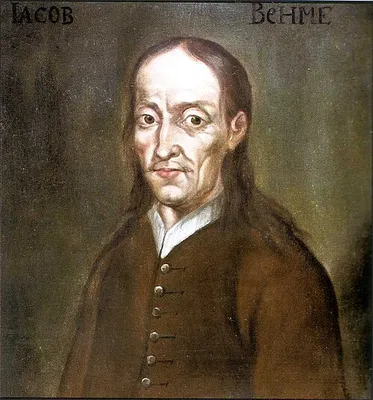
Sarah Apetrei Ariel Hessayon
Jakob Böhme was a 17th-century German philosopher and mystic whose unique theological ideas caused controversy.
Jakob Böhme (1575–1624) was a German philosopher, Christian mystic, and theologian within the Lutheran tradition. Despite lacking formal education, he developed original ideas that profoundly influenced later philosophical movements like German Idealism and Romanticism, with Hegel calling him the "first German philosopher." Born in Upper Lusatia, Böhme initially trained as a shoemaker and experienced mystical visions, notably one in 1600 that he believed revealed the spiritual structure of the universe. This led him to write his first book, "Aurora," which, upon circulation, sparked significant controversy and accusations of heresy from the local pastor, Gregorius Richter. Böhme faced pressure to cease writing and was even warned to leave his town. However, encouraged by friends and supporters, he continued to produce numerous theological and philosophical treatises, which were primarily circulated in manuscript form among his followers. His writings explored complex themes of sin, evil, redemption, and the divine nature, often deviating from mainstream Lutheran doctrines. Böhme's work gained a following across Europe, known as Behmenists, and his collected works were eventually published posthumously.
Early Life and Mystical Experiences
Jakob Böhme was born in 1575 in a village near Görlitz. His father was a Lutheran peasant. Böhme's early life involved working as a herd boy and then as an apprentice shoemaker, a period marked by hard labor and exposure to religious controversies. He had no formal schooling but engaged in prayer and read works by mystics like Paracelsus. After completing his apprenticeship and traveling as a journeyman, Böhme established himself as a master shoemaker in Görlitz by 1599. He married Katharina Kuntzschmann and raised six children. A pivotal moment occurred around 1600 when a mystical vision, inspired by sunlight on a pewter dish, led him to perceive the underlying spiritual reality of the world and the connection between the divine and humanity. He experienced further profound visions in 1610, deepening his understanding of cosmic unity and a perceived divine calling.
Writings and Controversy
Twelve years after his significant 1600 vision, Böhme began writing his first book, "Morgenröte im Aufgang" (later known as "Aurora"). This work, initially intended for personal reflection, was circulated in manuscript form and soon attracted the attention of Gregorius Richter, the chief pastor of Görlitz. Richter vehemently denounced the book as heretical, leading to a scandal and Böhme being threatened with exile. This opposition caused Böhme to cease writing for several years. However, at the urging of friends, he resumed his literary efforts in 1618, producing works like "The Three Principles of the Divine Essence" and "The Threefold Life of Man." His writings were copied by hand and shared among his followers. In 1624, a collection of his shorter works was published as "Weg zu Christo" (The Way to Christ), reigniting controversy. The publication led to Böhme being summoned by the Town Council and warned to leave Görlitz.
Theology and Key Ideas
Böhme's theological focus centered on the nature of sin, evil, and redemption, aiming to reconcile them within a divine framework. While rooted in Lutheranism, his ideas presented significant departures. He questioned the doctrine of justification by faith alone, suggesting it was akin to choosing spiritual poison over healing. Böhme also posited that the Fall might be a necessary stage in the universe's evolution. His theology, derived from mystical visions, described God as existing beyond time and space, regenerating eternally. He interpreted the Trinity with novel concepts: God the Father as fire, the Son as light, and the Holy Spirit as divine life. Böhme clarified that he did not view evil as desirable or part of God's will, but rather as a perversion of the original divine order, arising from the fallen state of nature after Lucifer's rebellion. His system incorporated correspondences between spiritual qualities, planets, and elements.
Key Ideas
- The spiritual structure of the universe revealed through mystical vision.
- The relationship between God, humanity, good, and evil.
- Reinterpretation of Lutheran theology, including justification and the concept of the Fall.
- God as an eternally regenerating being beyond time and space.
- Evil as a perversion of divine order rather than a divinely willed necessity.
Notable Quotes
“For he that will say, I have a Will, and would willingly do Good, but the earthly Flesh which I carry about me, keepeth me back, so that I cannot; yet I shall be saved by Grace, for the Merits of Christ. I comfort myself with his Merit and Sufferings; who will receive me of mere Grace, without any Merits of my own, and forgive me my Sins. Such a one, I say, is like a Man that knoweth what Food is good for his Health, yet will not eat of it, but eateth Poison instead thereof, from whence Sickness and Death, will certainly follow.”
“[I]n the order of nature, an evil thing cannot produce a good thing out of itself, but one evil thing generates another.”
Books by Sarah Apetrei Ariel Hessayon
0 free public domain books · Read online or download
