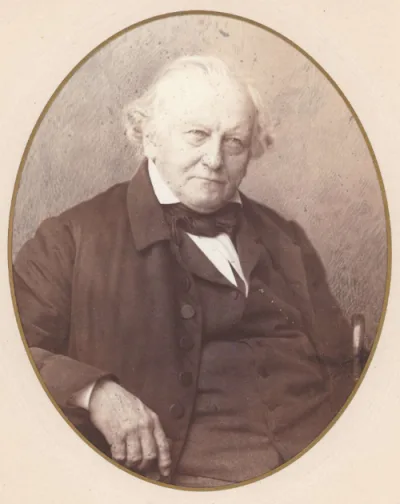
Samuel Taylor Coleridge
Samuel Taylor Coleridge was a foundational English Romantic poet, critic, and philosopher, known for influential works and introducing German idealism.
Samuel Taylor Coleridge (1772–1834) was a pivotal figure in English literature, co-founding the Romantic Movement and contributing significantly as a poet, literary critic, philosopher, and theologian. Alongside his friend William Wordsworth, he was a member of the Lake Poets, and collaborated with other notable writers like Charles Lamb and Robert Southey. Coleridge's poetic output includes famous works such as "The Rime of the Ancient Mariner" and "Kubla Khan," while his prose work, "Biographia Literaria," remains highly regarded. He was instrumental in bringing German idealist philosophy to the English-speaking world and coined influential phrases like "suspension of disbelief." Despite personal struggles with anxiety, depression, and opium addiction, his intellectual contributions were profound, influencing later movements like American transcendentalism. His reputation grew posthumously, solidifying his status as a literary genius, with his work still celebrated today.
Early Life and Education
Born in Devon, England, Coleridge was the youngest of ten children. His father was a respected vicar and headmaster. Coleridge showed an early inclination towards reading rather than typical childhood games. Following his father's death at age eight, he was sent to Christ's Hospital in London, a charity school where he studied and wrote poetry, forming a significant friendship with Charles Lamb. His education there instilled a deep appreciation for classical literature and a rigorous understanding of poetic structure, as he later reflected in "Biographia Literaria." He attended Jesus College, Cambridge, where he won a medal for an anti-slavery ode, but left without a degree, briefly enlisting in the army under a false name due to debts or unrequited love.
Pantisocracy and Literary Beginnings
While at Cambridge, Coleridge engaged with radical political and theological ideas, leading to a collaboration with Robert Southey on a play. They conceived an ambitious, though ultimately abandoned, plan for a utopian settlement in Pennsylvania called Pantisocracy. In 1795, both Coleridge and Southey married sisters from the Fricker family. Coleridge's marriage to Sara proved unhappy, leading to their separation. His early literary output included "Poems on Various Subjects" (1796), featuring contributions from Lamb and Southey. He also attempted to launch a journal, "The Watchman," which was short-lived. His time in Somerset, particularly at Coleridge Cottage, proved highly productive, marking the period when he wrote seminal works.
The Romantic Movement and Key Works
Coleridge's collaboration with William Wordsworth was instrumental in launching the English Romantic Movement. Their joint publication, "Lyrical Ballads" (1798), is considered a foundational text of the era. While Wordsworth contributed significantly, Coleridge's "The Rime of the Ancient Mariner" was the standout piece, drawing considerable attention. During his fruitful period in Somerset, he also composed the enigmatic "Kubla Khan," famously attributed to an opium-induced dream, and the narrative poem "Christabel." His "conversation poems," such as "This Lime-Tree Bower My Prison" and "Frost at Midnight," further showcased his lyrical and philosophical depth, exploring themes of nature, imagination, and the human condition.
Philosophical Influence and Later Life
Coleridge played a crucial role in introducing German idealist philosophy to English readers. His critical analyses, particularly of Shakespeare, were highly influential. He was also known for coining memorable phrases, including the concept of "suspension of disbelief," essential for engaging with imaginative literature. His intellectual legacy extended to America, significantly impacting Ralph Waldo Emerson and the development of transcendentalism. Despite lifelong struggles with physical and mental health, including anxiety, depression, and an opium addiction stemming from medical treatment, Coleridge's posthumous reputation soared, cementing his position as a major figure in English literary history.
Key Ideas
- Suspension of disbelief
- Introduction of German idealism to English culture
- Foundational figure of English Romanticism
- Influence on American transcendentalism
Notable Quotes
“The few friends who have been Witnesses of my domestic life have long advised separation as the necessary condition of everything desirable for me...”
“At six years old I remember to have read Belisarius, Robinson Crusoe, and Philip Quarll – and then I found the Arabian Nights' Entertainments – one tale of which (the tale of a man who was compelled to seek for a pure virgin) made so deep an impression on me (I had read it in the evening while my mother was mending stockings) that I was haunted by spectres whenever I was in the dark – and I distinctly remember the anxious and fearful eagerness with which I used to watch the window in which the books lay – and whenever the sun lay upon them, I would seize it, carry it by the wall, and bask, and read.”
“I enjoyed the inestimable advantage of a very sensible, though at the same time, a very severe master...At the same time that we were studying the Greek Tragic Poets, he made us read Shakespeare and Milton as lessons: and they were the lessons too, which required most time and trouble to bring up, so as to escape his censure. I learnt from him, that Poetry, even that of the loftiest, and, seemingly, that of the wildest odes, had a logic of its own, as severe as that of science; and more difficult, because more subtle, more complex, and dependent on more, and more fugitive causes...In our own English compositions (at least for the last three years of our school education) he showed no mercy to phrase, metaphor, or image, unsupported by a sound sense, or where the same sense might have been conveyed with equal force and dignity in plainer words...In fancy I can almost hear him now, exclaiming Harp? Harp? Lyre? Pen and ink, boy, you mean! Muse, boy, Muse? your Nurse's daughter, you mean! Pierian spring? Oh aye! the cloister-pump, I suppose!...Be this as it may, there was one custom of our master's, which I cannot pass over in silence, because I think it ...worthy of imitation. He would often permit our theme exercises...to accumulate, till each lad had four or five to be looked over. Then placing the whole number abreast on his desk, would ask the writer, why this or that sentence might not have found as appropriate a place under this or that other thesis: and if no satisfying answer could be returned, and two faults of the same kind were found in one exercise, the irrevocable verdict followed, the exercise was torn up, and another on the same subject to be produced, in addition to the tasks of the day.”
“With unclosed lids, already had I dreamt/Of my sweet birth-place.”
Books by Samuel Taylor Coleridge
5 free public domain books · Read online or download