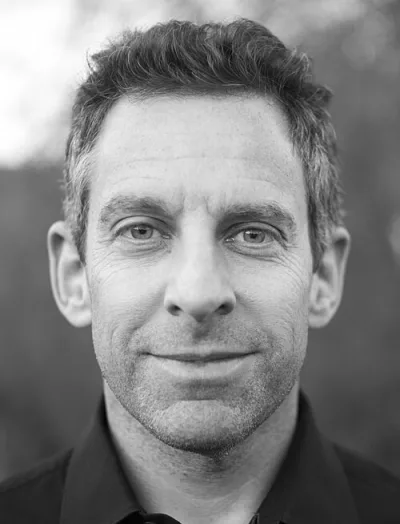
Sam Harris is a neuroscientist and philosopher known for his critique of religion and advocacy for secularism, rationality, and mindfulness.
Samuel Benjamin Harris, born in 1967, is an American neuroscientist, philosopher, author, and podcast host. His intellectual work spans a broad spectrum of topics including rationality, ethics, free will, neuroscience, meditation, and artificial intelligence. Harris gained significant recognition for his critical stance on religion, particularly Islam, and is often associated with the New Atheist movement. His first book, 'The End of Faith,' was a bestseller and established his public profile.
Harris's background includes a secular upbringing, though his philosophical interests were significantly shaped by an experience with MDMA at Stanford University, leading him to explore meditation and Eastern spiritual traditions. He later pursued formal studies in philosophy and cognitive neuroscience. Beyond his writing, Harris hosts the 'Making Sense' podcast, which delves into his diverse areas of inquiry, and has developed a meditation app. He has engaged in numerous public debates on religion and related philosophical issues. While his critiques of Islam have led some to label his views as Islamophobic, Harris and his supporters contend that these criticisms are aimed at specific doctrines and not at the religion as a whole.
Philosophical and Scientific Inquiry
Sam Harris's academic and intellectual pursuits are multifaceted, integrating neuroscience, philosophy, and ethics. His work explores fundamental questions about human consciousness, the nature of belief, and the basis for morality. He is particularly interested in how scientific understanding, especially from neuroscience, can inform our ethical frameworks and understanding of well-being. Harris's exploration of free will and determinism challenges conventional notions of personal responsibility, drawing on scientific findings to suggest that our actions may be predetermined by factors beyond our conscious control. His research at UCLA utilized fMRI to investigate the neural underpinnings of belief and doubt, directly linking his philosophical inquiries to empirical scientific investigation.
Critique of Religion and New Atheism
Harris is a prominent figure in the New Atheist movement, known for his sharp critiques of religious dogma and institutions. He argues that religious faith, particularly when it involves claims to absolute knowledge, represents a betrayal of rational inquiry and scientific principles. While critical of religion broadly, he distinguishes between different faiths, often highlighting Jainism and Buddhism for their emphasis on non-violence and compassion, and contrasting them with what he perceives as more dangerous aspects of other religious traditions, particularly Islam. His criticisms have sometimes drawn accusations of Islamophobia, a characterization he and his supporters reject, asserting that their focus is on specific doctrines and their societal implications rather than on an entire population.
Secular Spirituality and Mindfulness
Despite his atheistic stance, Harris has explored the concept of spirituality outside of traditional religious contexts. His book 'Waking Up: A Guide to Spirituality Without Religion' and the accompanying meditation app advocate for secular mindfulness practices. He suggests that the benefits often associated with religious experience, such as peace of mind, compassion, and insight, can be cultivated through scientifically grounded meditation techniques. Harris draws inspiration from Buddhist and Hindu contemplative traditions, believing that these practices offer a path to psychological well-being and a deeper understanding of consciousness, independent of supernatural beliefs. His work aims to provide tools for individuals to achieve inner peace and ethical clarity through rational and empirical means.
Key Ideas
- Critique of religious dogma and its conflict with rationality
- The potential for science to establish objective moral values
- Exploration of free will and determinism through neuroscience
- Advocacy for secular mindfulness and non-religious spirituality
- Analysis of the societal impact of religious beliefs, particularly Islam
Books by
3 free public domain books · Read online or download