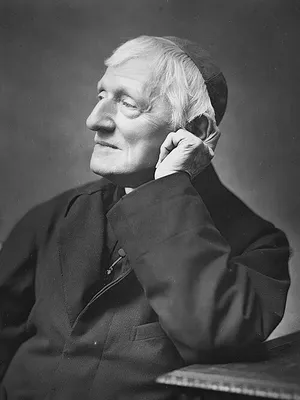
Saint Bonaventure Cardinal
John Henry Newman was a prominent 19th-century English theologian and poet who transitioned from Anglicanism to Catholicism, influencing Catholic thought.
John Henry Newman (1801–1890) was a significant English theologian, academic, and writer who played a crucial role in 19th-century English religious history. Initially an evangelical Anglican at Oxford, he was drawn to the high-church tradition and became a leading figure in the Oxford Movement, which aimed to reintroduce Catholic practices into the Church of England. Following the controversial publication of Tract 90 in 1841, Newman felt his position within Anglicanism was untenable.
In 1845, he left the Church of England and was received into the Catholic Church, where he was later ordained a priest. Based in Birmingham, he continued his influential work and was made a cardinal in 1879. Newman was instrumental in founding the Catholic University of Ireland, which evolved into University College Dublin. His writings, including "Tracts for the Times" and "An Essay on the Development of Christian Doctrine," significantly shaped subsequent Catholic theology, particularly his theories on doctrinal development. He was canonized in 2019 and proclaimed a Doctor of the Church in 2025.
Early Life and Intellectual Development
Born in London in 1801, John Henry Newman's early life saw him educated at Great Ealing School. He developed a deep love for reading, particularly the novels of Walter Scott and the works of poets like Robert Southey. At age 14, he encountered skeptical writings from philosophers such as Thomas Paine and David Hume, and possibly Voltaire. A pivotal moment occurred at age 15 when he converted to Evangelical Christianity, an event he later described as profoundly certain. Around the same time, his family faced financial difficulties. Influenced by books from the English Calvinist tradition and devotional writers like William Beveridge and William Law, Newman embraced evangelical Calvinism. However, he began to question the tenets of Evangelicalism, perceiving its emphasis on individual religious feeling and justification by faith alone as potentially leading to undogmatic individualism and subjectivism.
Academic Career and Oxford Movement
Newman entered Trinity College, Oxford, where he pursued a broad range of studies, though his initial examination performance was not stellar. He later became a fellow at Oriel College, an intellectual hub at Oxford. Ordained an Anglican deacon in 1824 and a priest in 1825, he engaged in parish work and academic writing. He was associated with the Oriel Noetics, a group of dons valuing free debate, and served as vice-principal of St Alban Hall. Returning to Oriel as a tutor in 1826, he formed a close intellectual relationship with Richard Hurrell Froude, with whom he shared a vision of the tutorial office as having a pastoral, clerical dimension. Newman's views gradually shifted towards a higher ecclesiastical perspective, particularly after his sister's death and through his thorough study of the Church Fathers. He also began to distance himself from low-church groups, withdrawing from the Church Missionary Society and the Bible Society.
Mediterranean Travels and the "Tracts for the Times"
In late 1832, Newman embarked on a Mediterranean journey with Archdeacon Robert Froude and his son Hurrell. During this trip, which included visits to Sicily, Naples, and Rome, Newman composed many of the poems later published in "Lyra Apostolica." A severe illness in Sicily led him to believe he had a divine purpose awaiting him in England. Upon his return to Oxford in July 1833, he regarded John Keble's sermon on "National Apostasy" as the catalyst for the Oxford Movement. This movement, which Newman became a central figure in, sought to revive Catholic doctrines and practices within the Church of England. A key output of this period was the "Tracts for the Times," a series of pamphlets authored by Newman and his associates, which articulated the movement's theological arguments and aspirations.
Conversion to Catholicism and Later Influence
Newman's growing conviction that the Church of England was diverging from its historical roots, particularly after publishing "Tract 90" in 1841, led him to feel his position was untenable. He resigned his Oxford post in 1845 and officially joined the Catholic Church, subsequently being ordained a priest. He established a significant base in Birmingham, where he continued his intellectual and spiritual leadership. His contributions were recognized in 1879 when Pope Leo XIII made him a cardinal. Newman was a driving force behind the establishment of the Catholic University of Ireland in 1854, a precursor to University College Dublin. His theological writings, especially his theory on the development of Christian doctrine, proved highly influential in Catholic thought. His canonization in 2019 and proclamation as a Doctor of the Church in 2025 cemented his lasting legacy.
Key Ideas
- Theory of the development of Christian doctrine
- The Oxford Movement's aim to restore Catholic beliefs and liturgical rituals to the Church of England
- The concept of the Christian Church as a divinely appointed, independent institution
Notable Quotes
“I was on my death-bed, as regards my membership with the Anglican Church.”
“more certain than that I have hands or feet”
“It was in the autumn of 1816 that Newman fell under the influence of a definite creed and received into his intellect impressions of dogma never afterwards effaced.”
“He came to see Evangelicalism, with its emphasis on religious feeling and on the Reformation doctrine of justification by faith alone, as a Trojan horse for an undogmatic religious individualism that ignored the Church's role in the transmission of revealed truth, and that must lead inexorably to subjectivism and skepticism.”
“the acknowledged centre of Oxford intellectualism”
Books by Saint Bonaventure Cardinal
0 free public domain books · Read online or download
