Sagittarius Zodiac Sign Designs
Chinese numismatic charms are decorative coins used for rituals, fortune-telling, and displaying hidden symbolism.
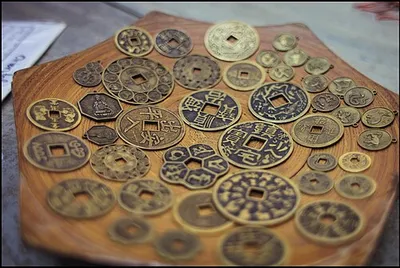
Yansheng coins, also known as Chinese numismatic charms, are special decorative coins primarily used for rituals, fortune-telling, and feng shui. Originating in the Western Han dynasty as variations of standard currency, they evolved over centuries into distinct items with diverse shapes and sizes. While typically privately cast by affluent families for personal ceremonies, some were produced by governments or religious orders. These charms often feature intricate designs, hidden symbolism, and visual puns, differentiating them from regular currency which usually bears fewer characters. Although not legal tender, they circulated alongside official coinage and were valued for their material, often copper alloys, and sometimes made from precious metals or jade. In certain periods, like the Yuan dynasty, some were used as alternative currencies, such as 'temple coins' issued by Buddhist temples during times of currency scarcity.
Origins and Symbolism
The earliest Chinese coins bore inscriptions indicating origin and value, alongside symbols like circles for the sun, crescents for the moon, and dots for stars. These symbols, appearing as raised or engraved marks, eventually developed into the designs found on Chinese charms. Early coins, particularly Ban Liang coins during the Han dynasty, frequently featured dots. Crescent symbols also appeared around this time. The appearance of Chinese characters on early cash coins may have indicated regional circulation or mint names. Coins from Emperor Wang Mang's Xin dynasty served as precursors to many later amulets and charms. The character for 'star' (星) also meant 'to spread,' linking coinage to widespread distribution. Hypotheses suggest symbols like stars, moon, clouds, and dragons represented concepts like yin and yang, the five elements (wu xing), and the element of water, with the character for 'coin' (泉) also meaning 'water spring.' The moon was seen as a heavenly messenger, and water symbolized flowing currency.
Evolution and Usage
From the Han dynasty through the Northern and Southern dynasties, Chinese numismatic charms closely resembled official currency, distinguished mainly by symbols on the reverse, such as animals, celestial bodies, and zodiacs. Significant evolution occurred from the Six Dynasties to the Yuan dynasty, with charms increasingly bearing inscriptions for longevity and happiness, becoming widespread. Taoist and Buddhist amulets emerged, alongside marriage charms with explicit imagery. The materials diversified to include iron, lead, tin, silver, gold, porcelain, jade, and paper. New scripts, including Taoist 'magic writing,' were incorporated, adding mystical layers. Inscriptions like 'fú dé cháng shòu' (fortune, virtue, longevity) and 'qiān qiū wàn suì' (a thousand autumns, ten thousand years) became common. Open-work charms featuring dragons, mythical creatures, and flora appeared in the Tang and Song dynasties, used as adornments. The inscription 'cháng mìng fù guì' (long life, riches, honor) was introduced, and Taoist symbols like yin-yang and the eight trigrams became prevalent on the reverse. Gambling tokens and board game pieces, particularly horse coins, were also produced.
Cultural Influence and Naming
Chinese numismatic talismans have influenced similar traditions in Japan, Korea, and Vietnam, sometimes leading to confusion due to shared symbolism and inscriptions. Chinese cash coins themselves are sometimes treated as lucky charms outside of China. The formal name for these coins was 'Yasheng coin' or 'money,' but 'Yansheng' is the commonly accepted pronunciation and spelling today. They are also known as 'flower coins' or 'patterned coins' ('huā qián'), and historically as 'play coins' ('wanqian'). While 'Yansheng coins' was historically more popular, 'flower coins' is now more common in China and Taiwan. The term 'charm' is broadly applied to coin-shaped items that were not official currency, including those not necessarily considered magical, such as mnemonic coins or gambling tokens.
Key Ideas
- Yansheng coins are decorative Chinese coins used for rituals, fortune-telling, and feng shui.
- They evolved from standard currency and often feature hidden symbolism and visual puns.
- While not legal tender, they circulated and held value, sometimes serving as alternative currency.
- Symbols on these coins have historical and mythological significance, relating to cosmology and good fortune.
- Their designs and usage influenced similar traditions in neighboring countries.
Books by Sagittarius Zodiac Sign Designs
2 free public domain books · Read online or download