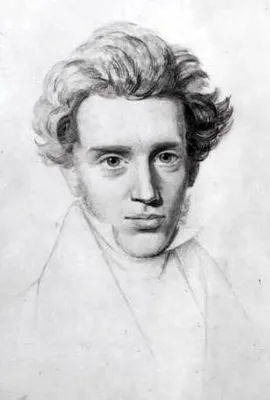
S Ren Kierkegaard
Kierkegaard, a Danish philosopher, is a foundational figure in existentialism, emphasizing subjective truth and individual existence.
Søren Kierkegaard was a 19th-century Danish philosopher whose ideas significantly shaped 20th-century thought, particularly existentialism and postmodernism. Often called the "Father of Existentialism," his work also influenced existential psychology. Kierkegaard challenged the abstract philosophical systems of his predecessors, like Hegel, and found inspiration in Socrates' focus on individual existence rather than grand theories.
Central to his philosophy is the concept of subjectivity, which he argued is crucial for understanding truth. For Kierkegaard, truth is not merely about objective facts but also about an individual's personal relationship and commitment to those facts. He believed that how one lives and acts is more significant than mere objective knowledge. His writings often explored themes of alienation, abstraction, the inevitability of death, dread, and despair, examining the human condition through a lens of intense personal experience and self-awareness. Many of his earlier works were published under pseudonyms, each representing a distinct philosophical or religious perspective, which Kierkegaard then used to explore and critique various viewpoints.
Subjectivity and Truth
A core tenet of Kierkegaard's philosophy is the profound importance of subjectivity. He contended that truth is not solely derived from objective, verifiable facts, but crucially involves an individual's personal engagement and relation to those facts. In works like "Concluding Unscientific Postscript to Philosophical Fragments," he famously stated that "subjectivity is truth" and "truth is subjectivity." This means that while objective realities exist, the essential nature of truth is found in one's inward stance, commitment, and lived experience. From an ethical standpoint, Kierkegaard argued that how an individual acts and relates to the world is more significant than objective understanding, locating true meaning in personal conviction.
Critique of Modernity and Abstraction
Kierkegaard offered a critique of the "present age," which he characterized as overly reflective, prioritizing abstract thought and discussion over genuine action and lived experience. He identified "money" as a prime example of abstraction, noting how it distorts the inherent meaning and personal value of work. Instead of being an expression of one's identity and contribution to the world, work is reduced to a mere quantifiable monetary value. This, he argued, strips life of its concrete reality and replaces it with an artificial construct, leading individuals to devalue personal capacities and relationships in favor of financial gain, which he saw as a dangerous detachment from authentic existence.
Existential States: Dread and Despair
Kierkegaard extensively explored states of human consciousness like dread (or anxiety) and despair. Dread, described as the "dizziness of freedom," arises from the awareness of one's infinite possibilities and choices, even terrifying ones. It is the unfocused fear that precedes sin, as exemplified by Adam's choice. However, dread also serves as a catalyst for self-awareness and personal responsibility, moving individuals from unconscious immediacy to conscious reflection. Despair, on the other hand, is presented as a spiritual sickness, a state of being that, while indicating humanity's unique capacity for spirit and infinite potential, represents profound misfortune and ruin if not overcome.
Pseudonymous Authorship
A distinctive feature of Kierkegaard's writing is his use of pseudonyms, particularly in his earlier works (1843–1846). He employed these different authorial voices, such as Johannes Climacus and Anti-Climacus, to explore various philosophical and religious perspectives from viewpoints not necessarily his own. These pseudonyms allowed him to delve deeply into specific modes of existence, like the aesthetic or the speculative, and even extreme religious idealism, without immediately attributing those views to himself. This method enabled him to examine and critique different ways of being and understanding truth, placing his own beliefs in the complex space between these explored positions.
Key Ideas
- Subjectivity as truth
- The individual's existence and choice
- Critique of abstract systems and modernity
- Dread as the dizziness of freedom
- Despair as a spiritual sickness
- Pseudonymous authorship to explore viewpoints
Notable Quotes
“subjectivity is truth”
“truth is subjectivity”
Books by S Ren Kierkegaard
0 free public domain books · Read online or download
