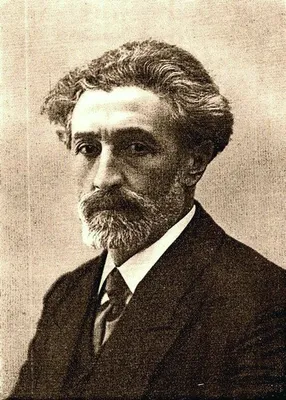
S Ansky
S. Ansky was a multifaceted Jewish writer, activist, and ethnographer, renowned for his play 'The Dybbuk'.
Shloyme Zanvl Rappoport, widely known as S. An-sky, was a significant figure in Jewish culture at the turn of the 20th century. Born in the Russian Empire, he was a prolific author, playwright, researcher of folklore, and an active political and cultural organizer. His early life was marked by a religious upbringing and limited formal education, but he became deeply involved in revolutionary movements, initially aligning with populist ideals and later the Socialist Revolutionary Party. This political engagement led him to adopt a Russian name and engage in activities aimed at educating peasants, which resulted in his arrest. He spent time in Paris, working with philosopher Petr Lavrov, and later co-founded a socialist organization in Switzerland. Upon returning to Russia, An-sky became a prominent voice in Jewish intellectual debates and publishing, traveling extensively and lecturing on Jewish cultural topics. His most enduring legacy stems from his ethnographic work and his celebrated play, 'The Dybbuk'.
Ethnographic Expeditions and 'The Dybbuk'
Influenced by socialist and ethnographic interests, An-sky led a significant Jewish Ethnographic Expedition between 1912 and 1914. This expedition, financed by Baron Vladimir Günzburg, traversed the Pale of Settlement, meticulously documenting the traditions, folklore, and daily lives of Eastern European Jews whose culture was facing rapid change. An-sky collected thousands of photographs, folk tales, songs, and artifacts, and even developed a detailed questionnaire with over 2,000 questions. A key inspiration for his most famous work, the play 'The Dybbuk or Between Two Worlds', reportedly came from local legends of a sage and exorcist, Samuel of Kaminka-Miropol, and possibly the story of the 'Maiden of Ludmir'. The play, written in 1914, became a cornerstone of Yiddish theatre and is considered a masterpiece, exploring themes of spiritual possession and the afterlife.
Literary and Political Contributions
While An-sky initially wrote in Russian, he later gained prominence as a Yiddish author. Beyond 'The Dybbuk', his literary output was substantial, encompassing numerous plays, essays, and political writings. His collected works fill fifteen volumes. Other plays, such as 'Day and Night', explored Hasidic Gothic themes, while works like 'Father and Son' and 'In a Conspiratorial Apartment' delved into revolutionary narratives. An-sky also penned 'Di Shvue' (The Oath), a song that became the anthem for the Jewish Socialist Bund party, reflecting his deep commitment to Jewish socialist ideals. His writings on the destruction of Jewish communities during World War I, such as 'Khurbn Galitsye' (The Destruction of Galicia), are considered crucial historical sources.
Activism and Later Life
An-sky's life was deeply intertwined with political activism. He was a member of the Russian Constituent Assembly after the 1917 Revolution, representing the Social-Revolutionary party. His involvement in revolutionary movements led to arrests for disseminating propaganda. During World War I, he worked with the Jewish Committee for the Relief of War Victims. Following the Russian Revolution, he escaped to Poland, where he died in Warsaw in 1920. His ethnographic collections, preserved for decades, have gradually come to light since the 1990s, with significant portions held by the State Ethnographic Museum in St. Petersburg and digitized recordings by the Vernadsky National Library of Ukraine.
Key Ideas
- Preservation of Jewish folklore and culture through ethnography
- Exploration of spiritual and mystical themes in Jewish tradition, particularly in 'The Dybbuk'
- Commitment to Jewish socialist ideals and political activism
Books by S Ansky
0 free public domain books · Read online or download
