Rowena Pattee
Jane English co-created bestselling translations of Tao Te Ching and Zhuangzi Inner Chapters, blending her photography with Gia-Fu Feng's calligraphy.
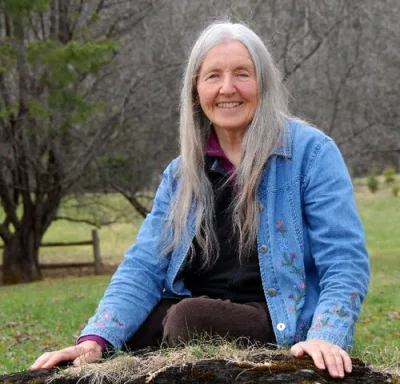
Jane English, born in 1942, is an artist and author recognized for her significant contributions to accessible translations of classic Eastern texts. Holding a doctorate in particle physics, English also possesses diverse skills including being a licensed hot-air balloon pilot and amateur radio operator. Her most celebrated works are the bestselling illustrated translations of the Tao Te Ching and the Zhuangzi Inner Chapters, created in collaboration with Gia-Fu Feng. These books, first published in the 1970s, uniquely combine Feng's calligraphy and translations with English's evocative photography and design, making ancient philosophical concepts more approachable.
English's journey into these profound texts began after her academic career in physics. While pursuing her Ph.D. in particle physics, she also explored photography, finding it a valuable counterpoint to the scientific environment. Her interest in Eastern philosophy deepened through figures like Alan Watts. After completing her doctorate, she transitioned from physics to focus on photography and alternative explorations, leading her to the Stillpoint intentional community founded by Gia-Fu Feng. This community became a hub for their creative and spiritual collaboration.
Beyond her foundational translations, English has continued to produce books, calendars, and art that delve into nature, consciousness, and Eastern and indigenous traditions. She has also collaborated with Chungliang Al Huang on various projects. Her work, particularly the Tao Te Ching and Zhuangzi translations, has achieved widespread acclaim, selling millions of copies and reaching a global audience through translations into multiple languages. She also ensured equitable credit and compensation for her role in these influential publications.
Early Life and Scientific Pursuits
Born in 1942 in Massachusetts, Jane English grew up in a family with a strong academic and scientific background; her grandfather was a professor at MIT, and her father an electrical engineer. She earned a Bachelor of Arts in Physics from Mount Holyoke College in 1964 and later completed a Ph.D. in particle physics at the University of Wisconsin–Madison in 1970. During her graduate studies, she began seriously pursuing photography, influenced by family members who were also photographers. English found photography to be a welcome contrast to the male-dominated environment of physics laboratories. Her intellectual curiosity extended beyond science, as she explored the works of Alan Watts and engaged with concepts of consciousness during her graduate school years.
Transition to Art and Eastern Philosophy
Following her Ph.D., English initially took a postdoctoral position in particle physics but soon chose to leave the field to focus on photography and explore alternative paths. This decision led her to Stillpoint, an intentional community in the Santa Cruz Mountains founded by Gia-Fu Feng, a Taoist meditation teacher. There, English found a supportive environment for her artistic endeavors and a deep connection with Feng. Their shared interests in Eastern thought and practice blossomed into a personal and creative partnership. She became co-director of Stillpoint, which served as a center for personal growth and exploration of Taoist principles.
Collaborative Translations and Artistic Integration
Jane English's most significant contributions emerged from her collaboration with Gia-Fu Feng. Together, they embarked on translating the Tao Te Ching and the Zhuangzi Inner Chapters. English integrated her distinctive black-and-white nature photography and design with Feng's calligraphy and translations, creating visually rich and accessible editions. The Tao Te Ching translation, published in 1972, and the Zhuangzi Inner Chapters, published in 1974, became international bestsellers. English insisted on equal credit and compensation for her crucial role in these projects, challenging the norms of the time. These works have introduced millions to classical Chinese philosophy through a unique synthesis of text and image.
Continued Artistic Exploration and Teaching
Following the success of their initial translations, English and Feng continued their work and collaboration, moving between locations like Vermont and Colorado. They also became traveling teachers, leading workshops and classes on Chinese philosophy, physics, and tai chi at institutions such as Thomas Jefferson College and Colorado College. English's artistic output continued, exploring themes of nature and consciousness through various media, including books, calendars, and notecards. She has also collaborated with Chungliang Al Huang on numerous projects, further disseminating Eastern wisdom and artistic expression.
Key Ideas
- Integration of photography and visual art with philosophical texts
- Making ancient Eastern wisdom accessible through illustrated translations
- Exploration of nature and consciousness through art and philosophy
- Balancing scientific inquiry with artistic and spiritual pursuits
Notable Quotes
“The farther you go, the less you know”
Books by Rowena Pattee
8 free public domain books · Read online or download