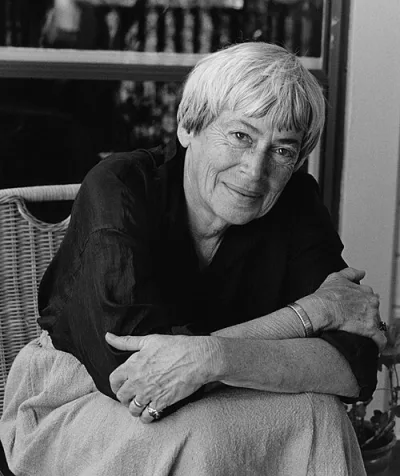
Rita Robinson Mary K Greer
Ursula K. Le Guin was a celebrated American author known for her profound speculative fiction, deeply influenced by philosophy and anthropology.
Ursula Kroeber Le Guin (1929–2018) was an American writer celebrated for her speculative fiction, particularly her science fiction set in the Hainish universe and her Earthsea fantasy series. Her extensive career, spanning nearly six decades, produced over twenty novels, numerous short stories, poetry, translations, and children's books. While often categorized as a science fiction author, Le Guin preferred to be identified as an "American novelist." Born in Berkeley, California, to anthropologist Alfred Louis Kroeber and author Theodora Kroeber, she pursued graduate studies in French literature before dedicating herself to writing full-time in the late 1950s.
Le Guin's work was significantly shaped by cultural anthropology, Taoism, feminism, and the writings of Carl Jung. She frequently featured anthropologists as protagonists and explored Taoist concepts of balance. Her writing often challenged conventional speculative fiction tropes, incorporating diverse protagonists and experimental narrative structures, as seen in "Always Coming Home." Themes of social and political import, including race, gender, sexuality, and societal structures, were central to her narratives, exemplified by works like "The Ones Who Walk Away from Omelas" and "The Dispossessed."
Her literary achievements garnered numerous awards, including multiple Hugo, Nebula, and Locus Awards. She was recognized as a Grand Master by the Science Fiction and Fantasy Writers of America and honored as a Living Legend by the U.S. Library of Congress. Le Guin's influence extended to many contemporary authors, solidifying her position as a major figure in American literature.
Philosophical and Anthropological Influences
Ursula K. Le Guin's writing was profoundly influenced by a range of intellectual traditions. Cultural anthropology, a field deeply embedded in her family background, provided frameworks for her explorations of societies and human behavior. Her father, Alfred Louis Kroeber, was a prominent anthropologist, and this discipline informed Le Guin's approach to creating detailed, believable fictional worlds and characters who often acted as observers or cultural analysts. Taoism was another significant influence, offering concepts of balance, equilibrium, and the natural flow of existence that permeated many of her narratives. Le Guin herself translated the Tao Te Ching, further engaging with its philosophical tenets. Additionally, feminist thought and the psychological theories of Carl Jung contributed to her nuanced examination of identity, gender, and the human psyche, often subverting traditional archetypes and exploring alternative societal structures.
Subversion of Tropes and Thematic Depth
A hallmark of Le Guin's work was her innovative approach to speculative fiction, frequently challenging and subverting established genre conventions. She deliberately introduced diversity into her narratives, for instance, by featuring dark-skinned protagonists in her fantasy world of Earthsea, a departure from common portrayals at the time. Le Guin also experimented with narrative form and style, employing unusual structures and devices, as demonstrated in her ambitious work "Always Coming Home." Her stories delved into complex social and political themes, examining issues of race, gender, sexuality, and the process of maturation. She used her fictional settings to explore alternative political systems, critically examining concepts of anarchy, utopia, and societal organization in works such as the philosophical short story "The Ones Who Walk Away from Omelas" and the anarchist utopian novel "The Dispossessed."
Advocacy and Literary Stature
Beyond her literary output, Ursula K. Le Guin was known for her principled stands on issues within the publishing world and broader society. She once refused a Nebula Award in protest against the Science Fiction Writers of America's actions, citing political intolerance. Le Guin was also a vocal critic of corporate influence in publishing, notably expressing concerns about Google's book digitization project and Amazon's business practices, advocating for the protection of copyright and fair treatment of authors. Her work received widespread critical acclaim and numerous prestigious awards, including multiple Hugo, Nebula, and Locus Awards. She was recognized as a Grand Master by the Science Fiction and Fantasy Writers of America and was named a Living Legend by the U.S. Library of Congress, cementing her legacy as a "major voice in American Letters" and a profoundly influential figure in literature.
Key Ideas
- Exploration of Taoist concepts of balance and equilibrium
- Subversion of traditional speculative fiction tropes
- Examination of social and political themes including race, gender, and sexuality
- Use of anthropological frameworks in world-building
- Critique of corporate power in publishing
Notable Quotes
“She would prefer to be known as an "American novelist".”
“She said that she felt reluctant to receive an award "for a story about political intolerance from a group that had just displayed political intolerance".”
“She was "raised as irreligious as a jackrabbit".”
“Taoism gave her a "handle on how to look at life" during her adolescent years.”
“"You decided to deal with the devil"”
Books by Rita Robinson Mary K Greer
0 free public domain books · Read online or download
