Richard Jelusich
The Nazi regime dictated art, favoring classical styles and using culture for propaganda, while suppressing modern and 'degenerate' art.
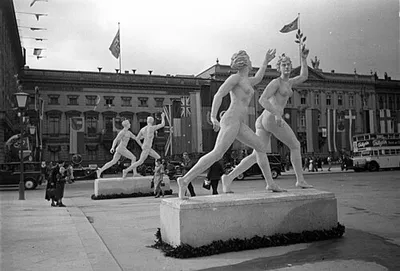
Between 1933 and 1945, the Nazi regime in Germany exerted strict control over artistic expression, with Adolf Hitler personally influencing artistic preferences and making them law. The regime favored classical Greek and Roman art, viewing it as embodying an ideal and being accessible to the general populace, contrasting sharply with the modern art of the Weimar period, which they found abhorrent. This cultural policy was deeply intertwined with their anti-Semitic ideology, labeling modern art as a form of 'aesthetic violence' perpetrated by Jews against the German spirit. The concept of 'degenerate art' was propagated to explain why certain art was indecipherable or distorted, linking it to racial inferiority and consolidating public support for both anti-Semitism and cultural control.
The Nazis established the Reich Culture Chamber in 1933, headed by Joseph Goebbels, to oversee various cultural sectors and ensure the 'Aryanization' of German culture. Membership in these chambers became a prerequisite for engaging in cultural activities, effectively excluding individuals deemed undesirable. While there was internal debate regarding the merits of Expressionism, Hitler ultimately decreed in 1934 that modernist experimentation would not be tolerated. This policy led to the infamous 'Degenerate Art Exhibition' in Munich in 1937, which deliberately showcased modern art in a chaotic, derogatory manner, in stark contrast to the officially sanctioned 'Great German Art Exhibition'. The former attracted significantly more visitors, highlighting public interest despite the regime's efforts.
Nazi Artistic Ideology and Control
The Nazi regime's approach to art was characterized by a strong ideological stance, heavily influenced by Adolf Hitler's personal aesthetic preferences. Upon assuming power, Hitler elevated his artistic tastes to the level of law, championing a return to classical Greek and Roman artistic models. He perceived these styles as embodying a superior racial ideal and being easily understood by the masses, promoting themes of heroism and romanticism. This directive was partly fueled by a deep-seated animosity towards the cultural output of the Weimar Republic, which the Nazis viewed with disdain. Their cultural policy served a dual purpose: to enforce conservative aesthetic standards and to utilize art as a potent tool for propaganda, aiming to shape public perception and national identity.
The Concept of 'Degenerate Art'
Central to the Nazi cultural agenda was the theory of 'degenerate art,' which served to legitimize the suppression of modern artistic movements. Hitler, as historian Henry Grosshans noted, viewed modern art as being corrupted by Jewish influence, an 'aesthetic violence' against the German spirit. This perception persisted even when Jewish artists were a minority within the modernist movement. The Nazis used the concept of degeneracy to explain art that was abstract, distorted, or depicted unconventional subject matter, associating such qualities with racial inferiority. By promoting this theory, the regime effectively merged its anti-Semitic ideology with its ambition to control cultural production, capitalizing on pre-existing public resentment towards modern art, which many found elitist, morally questionable, and difficult to comprehend.
Cultural Institutions and Enforcement
To implement its cultural policies, the Nazi regime established the Reich Culture Chamber (Reichskulturkammer) in September 1933, under the direction of Joseph Goebbels, the Minister for Public Enlightenment and Propaganda. This organization comprised various divisions for press, radio, literature, film, theater, music, and visual arts. Membership in the Chamber became mandatory for anyone wishing to participate in cultural life, acting as a mechanism to exclude 'unwanted and damaging elements.' Despite some initial internal debate about the merits of Expressionism, Hitler ultimately settled the dispute in 1934, forbidding modernist experimentation. Enforcement of these policies was rigorous, with the Gestapo conducting raids on artists' studios, and non-compliance or the mere presence of artistic materials leading to arrest, prompting many artists to flee the country.
Art Theft and Plunder
Beyond controlling domestic art production, the Nazi regime engaged in extensive art theft and plunder across Europe. Beginning in 1933, Jewish art collections in Germany were confiscated through 'Aryanization' processes. As Nazi occupation spread, Jewish collectors and dealers in countries like Austria, France, and Holland were systematically dispossessed as part of the Holocaust. German forces looted museums and private collections throughout Europe, seeking art deemed 'Aryan' for a grand gallery planned for Hitler's hometown. While initial acquisitions sometimes involved exchanges, they quickly devolved into forced donations and outright looting. This vast operation, considered the largest art theft in modern history, involved paintings, sculptures, and other valuable items, profoundly impacting cultural heritage and leading to ongoing efforts to recover stolen works and determine rightful ownership.
Notable Quotes
“saw Greek and Roman art as uncontaminated by Jewish influences. Modern art was [perceived by him as] an act of aesthetic violence by the Jews against the German spirit. Such was true to Hitler – wrote Grosshans – even though only Liebermann, Meidner, Freundlich, and Marc Chagall, among those who made significant contributions to the German modernist movement, were Jewish. But Hitler ... took upon himself the responsibility of deciding who, in matters of culture, thought and acted like a Jew.”
“In the future, only those who are members of the chamber will be allowed to be productive in our cultural life. Membership is open only to those who fulfil the entrance condition. In this way, all unwanted and damaging elements have been excluded.”
“We National Socialists are not un-modern; we are the carrier of a new modernity, not only in politics and in social matters, but also in art and intellectual matters.”
“The Reich Minister of Public Enlightenment and Propaganda has jurisdiction over the whole field of spiritual indoctrination of the nation, of propagandizing the State, of cultural and economic propaganda, of enlightenment of the public at home and abroad; furthermore, he is in charge of the administration of all institutions serving these purposes”
“The Chancellor of the Reich will determine the various duties of the Reich Ministry for Science, Education, and Popular Culture.”
Books by Richard Jelusich
2 free public domain books · Read online or download