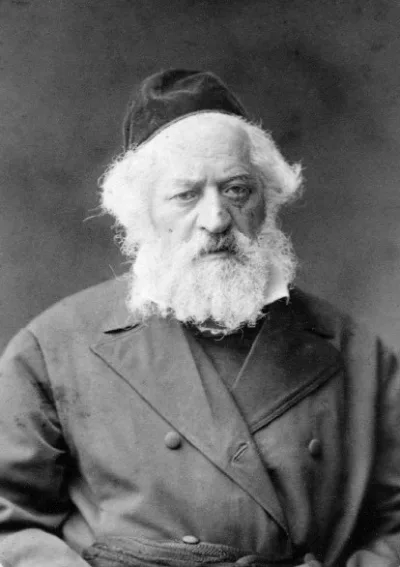
Reuben R Isaac
Rabbi Yitzchak Elchanan Spektor was a prominent 19th-century Russian rabbi, Talmudist, and posek known for his legal rulings and community leadership.
Yitzchak Elchanan Spektor, born in Ros', Belarus in 1817, was a highly respected Russian rabbi, posek (legal decisor), and Talmudist of the 19th century. He began his studies at a young age and married at thirteen, settling with his wife's family. After receiving rabbinic ordination from prominent figures like Benjamin Diskin, Spektor served in several small towns before being appointed rabbi of Novohrodok in 1851. His career culminated in 1864 when he became the chief rabbi of Kovno, a position he held until his death in 1896.
Spektor was a significant figure in rabbinic leadership and communal affairs. He participated in committees regulating the Volozhin yeshiva and led efforts to aid the poor during times of drought, even making concessions on dietary laws for Passover. He also engaged with governmental matters, opposing anti-Semitic decrees and advocating for the recognition of traditional rabbis. While he maintained traditional rabbinic values, he did not actively confront the Haskala movement. His influence extended to anonymously supporting defenses of Talmudic literature against anti-Semitic attacks.
Early Life and Rabbinic Training
Born in Ros', Belarus (then part of the Russian Empire) in 1817, Yitzchak Elchanan Spektor's father, Israel Issar, was a rabbi with Hasidic leanings and his first teacher. Spektor married at thirteen and resided with his in-laws in Vilkovisk. He studied Talmud extensively, briefly under Elijah Schick, and later under Benjamin Diskin, the rabbi of Vilkovisk. He was a fellow student of Diskin's son, Joshua Leib. Spektor received his rabbinic ordination (semikhah) from Benjamin Diskin and R. Isaac Ḥaber. After his wife's dowry was lost, he began his rabbinical career in 1837 in the small town of Sabelin, earning a modest salary. He then moved to Karlin, where R. Jacob recommended him to the community of Baresa, where he became rabbi in 1839.
Rabbinical Leadership and Community Service
Spektor's influence grew, leading him to Nishvez in 1846, though the community of Baresa initially resisted his departure. He later secretly left Nishvez to accept the rabbinate of Novohrodok in 1851, serving there until 1864. His most significant position was as chief rabbi of Kovno, a role he assumed in 1864 and maintained until his passing. He was involved in the governance of the Volozhin yeshiva and headed a committee to assist the impoverished during a severe drought, allowing the temporary use of peas and beans during Passover, a deviation from strict Ashkenazic practice. He also ruled against the use of the Corfu Citron as an Etrog due to its high cost. Spektor advocated for the inclusion of rabbis on official commissions, ensuring a balance with secular scholars.
Engagement with Government and Intellectual Movements
In his dealings with the Russian government, Spektor, alongside Yisrael Salanter, actively opposed anti-Semitic policies. He participated in conferences in St. Petersburg following the riots of 1881, aiming to improve the situation for Jews. He successfully blocked the establishment of new rabbinical schools modeled after those in Vilna and Zhitomir but could not persuade the government to recognize synagogue rabbis over government-appointed ones. Spektor was elected an honorary member of the Society for the Promotion of Culture Among the Jews of Russia, finding its philosophy compatible with traditional Judaism. He navigated the era by adhering to traditional rabbinate without confronting the Haskala movement. He opposed a public celebration of his rabbinical jubilee and, though unsuccessful in preventing the closure of the Volozhin yeshiva, he supported the "Kovnoer Perushim" as an alternative. He was also a supporter of the Hovevei Zion movement and anonymously influenced Samson Raphael Hirsch to write a defense of Talmudic literature against anti-Semitic slanders.
Books by Reuben R Isaac
0 free public domain books · Read online or download
