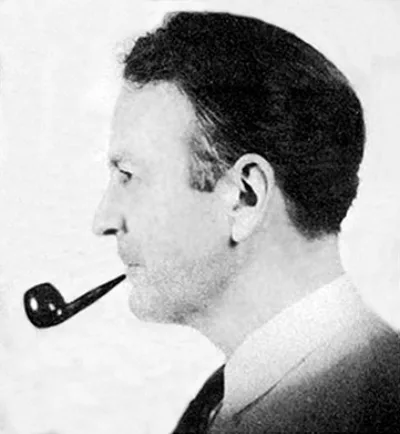
Raymond Chandler
Raymond Chandler, a founder of hardboiled detective fiction, transitioned to writing after a career in the oil industry.
Raymond Chandler was an American-British novelist and screenwriter, best known for his contributions to detective fiction. After losing his executive position during the Great Depression in 1932, he turned to writing, publishing his first short story in 1933 and his debut novel, The Big Sleep, in 1939. Chandler is recognized as a foundational figure in the hardboiled school of detective fiction, alongside writers like Dashiell Hammett and James M. Cain. His protagonist, Philip Marlowe, became an archetypal private detective, often associated with Humphrey Bogart's film portrayals. Chandler's novels, including The Big Sleep, Farewell, My Lovely, The Lady in the Lake, and The Long Goodbye, received critical acclaim and were adapted into films. His influential essay, "The Simple Art of Murder," outlined his vision for the detective hero. Chandler's prose style significantly impacted American popular literature.
Early Life and Career Transition
Born in Chicago in 1888, Raymond Chandler spent his early years in Nebraska before moving to England with his mother in 1900 for his education. He received a classical education at Dulwich College in London and later improved his language skills in Paris and Munich. After passing a civil service exam, he briefly worked for the Admiralty before resigning due to dissatisfaction. He then pursued journalism for the Daily Express and The Westminster Gazette, though he found limited success. A formative encounter with writer Richard Middleton, who later died by suicide, made a profound impression on Chandler. In 1912, he returned to America, eventually settling in Los Angeles. He served in the Canadian Expeditionary Force during World War I, experiencing combat in France and contracting Spanish flu. Post-war, he resumed life in Los Angeles, where he eventually married Pearl Eugenie Pascal. By 1931, Chandler had achieved a high-paying executive position at the Dabney Oil Syndicate, but his tenure ended a year later due to alcoholism and behavioral issues, leading him to seek a new career path.
Literary Style and Influence
Facing financial hardship during the Great Depression, Chandler taught himself to write pulp fiction, analyzing and imitating authors like Erle Stanley Gardner. His first published short story, "Blackmailers Don't Shoot," appeared in Black Mask magazine in 1933. Chandler's writing process was meticulous, involving extensive revision, contrasting with the rapid output of some pulp contemporaries. His debut novel, The Big Sleep, introduced the iconic private detective Philip Marlowe. Chandler's prose is celebrated for its forceful and honest, albeit sometimes crude, style, which he felt was a good way to learn fiction writing. His work profoundly influenced American popular literature, establishing him as a key figure in the hardboiled detective genre. The character of Philip Marlowe, often seen as synonymous with the private detective archetype, was famously portrayed by Humphrey Bogart in film adaptations.
Critical Reception and Legacy
Chandler's novels consistently garnered critical attention and were frequently adapted into motion pictures. The Big Sleep was ranked highly in a poll of the 100 best crime novels, with other works like Farewell, My Lovely, The Lady in the Lake, and The Long Goodbye also appearing on the list. The Long Goodbye, in particular, was lauded as a significant mainstream novel with mystery elements, comparable to Dashiell Hammett's earlier work. Chandler also contributed significantly to detective fiction criticism with his essay "The Simple Art of Murder." This essay articulated his vision for the ideal detective: a man of honor, integrity, and inherent goodness, navigating a corrupt world. His literary creations, particularly Philip Marlowe, are considered quintessential American heroes, embodying a complex blend of cynicism, hope, and romanticism, deeply congruent with the American landscape and its evolving ideals.
Key Ideas
- The 'hardboiled' detective as an honorable man in a corrupt world.
- Philip Marlowe as the quintessential American hero: cynical yet hopeful, tough yet sentimental.
- The detective novel as a serious literary form capable of exploring complex themes.
Notable Quotes
“Down these mean streets a man must go who is not himself mean, who is neither tarnished nor afraid. The detective must be a complete man and a common man and yet an unusual man. He must be, to use a rather weathered phrase, a man of honor—by instinct, by inevitability, without thought of it, and certainly without saying it. He must be the best man in his world and a good enough man for any world.”
Books by Raymond Chandler
0 free public domain books · Read online or download
