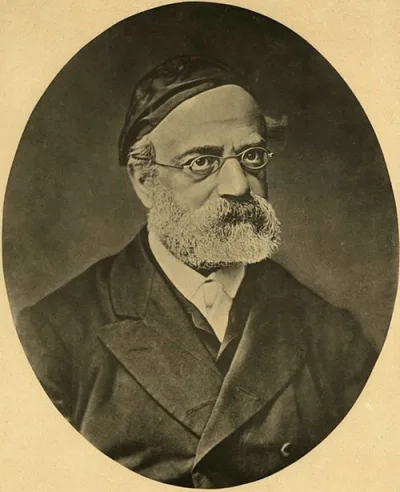
Raphael Ben Zion
Samson Raphael Hirsch was a leading German Orthodox rabbi and the intellectual architect of Torah im Derech Eretz.
Samson Raphael Hirsch (1808–1888) was a prominent German Orthodox rabbi, recognized as the principal founder of the Torah im Derech Eretz school of thought within contemporary Orthodox Judaism. His philosophical approach, sometimes referred to as neo-Orthodoxy, significantly shaped the development of Orthodox Judaism, alongside the work of Azriel Hildesheimer. Hirsch served as a rabbi in various German communities and as chief rabbi of Moravia before leading a separatist Orthodox community in Frankfurt am Main from 1851 until his passing.
He was a prolific writer, authoring influential books and publishing the journal "Jeschurun" to expound his philosophy. Hirsch was a staunch opponent of the Reform Judaism movement, as well as Zionism and early forms of Conservative Judaism. His intellectual contributions and defense of traditional Jewish observance in a modern context left a lasting impact on Jewish thought and practice.
Early Life and Education
Born in Hamburg, Samson Raphael Hirsch came from a family with a strong connection to Torah scholarship. His father was a merchant dedicated to religious study, and his grandfather was instrumental in establishing Talmud Torah schools in Hamburg. Hirsch received his foundational education from Chacham Isaac Bernays, whose influence, combined with his biblical and Talmudic studies, steered him toward a rabbinical career rather than the mercantile path his parents envisioned. He furthered his Talmudic studies under Rabbi Jacob Ettlinger in Mannheim, receiving his ordination in 1830. Subsequently, he attended the University of Bonn, where he encountered Abraham Geiger, a future ideological opponent.
Rabbinical Career and Key Works
Hirsch began his rabbinical service as chief rabbi in Oldenburg, where he penned "Nineteen Letters on Judaism" (1836) under a pseudonym. This work presented Orthodox Judaism in an accessible, intellectual manner, defending its institutions and ordinances, and profoundly influenced German Jewish intellectuals. He later published "Horeb" (1838), intended as a textbook on Judaism for educated youth. Hirsch also engaged in polemical writings against proposed reforms in Judaism, notably challenging Abraham Geiger and Samuel Holdheim. He served in Emden and later as chief rabbi of Moravia and Austrian Silesia, where he focused on reorganizing congregations and instructing students, while also advocating for civil rights for Jews. In 1851, he accepted a position with a separatist Orthodox community in Frankfurt am Main, where he remained for the rest of his life. There, he established educational institutions and continued his prolific writing, including commentaries on biblical texts and prayer books.
Philosophical Stance and Later Years
Hirsch championed the "Torah im Derech Eretz" philosophy, emphasizing the integration of Torah study with engagement in worldly affairs. He was a vocal critic of Reform Judaism, Zionism, and nascent Conservative Judaism, advocating for a strict adherence to traditional Jewish law and practice. In Frankfurt, he led a secessionist Orthodox community, known as the "Israelitische Religions-Gesellschaft," which grew significantly under his leadership. He also founded the "Freie Vereinigung für die Interessen des Orthodoxen Judentums," which served as a precursor to the international Orthodox movement Agudas Yisrael. Despite his love for the Land of Israel, he opposed early Zionist efforts to achieve political independence, believing such sovereignty was contingent on divine intervention. Hirsch suffered from recurring bouts of malaria throughout his later life, eventually passing away in Frankfurt in 1888.
Key Ideas
- Torah im Derech Eretz: The concept of maximizing Torah observance through engagement with secular life.
- Neo-Orthodoxy: A philosophical approach within Orthodox Judaism that sought to reconcile traditional observance with modernity.
Books by Raphael Ben Zion
4 free public domain books · Read online or download