Qisong Hong
The Platform Sutra details early Chan teachings, focusing on Buddha-nature and the story of Huineng, the Sixth Patriarch.
The Platform Sutra of the Sixth Patriarch, composed between the 8th and 13th centuries in China, is a significant Chan Buddhist scripture. It is unique as the only Chinese Buddhist text explicitly called a "Sutra," highlighting its importance. The text primarily centers on the teachings and life story attributed to Huineng, the Sixth Patriarch, including his succession through a poetic contest. It presents core Chan concepts, particularly the notion of Buddha-nature, which is obscured by human illusions but inherently present. The Sutra also attempts to reconcile different Chan schools, such as the Northern (gradual enlightenment) and Southern (sudden enlightenment) traditions, often favoring the latter.
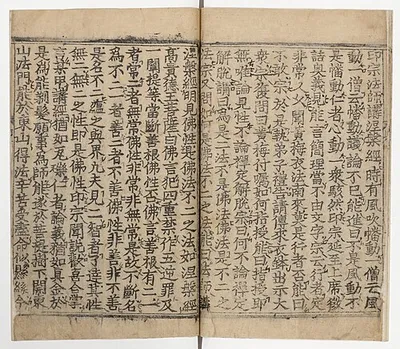
Its origins are complex, with the earliest known version being the Dunhuang Manuscript, likely a compilation from various Chan groups. Over time, the text underwent revisions, with notable editions produced by the scholar-monk Qisong in 1056 and a canonical version in 1291. The content draws from early Chan teachings, emphasizing inner realization over external practices and rituals. Key themes explored include the nature of meditation and wisdom, the concept of "thoughtlessness" as liberation, and the inherent purity of one's fundamental nature.
Core Teachings and Huineng's Narrative
The Platform Sutra is a foundational text in Chan Buddhism, offering a rich repository of early teachings. Central to its philosophy is the concept of Buddha-nature, the inherent potential for enlightenment that is obscured by ordinary human illusions. The text prominently features the life and teachings of Huineng, the Sixth Patriarch. A pivotal event described is the contest for succession initiated by the Fifth Patriarch, Hongren. Disciples were tasked with composing a poem to demonstrate their understanding of the mind's essence. While Shenxiu, a senior disciple, presented a poem reflecting a gradual approach to purification, the illiterate Huineng offered a counter-poem that, according to traditional interpretation, signified a sudden awakening. This narrative highlights Huineng's eventual recognition as the Sixth Patriarch and the transmission of the Dharma.
Philosophical Underpinnings and Textual Evolution
The Sutra delves into profound philosophical concepts, including the relationship between meditation and wisdom, stating they are of the same essence—meditation being the substance and wisdom its function. It critiques the notion of concentrating on the mind or purity, asserting that true purity arises from the absence of false thoughts, rather than an effortful pursuit. The text suggests that focusing on purity can become a form of attachment, obscuring one's inherent nature. The historical development of the Platform Sutra is complex, with early versions discovered among the Dunhuang Manuscripts, indicating a long evolutionary process and amalgamation of teachings from different Chan factions. Later editions, such as the one compiled by Qisong, expanded and structured the text, eventually leading to its inclusion in the Chinese Buddhist canon.
Esoteric Interpretations and Practice
The Platform Sutra offers guidance on spiritual practice that emphasizes inner realization over external forms. Huineng's teachings, particularly in response to questions, highlight the importance of one's internal state. For instance, when discussing the Pure Land, the emphasis is placed on cultivating an inner pure land rather than solely focusing on a physical location. The text suggests that sincere practice, even by laypeople outside of a monastic setting, is more valuable than formal renunciation without inner cultivation. The concept of "thoughtlessness" is presented not as the suppression of all thought, but as the unimpeded functioning of the mind, leading to liberation and Samadhi of Prajna. This approach underscores the esoteric nature of Chan, focusing on direct experience and the realization of one's innate enlightenment.
Key Ideas
- Buddha-nature: The inherent potential for enlightenment within all beings, obscured by illusions.
- Sudden vs. Gradual Enlightenment: A central debate reconciled in the text, favoring sudden enlightenment.
- Meditation and Wisdom: Interdependent aspects of the same essence.
- Thoughtlessness: The unimpeded functioning of the mind leading to liberation.
- Inner Purity: Realizing inherent purity through the absence of false thoughts, not through effortful concentration.
Notable Quotes
“The body is the bodhi tree.The mind is like a bright mirror's stand.At all times we must strive to polish itand must not let dust collect.”
“The mind is like a phantasm, so nothing can concentrate on it.”
“If you activate your mind to become attached to purity, you will only generate the falseness of purity.”
“Meditation and wisdom are of one essence, not different. Meditation is the essence of wisdom, and wisdom is the function of meditation.”
Books by Qisong Hong
2 free public domain books · Read online or download