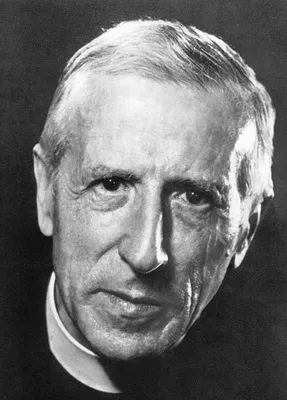
Pierre Teilhard de Chardin
Pierre Teilhard de Chardin was a French Jesuit priest, scientist, and philosopher who explored evolution through a mystical and scientific lens.
Pierre Teilhard de Chardin was a multifaceted French figure, serving as a Jesuit priest, scientist, paleontologist, philosopher, mystic, and educator. He approached the theory of evolution with a perspective blending Henri Bergson's philosophy and Christian mysticism. His scientific career included significant paleontological work in China, notably contributing to the discovery of the Peking Man fossils. Alongside his empirical research, Teilhard developed more speculative ideas, such as his concept of the Omega Point and contributions to the idea of the noosphere, which some have viewed as pseudoscientific.
His writings faced scrutiny from the Holy Office in 1962, which issued a warning about doctrinal ambiguities. However, in later years, prominent Catholic figures, including Popes Benedict XVI and Francis, have offered positive commentary on some of his concepts. The scientific community's reception to his work has been divided. Teilhard also served with distinction in World War I as a stretcher-bearer, earning military honors.
Early Life and Spiritual Awakening
Born in France in 1881, Pierre Teilhard de Chardin came from a family with a strong interest in natural science, a passion encouraged by his father. His mother was instrumental in awakening his spiritual sensibilities. After beginning his Jesuit education, he was sent to teach physics and chemistry in Cairo due to anti-clerical movements in France that temporarily exiled religious orders. During his theological studies in England, Teilhard synthesized his scientific, philosophical, and theological knowledge, influenced by Henri Bergson's "Creative Evolution." He was ordained a priest in 1911. Later, he formed a close intellectual bond with philosopher Édouard Le Roy, with whom he engaged in extensive discussions that helped shape his developing ideas.
Geological and Paleontological Research
Teilhard's lifelong fascination with geology, sparked in his youth, led him to study the subject at the University of Paris. He continued his geological studies while the Jesuits were in exile on Jersey. He became a lecturer and later a professor of geology at the Catholic University of Paris, earning his doctorate in 1922. His significant fieldwork took him to China, where he collaborated with Emile Licent on geological research and museum development. Together, they amassed a vast collection of specimens for the Musée Hoangho Paiho. Teilhard was also involved in the discovery of the Shuidonggou archaeological site and contributed to understanding China's sedimentary deposits and geological history, creating a geological map of the country. During his research periods in China, he participated in excavations that led to the discovery of the Peking Man fossils.
Scientific Contributions and Speculative Ideas
Teilhard's scientific career included work in paleontology, where he studied mammals and was briefly involved with the Piltdown fossil excavation, though claims of his complicity in the hoax have been widely rejected by experts. Influenced by paleontologists like Marcellin Boule, he focused on paleoanthropology. He also collaborated with Henri Breuil on excavations in prehistoric caves in Spain. Beyond his empirical work, Teilhard developed profound philosophical concepts. He co-contributed to the idea of the 'noosphere,' a layer of thought enveloping the Earth, alongside Vladimir Vernadsky. His most recognized speculative concept is the 'Omega Point,' a vitalist vision of the ultimate convergence and spiritualization of evolution, which has been a focal point of discussion and debate regarding his work.
Key Ideas
- Noosphere: A conceptual layer of human thought and consciousness surrounding the Earth.
- Omega Point: A teleological concept representing the ultimate point of convergence and spiritual evolution for humanity and the universe.
Notable Quotes
“"it is the dazzling of the East foreseen and drunk greedily ... in its lights, its vegetation, its fauna and its deserts."”
“"the only effect that brilliant book had upon me was to provide fuel at just the right moment, and very briefly, for a fire that was already consuming my heart and mind."”
“"I loved him like a father, and owed him a very great debt . . . he gave me confidence, enlarged my mind, and served as a spokesman for my ideas, then taking shape, on 'hominization' and the 'noosphere.'"”
“"I have so often and for so long talked over with Pierre Teilhard the views expressed here that neither of us can any longer pick out his own contribution."”
Books by Pierre Teilhard de Chardin
3 free public domain books · Read online or download