Patan Jali
Patanjali compiled the Yoga Sutras, a foundational text on yoga philosophy, drawing from various Indian traditions.
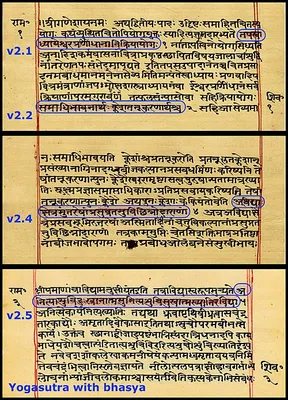
The Yoga Sutras of Patanjali is a seminal Sanskrit text on yoga practice, compiled by the sage Patanjali in the early centuries CE. It synthesizes knowledge from existing traditions, including Samkhya, Buddhism, and older ascetic practices. The text, comprising 195 or 196 aphorisms, outlines a path to spiritual liberation, focusing on mental discipline and awareness. Scholars generally agree that Patanjali also authored a commentary on the sutras, forming a unified work known as the Patañjalayogaśāstra. Despite its foundational status in classical Yoga, its prominence has fluctuated throughout history, with a significant revival in the late 19th century.
The precise dating of the Yoga Sutras remains a subject of academic discussion, with estimates ranging from several centuries BCE to the 5th century CE, though later dates are more commonly accepted. The identity of Patanjali himself is also debated, as a grammarian of the same name lived around the 2nd century BCE, but the styles and subjects of the two works suggest different authors. The Yoga Sutras are characterized by their compilation from diverse sources, leading to some perceived lack of textual unity, yet they present a coherent focus on achieving one-pointed and content-free awareness through practices like Kriya Yoga and Ashtanga Yoga, leading to the ultimate goal of Kaivalya.
Philosophical Foundations and Synthesis
The Yoga Sutras are a compilation drawing from distinct Indian philosophical streams, primarily Samkhya, Buddhist traditions, and older ascetic speculations. From Samkhya, it adopts concepts like purusha (consciousness) and prakriti (nature), viewing them as complementary. The text also incorporates Buddhist terminology and ideas, particularly concerning altered states of awareness and ontology. Patanjali's work is seen as a synthesis, potentially a 'hybrid formulation,' integrating these diverse strands into a cohesive philosophical framework. While there are noted variations in unity and coherence, the text consistently directs the practitioner towards achieving 'one-pointed awareness' (ekagrata) and 'content-free awareness' (nirvikalpa samadhi) as central goals.
The Path of Ashtanga Yoga
Central to the Yoga Sutras is the concept of Ashtanga Yoga, the 'eight-limb yoga,' which provides a structured path for spiritual development. These eight limbs are yama (ethical restraints), niyama (observances), asana (posture), pranayama (breath control), pratyahara (sense withdrawal), dharana (concentration), dhyana (meditation), and samadhi (absorption or stillness). The culmination of this practice is the stilling of mental modifications (vritti nirodha), leading to Kaivalya, the realization of purusha as distinct from prakriti. This state represents liberation and the ultimate goal of the yogic path as described in the text.
Authorship, Dating, and Textual History
The authorship and precise dating of the Yoga Sutras are subjects of scholarly debate. While manuscripts attribute the work to Patanjali, some scholars suggest the fourth chapter may be a later addition. The identity of Patanjali is also questioned due to a known grammarian of the same name from the 2nd century BCE, though linguistic and thematic differences exist between their works. Scholarly consensus on dating leans towards the early centuries CE, around 400 CE, though earlier and later estimates exist. The text, often considered alongside its commentary (Yogabhashya) as the Patañjalayogaśāstra, has experienced periods of obscurity, notably from the 12th to 19th centuries, before its resurgence in modern yoga traditions.
Key Ideas
- Purusha and Prakriti: The distinction between pure consciousness and nature/matter.
- Ashtanga Yoga: The eight-limbed path to yoga.
- Ekagrata: One-pointed awareness.
- Nirvikalpa Samadhi: Content-free absorption or meditative state.
- Kriya Yoga: Yoga of action.
- Kaivalya: Liberation or isolation of pure consciousness.
Books by Patan Jali
0 free public domain books · Read online or download
