Oswald Wirth
Oswald Wirth was a Swiss occultist, illustrator, and writer known for his work on Freemasonry and Tarot.
Joseph Paul Oswald Wirth (1860–1943) was a Swiss figure deeply involved in occultism, illustration, and writing, particularly concerning Freemasonry and esoteric symbolism. His prolific career began around 1880, and he was initiated into Freemasonry in 1884. A significant turning point occurred in 1887 when he met Stanislas de Guaita, who introduced him to the tarot as a magical system. This led to a decade-long association with de Guaita, serving as his secretary and fellow student, during which Wirth developed his own influential Tarot deck based on the Tarot de Marseille, incorporating occult symbolism. This deck was recognized as one of the most important modern tarot decks and is considered a foundational piece in the history of occult tarot designs.
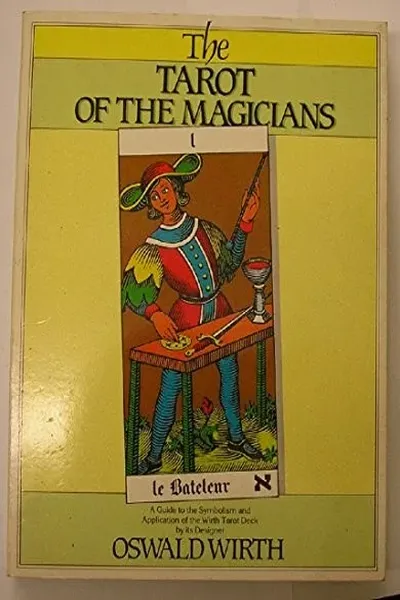
Wirth authored numerous books in French, many focusing on Freemasonry, aiming to make its doctrines and ceremonies accessible to initiates. His three-volume work, "La Franc-maçonnerie rendue intelligible à ses adeptes," became a standard text for different Masonic degrees. Beyond Freemasonry, his interests extended to astrology and Hermetic symbolism. He also edited Masonic periodicals and gave public lectures, sometimes sparking controversy over the revelation of Masonic teachings, though his efforts were also praised for promoting fraternity. His 1927 book, "Le Tarot des imagiers du Moyen Âge," later translated as "The Tarot of the Magicians," remains a notable work.
Freemasonry and Esoteric Writing
Oswald Wirth dedicated a significant portion of his writing career to Freemasonry, striving to elucidate its philosophy, purpose, methods, and ceremonies. His seminal work, "La Franc-maçonnerie rendue intelligible à ses adeptes," published in multiple volumes starting in 1894, served as a guide for initiates of the first three degrees. Wirth's contributions to Masonic literature earned him international recognition, with peers acknowledging his profound understanding of symbolic knowledge. He was also actively involved in Masonic publications, co-editing "La Lumière maçonnique" and founding his own periodical, "Le Symbolisme," which continued for decades after his death. Wirth also engaged in public discourse through lectures, disseminating Masonic principles and symbolism, though this sometimes led to accusations of revealing secrets, which he countered by stating he only shared what was permissible for public discussion.
Tarot and Occult Symbolism
Wirth's engagement with the esoteric deepened significantly through his introduction to Stanislas de Guaita, who presented the tarot as a magical system. This encounter spurred Wirth to create his own tarot deck, "Les 22 Arcanes du Tarot Kabbalistique," in 1889. Based on the Tarot de Marseille but enhanced with occult symbolism, this deck was groundbreaking as one of the earliest occult and initiatory tarot decks. It was featured in Gérard Encausse's "Le Tarot des Bohémiens" and is considered a significant development in tarot history. His later work, "Le Tarot des imagiers du Moyen Âge" (1927), translated into English as "The Tarot of the Magicians," further cemented his reputation as an authority on the subject, exploring the historical and symbolic dimensions of the tarot.
Illustration and Hermetic Interests
Beyond his extensive writing, Wirth was also an illustrator, contributing visual elements to his esoteric works. His interest in the occult extended to subjects like Hermetic symbolism, alchemy, and astrology, which he explored in books such as "Le Symbolisme hermétique dans ses rapports avec l'alchimie et la franc-maçonnerie." He also delved into astrological symbolism in "Les Signes du zodiaque, leur symbolisme initiatique" and "Le Symbolisme astrologique." Wirth's multifaceted engagement with these subjects, combining textual analysis with symbolic interpretation, positioned him as a key figure in the late 19th and early 20th-century esoteric revival.
Key Ideas
- Freemasonry made intelligible through accessible philosophical and ceremonial explanations.
- Tarot as a magical and initiatory system, integrating occult symbolism.
- Exploration of Hermetic, alchemical, and astrological symbolism.
Notable Quotes
“In the higher reaches of symbolic knowledge Brother Wirth stands almost without peer.”
Books by Oswald Wirth
2 free public domain books · Read online or download