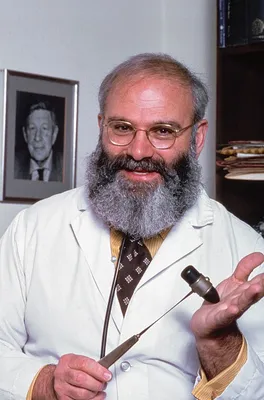
Oliver Sacks
Oliver Sacks was a British neurologist and writer known for his case studies of patients with neurological disorders.
Oliver Sacks, born in London in 1933, was a neurologist, naturalist, historian of science, and author who spent most of his career in the United States. After earning his medical degree from Oxford, he completed his residency in neurology in the U.S. A significant part of his early career involved working with survivors of encephalitis lethargica at Beth Abraham Hospital, leading to his influential book "Awakenings." Sacks became widely recognized for his collections of case studies, often focusing on individuals with unusual neurological conditions, presented in accessible and compelling narratives. His writings explored the complexities of the human brain and the experiences of those living with neurological differences. He also published numerous scientific articles and essays on various aspects of science and nature. Despite his extensive career in the U.S., he maintained his status as a "resident alien," never becoming a U.S. citizen. Sacks passed away in 2015, leaving behind a legacy as a significant clinical writer and a compassionate observer of the human condition.
Early Life and Education
Born in London to a physician father and a pioneering surgeon mother, Oliver Sacks was the youngest of four children. His early life included an evacuation from London during the Blitz, leading to a period in a boarding school where he and his brother endured harsh conditions. Upon returning home, he developed a strong interest in chemistry under his uncle's guidance and later attended St Paul's School, where he formed lasting friendships. He pursued medicine at The Queen's College, Oxford, graduating with a degree in physiology and biology. During his studies, he conducted research on the toxic effects of "Jamaica ginger" and experienced a period of depression, which led him to spend time on an Israeli kibbutz. This experience, along with travel, helped him re-evaluate his path before returning to his medical studies, ultimately graduating with degrees in medicine and surgery.
Neurological Career and Notable Works
After completing his medical training in London, Sacks moved to North America in 1960, first to Canada and then to the United States. He undertook internships and residencies in neurology and neuropathology, including at UCLA. His early career was marked by intense personal exploration, including pharmacological experimentation and a rigorous bodybuilding regimen, which he later abandoned. Inspired by a historical medical text, he resolved to chronicle neurological conditions, aiming to become a significant voice in the field. He held academic positions at Albert Einstein College of Medicine, New York University School of Medicine, and Columbia University Medical Center. His work often focused on the intersection of neurology, human experience, and the natural world, presenting complex medical cases with empathy and literary flair.
Literary Style and Impact
Oliver Sacks gained widespread acclaim for his ability to translate complex neurological cases into engaging narratives, earning him the description "poet laureate of contemporary medicine." His books, such as "Awakenings" and "The Man Who Mistook His Wife for a Hat," explored the lives of individuals with rare neurological disorders, highlighting their unique perceptions and experiences. These works often served as the basis for adaptations in film, opera, and other artistic mediums, demonstrating their broad cultural impact. Sacks's writing was characterized by a deep humanism and a profound curiosity about the mind, memory, and the diverse ways in which people navigate the world with their particular neurological makeup. While his work was celebrated for its insight and storytelling, it was also noted that some accounts may have been embellished.
Key Ideas
- Exploration of neurological disorders through case studies.
- The intersection of neurology, human experience, and identity.
- Empathy and literary portrayal of patients' subjective realities.
- Fascination with the history of medicine and science.
Notable Quotes
“I had been seduced by a series of vivid lectures on the history of medicine and nutrition, given by Sinclair ... it was the history of physiology, the ideas and personalities of physiologists, which came to life.”
“I felt myself sinking into a state of quiet but in some ways agitated despair.”
“I had been seduced by a series of vivid lectures on the history of medicine and nutrition, given by Sinclair ... it was the history of physiology, the ideas and personalities of physiologists, which came to life.”
“I felt myself sinking into a state of quiet but in some ways agitated despair.”
“I wondered again, as I had wondered when I first went to Oxford, whether I really wanted to become a doctor. I had become very interested in neurophysiology, but I also loved marine biology; ... But I was 'cured' now; it was time to return to medicine, to start clinical work, seeing patients in London.”
Books by Oliver Sacks
0 free public domain books · Read online or download
