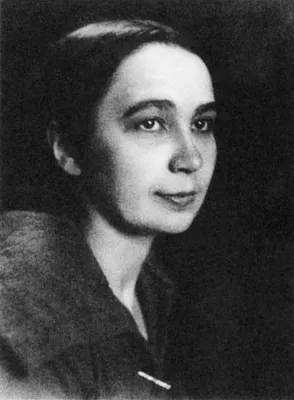
Natal I A Stepanova
Natalia Goncharova was a pioneering Russian avant-garde artist, co-inventor of Rayonism, and influential figure in Moscow and Paris.
Natalia Sergeevna Goncharova (1881–1962) was a prominent Russian avant-garde artist whose work spanned painting, costume design, illustration, and set design. Alongside her lifelong partner Mikhail Larionov, she was instrumental in founding influential art groups like the Jack of Diamonds and the Donkey's Tail, and together they developed the art movement known as Rayonism. Born in Russia, she later moved to Paris, where she continued her artistic career until her death.
Goncharova's art significantly impacted the Russian avant-garde. Her exhibitions in Moscow and St. Petersburg were groundbreaking, showcasing a "new" artist through independent galleries. Her modern interpretations of traditional Russian icons and folk art were considered transgressive and challenged established norms. She was a key figure in merging Western European Modernism with Eastern traditions in her work, influencing subsequent art movements and artists.
Early Life and Education
Born in 1881 in Nagaevo, Russia, Natalia Sergeevna Goncharova came from an educated, liberal family. Her father was an architect, and she grew up in the Tula and Orlov provinces before moving to Moscow at age 10. After exploring various fields, she decided to pursue sculpture. She enrolled in the Moscow School of Painting, Sculpture and Architecture in 1901, studying under Pavel Trubetskoi. By 1903, she was exhibiting in major Russian salons and received a silver medal for sculpture. It was at this school she met Mikhail Larionov, her future partner and collaborator. Despite advancements, women were still denied diplomas, leading Goncharova to leave the institution in 1909 for studios offering more comprehensive training, including the study of nudes.
Participation in Avant-Garde Movements
Goncharova was a central figure in Moscow's radical art scene, co-founding the Jack of Diamonds group in 1909 and the more provocative Donkey's Tail in 1912. She drew inspiration from Russian icons and folk art, incorporating Primitivist, Cubist, and Futurist elements into her work, leading to Cubo-Futurism. With Larionov, she developed Rayonism in 1911, a style characterized by intersecting rays of light. Their exhibitions, such as "The Target" (1913) and "No. 4" (1914), were pivotal in bridging Eastern and Western artistic traditions. Goncharova's approach to religious themes, like in "The Evangelists," was often controversial. She also engaged in public performance art, sometimes painting symbols on her body and appearing topless as part of her artistic manifestos.
Later Career and Influence
In 1911, Goncharova became associated with the German avant-garde movement Der Blaue Reiter. After leaving Russia in 1914, she settled in Paris in 1921. There, she significantly contributed to the Ballets Russes, designing costumes and sets for productions like "The Golden Cockerel" and collaborating with figures like Sergei Diaghilev and Igor Stravinsky. She also designed fashion for Marie Cuttoli's Maison Myrbor, drawing on Russian folk art and Byzantine influences. Goncharova embraced the philosophy of Everythingism, an avant-garde movement that promoted the blending of diverse cultural traditions and artistic styles. She became a French national in 1938 and married Larionov in 1955. Goncharova died in Paris in 1962, leaving a lasting legacy on 20th-century art.
Key Ideas
- Rayonism: A style developed with Larionov, characterized by intersecting rays of light.
- Everythingism (Vsechestvo): An avant-garde movement embracing heterogeneity and the blending of multiple cultural traditions and styles.
- Neo-Primitivism: An influence, drawing inspiration from Russian icons and folk art.
- Cubo-Futurism: A style blending Cubist and Futurist elements.
Books by Natal I A Stepanova
0 free public domain books · Read online or download
