Naguib Kanawati Zahi Hawass
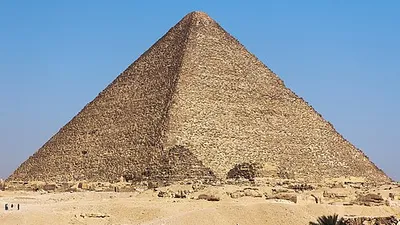
The Great Pyramid of Giza, built for Pharaoh Khufu around 2600 BC, served as his tomb and a monumental symbol of status.
The Great Pyramid of Giza, the largest and most enduring of the Seven Wonders of the Ancient World, was constructed as the tomb for Pharaoh Khufu during Egypt's Fourth Dynasty, approximately 4,600 years ago. Initially standing at 146.6 meters, it was the world's tallest man-made structure for over three millennia. Its construction involved quarrying and transporting millions of tons of stone, including granite from Aswan for the internal chambers and limestone from Tura for its casing. The pyramid's internal structure contains three chambers, with the King's Chamber housing Khufu's granite sarcophagus. While Hemiunu is sometimes credited as the architect, the precise construction methods remain a subject of debate.
The pyramid complex was part of a larger funerary landscape, including mortuary temples, a causeway, family tombs, and solar barques. Its primary purposes were to house and protect the pharaoh's body, signify his immense status, maintain his societal position, and serve as a site for offerings. The lack of internal inscriptions, common for tombs of its era, is notable, though surrounding temples were decorated. Evidence attributing the pyramid to Khufu includes inscriptions found within the pyramid and surrounding burials, as well as historical accounts and the discovery of the "Diary of Merer" documenting stone transport.
Purpose and Symbolism
The Great Pyramid of Giza was designed as the final resting place for Pharaoh Khufu, and its monumental scale served multiple purposes beyond merely housing his sarcophagus. It acted as a powerful symbol of Khufu's elevated status and his enduring place in society, reflecting the significant social inequalities of the Old Kingdom where only royalty could command such grand tomb structures. The pyramid's design and construction were strictly regulated by royal decrees, underscoring the pharaoh's absolute authority. The funerary complex surrounding the pyramid, including temples and family burials, further reinforced Khufu's legacy and the continuity of his mortuary cult, which operated for centuries after his death, indicating his successful interment and veneration.
Construction and Materials
The construction of the Great Pyramid involved an immense logistical undertaking, quarrying approximately 2.3 million stone blocks totaling 6 million tons. While most stones were roughly dressed and varied in size, the outer casing was made of smooth white limestone imported from Tura, and significant granite blocks, some weighing up to 80 tons, were brought from Aswan for the King's Chamber. The pyramid's dimensions were precisely calculated, with a base length of 440 royal cubits and a height of 280 royal cubits, resulting in a specific slope. Despite various hypotheses, the exact construction techniques employed remain debated, with no definitive consensus among scholars. The pyramid's internal structure features three chambers, including the unfinished lower chamber, the Queen's Chamber, and the King's Chamber.
Attribution and Historical Evidence
The attribution of the Great Pyramid to Pharaoh Khufu is supported by a convergence of historical accounts and archaeological findings. Classical authors like Herodotus and Diodorus Siculus historically credited Khufu, though later periods saw other figures attributed with its construction. Crucially, hieroglyphic inscriptions found in relieving chambers above the King's Chamber bear the names of work gangs that explicitly mention Khufu, such as "The gang, The white crown of Khnum-Khufu is powerful." Further evidence comes from the extensive cemeteries surrounding the pyramid, where relatives and high officials of Khufu were buried, often bearing names incorporating the pharaoh's. Inscriptions in associated chapels also refer to Khufu and his pyramid. The discovery of the "Diary of Merer" in 2013 provided direct documentation of the transportation of Tura limestone blocks to the pyramid, identified by its ancient name, Akhet Khufu.
Key Ideas
- Monumental tomb construction as a symbol of royal power and status in ancient Egypt.
- The complex purposes of Egyptian pyramids beyond simple burial, including societal positioning and mortuary cults.
- The historical evolution of pyramid attribution, from classical antiquity to modern archaeological evidence.
- The logistical and engineering challenges of ancient mega-structures, with ongoing scholarly debate on construction techniques.
Books by Naguib Kanawati Zahi Hawass
0 free public domain books · Read online or download
