Lorna Oakes, Lucia Gahlin
Deir el-Medina was an ancient Egyptian village of tomb builders, offering unparalleled insights into community life.
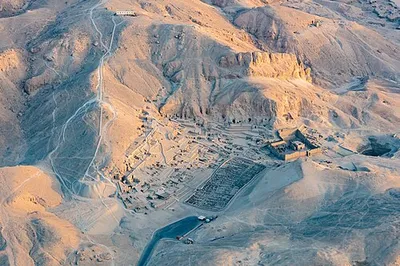
Deir el-Medina, anciently known as Set maat, was a village inhabited by the artisans and workmen who constructed the tombs in the Valley of the Kings during Egypt's New Kingdom (circa 1550–1080 BC). Its name evolved to Deir el-Medina, meaning 'Monastery of the City,' after a Christian monastery was established there. Excavations, notably by Bernard Bruyère starting in 1922, have provided an exceptionally detailed understanding of community organization, social interactions, and living conditions spanning nearly four centuries. The village's layout and its inhabitants' lives, including their work, social structures, and legal recourse, have been meticulously documented through surviving texts, papyri, and ostraca. The site's unique preservation offers a rare window into the daily existence of a specialized ancient community.
Community Life and Social Structure
The inhabitants of Deir el-Medina were a diverse group, including Egyptians, Nubians, and Asiatics, who served as laborers, craftsmen, and administrators involved in the construction and decoration of royal tombs and temples. The community was organized into two work crews, or 'gangs,' that operated on opposing sides of tomb construction sites, each led by a foreman. These workmen were considered middle-class, earning a living wage in rations, often supplemented by unofficial work. Their working schedule involved eight days of labor followed by two days off, with additional leave for festivals, illness, and personal reasons, amounting to over a third of the year off. The village itself was a walled settlement, possibly designed to maintain secrecy regarding the sensitive work in the royal tombs. The community was relatively self-sufficient, possessing its own court system to handle civil and some criminal matters.
Daily Existence and Family Life
Surviving texts from Deir el-Medina offer a rich tapestry of daily life, detailing social relations, family matters, and economic transactions. Personal letters shed light on familial bonds and social interactions, while records of sales and prices illuminate the ancient economy. The villagers lived in mudbrick houses, typically comprising four to five rooms, with construction methods and features designed for the desert climate. Women played significant roles within the community; they managed households, cared for children, and some held religious titles, serving as chantresses or singers in local shrines. Under Egyptian law, women possessed property rights and were entitled to a share of marital assets. Family life was characterized by monogamous marriages, with couples often having numerous children, and provisions existed for separation, divorce, and remarriage. The availability of servants, provided by the state for tasks like grinding grain and laundry, eased the domestic burden for many households.
Spiritual Beliefs and Afterlife
The spiritual beliefs of the inhabitants of Deir el-Medina are reflected in the personal prayers and charms discovered, offering insight into their popular conceptions of the divine. Many houses contained niches for statues and small altars, indicating domestic religious practices. The workmen, being skilled artisans themselves, dedicated considerable effort to constructing their own tombs, which are noted for their beauty and artistry, featuring rock-cut chapels and small pyramids. These personal burial sites, adorned with decorations comparable to those in royal tombs, underscore the importance placed on the afterlife and the desire for a well-prepared eternal existence. The village's original name, Set maat ('Place of Truth'), and the title of its inhabitants, 'Servants in the Place of Truth,' suggest a deep connection to Ma'at, the ancient Egyptian concept of truth, order, and justice, which permeated their worldview and daily lives.
Key Ideas
- Detailed community life in ancient Egypt
- Social structure and organization of skilled laborers
- Daily routines, family life, and economic practices
- Women's roles and legal rights in the New Kingdom
- Religious beliefs and funerary practices of commoners