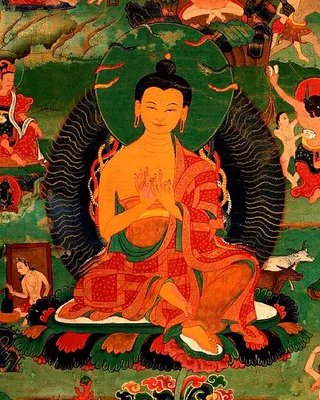
N G Rjuna
Nāgārjuna, a pivotal Indian Buddhist philosopher, founded the Madhyamaka school and is revered as the 'second Buddha' for his teachings on emptiness.
Nāgārjuna, a South Indian philosopher and Mahāyāna Buddhist monk active around the 2nd to 3rd centuries CE, is credited as the founder of the Madhyamaka school of Buddhist philosophy. He is widely regarded as the most significant Buddhist thinker after the Buddha himself, earning the title "second Buddha" in Tibetan Buddhism. His philosophical treatises, particularly on the concept of emptiness (śūnyatā), form the bedrock of the Madhyamaka school and profoundly influenced Indian philosophy for a millennium. Nāgārjuna's teachings remain central to all contemporary Mahāyāna Buddhist traditions, including those in East Asia and Indo-Tibet.
Historical details about Nāgārjuna's life are scarce and debated among scholars, with most placing him in South India between the 1st and 3rd centuries CE. Surviving biographical accounts are mostly hagiographical, written centuries after his death. Some scholars suggest he may have advised a king of the Sātavāhana dynasty. Traditional accounts, however, often portray him with mystical abilities, a master of esoteric practices, and a key figure in reviving Mahāyāna Buddhism. His most influential work, the Mūlamadhyamakakārikā, continues to be a subject of study worldwide.
Founder of Madhyamaka and the Doctrine of Emptiness
Nāgārjuna is celebrated as the architect of the Madhyamaka (Middle Way) school of Mahāyāna Buddhism. His philosophical system centers on the profound doctrine of emptiness (śūnyatā), which posits that all phenomena lack inherent existence. This concept, articulated most famously in his seminal work Mūlamadhyamakakārikā, challenges conventional understandings of reality and self. Nāgārjuna's rigorous analysis sought to dismantle metaphysical assumptions, demonstrating that existence is contingent and interdependent. His teachings became foundational for a significant stream of Buddhist thought, influencing subsequent philosophical developments across India and beyond. The Madhyamaka view, often referred to as the "view of emptiness," remains a cornerstone of Mahāyāna Buddhist philosophy.
Historical Context and Biographical Challenges
Nāgārjuna lived during a period of political fragmentation in India (1st-3rd centuries CE), a time when Buddhism was already diversifying into various schools, and the Mahāyāna movement was nascent and largely a minority perspective. Reliable biographical information about Nāgārjuna is notably scarce, with modern historians disagreeing on precise dates and locations. Surviving accounts, primarily from Chinese and Tibetan traditions centuries after his passing, are often hagiographical and difficult to verify historically. While some scholars propose he may have served as an advisor to the Sātavāhana dynasty, based on traditional sources and archaeological findings, concrete evidence remains elusive. This lack of definitive historical data contributes to the mystique surrounding his life and teachings.
Esoteric Associations and Later Traditions
Beyond his philosophical contributions, Nāgārjuna is associated with various esoteric traditions. Some Chinese and Tibetan sources link him to the practice of mantras and the Vajrayāna tradition, even suggesting he initiated the East Asian Buddhist esoteric lineage. He is also considered a foundational figure in the Pure Land tradition, based on interpretations of his commentaries and prophecies. Traditional accounts further attribute to him mastery of Ayurvedic alchemy (rasāyana), including the creation of elixirs and the transmutation of base metals into gold. These associations, while often steeped in legend, highlight Nāgārjuna's multifaceted influence across different Buddhist lineages and practices.
Key Ideas
- Madhyamaka (Middle Way)
- Śūnyatā (Emptiness)
- Lack of inherent existence of phenomena
Books by N G Rjuna
0 free public domain books · Read online or download
