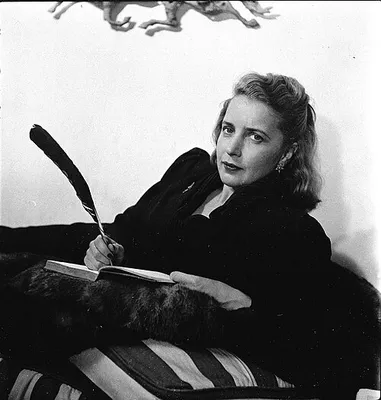
Margaret Wise Brown
Margaret Wise Brown was a prolific children's author known for 'Goodnight Moon,' who also used pseudonyms and was influenced by modernism.
Margaret Wise Brown (1910-1952) was an American author celebrated for her contributions to children's literature, most notably "Goodnight Moon" and "The Runaway Bunny." She employed several pseudonyms, including Golden MacDonald, Timothy Hay, and Juniper Sage, to publish works with different houses like Doubleday, Harper & Brothers, and W. R. Scott. Brown's writing was significantly shaped by the "here and now" philosophy of the Bank Street Experimental School where she worked and taught, as well as the experimental literary style of Gertrude Stein, whom she admired and collaborated with.
Born in Brooklyn, Brown attended boarding and preparatory schools before graduating from Hollins College. Her career began after college, first as a teacher and art student, then as an editor at W. R. Scott, where she championed new children's authors. She developed a close working relationship with illustrator Clement Hurd, leading to some of her most iconic books. Despite her success, "Goodnight Moon" faced initial resistance from a prominent librarian. Brown's personal life included various relationships and an engagement shortly before her untimely death from an embolism in France at age 42. She left behind a substantial body of work, including over 70 unpublished manuscripts that were later discovered and published.
Literary Influences and Style
Margaret Wise Brown's distinctive writing style, particularly her focus on the "here and now," was deeply influenced by the educational philosophy of the Bank Street Experimental School. This approach emphasized grounding children's literature in their immediate experiences and the tangible world. Furthermore, Brown was profoundly inspired by the avant-garde poet Gertrude Stein. Stein's experimental literary techniques, characterized by repetition, unconventional syntax, and a stream-of-consciousness flow, resonated with Brown and found echoes in her own lyrical and often minimalist prose. This synthesis of educational realism and modernist experimentation contributed to the unique, enduring appeal of her work, earning her the moniker "the laureate of the nursery."
Pseudonyms and Publishing Ventures
To navigate the diverse landscape of children's publishing, Margaret Wise Brown utilized several pen names. Under "Golden MacDonald," she published with Doubleday, often collaborating with illustrator Leonard Weisgard. For Harper & Brothers, she sometimes wrote as "Timothy Hay." Her collaboration with Edith Thacher Hurd, under the name "Juniper Sage," appeared under William R. Scott, Inc. This strategic use of pseudonyms allowed her work to be associated with different publishing houses and imprints, expanding her reach and potentially allowing for stylistic variations or thematic explorations tailored to specific audiences or editorial directions.
Personal Life and Legacy
Brown's personal life was marked by several significant relationships, including a long-term romance with Blanche Oelrichs (Michael Strange) and a final engagement to James Stillman Rockefeller Jr. She was known by various nicknames among her friends, reflecting different facets of her personality and social circles. Her untimely death at 42 from an embolism occurred while on a book tour in France. Posthumously, Brown's legacy includes not only her published works but also over 70 unpublished manuscripts that were rediscovered and brought to light years after her death. She bequeathed royalties from her most famous books to a young neighbor, Albert Clarke, whose complicated life story became a subject of journalistic attention. Her "Only House" on Vinalhaven, Maine, remains a testament to her life and work.
Key Ideas
- Emphasis on the 'here and now' in children's literature, reflecting real-world experiences.
- Influence of modernist literary techniques, particularly from Gertrude Stein, on children's writing.
Books by Margaret Wise Brown
0 free public domain books · Read online or download
