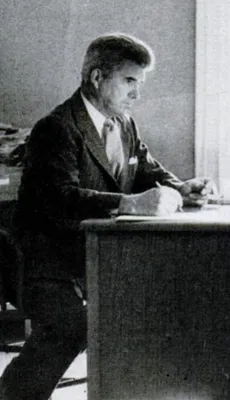
Louisa E Rhine
J.B. Rhine pioneered parapsychology as a scientific field, establishing labs and journals to study extrasensory perception and psychokinesis.
J.B. Rhine was an American botanist who transitioned to studying psychic phenomena, establishing parapsychology as a formal scientific discipline. He founded key institutions like the parapsychology lab at Duke University, the Journal of Parapsychology, and the Foundation for Research on the Nature of Man. Rhine's research focused on extrasensory perception (ESP) and psychokinesis, employing rigorous laboratory methods and statistical analysis. His work, particularly with subjects like Adam Linzmayer and Hubert Pearce, aimed to provide empirical evidence for psychic abilities. Despite facing criticism and replication challenges, Rhine's efforts laid the groundwork for the continued study of parapsychology.
Foundations of Parapsychology
Joseph Banks Rhine, originally trained as a botanist, became a pivotal figure in the development of parapsychology. Motivated by lectures and readings on spiritualism and communication with the deceased, Rhine pursued studies in psychology, eventually joining Duke University. There, he began developing experimental methodologies to investigate phenomena such as extrasensory perception (ESP) and psychokinesis. Rhine viewed parapsychology as a branch of psychology, specifically 'abnormal psychology,' and dedicated his career to establishing it as a legitimate scientific field. His early work involved investigating mediums, including Mina Crandon, where he documented instances of alleged trickery, contributing to his understanding of the challenges in verifying psychic claims.
ESP Research and Key Experiments
Rhine's research at Duke University involved extensive testing of volunteer subjects for ESP capabilities, most notably using Zener cards. Early subjects like Adam Linzmayer demonstrated statistically significant results in card-guessing tests, although their performance sometimes declined over time, attributed to factors like boredom. Hubert Pearce later showed even higher average scores, though his involvement in handling the cards raised questions. A significant series of experiments involved Pearce and research assistant Joseph Gaither Pratt, where Pearce attempted to identify cards shuffled by Pratt at varying distances. These experiments, along with investigations into psychokinesis (the influence of mind over matter, tested via dice), formed the basis of Rhine's seminal book, 'Extra-Sensory Perception'.
Methodology, Legacy, and Reception
Rhine's work was characterized by a commitment to empirical observation and statistical analysis, aiming to legitimize the study of psychic phenomena. He co-authored 'Extra-Sensory Perception After Sixty Years,' recognized as an early meta-analysis in science. Rhine also established crucial infrastructure for the field, including the Journal of Parapsychology and the Parapsychological Association. Despite his efforts, Rhine's experimental results faced significant challenges regarding replicability, with several attempts by other researchers failing to reproduce his findings. Methodological criticisms were also raised concerning record-keeping and potential sensory leakage in his experiments. Nevertheless, Rhine's legacy lies in his foundational role in establishing parapsychology as an area of scientific inquiry.
Key Ideas
- Extrasensory Perception (ESP): The ability to acquire information not through the recognized senses but by means of paranormal means.
- Psychokinesis (PK): The supposed ability to influence physical systems by thought alone.
- Parapsychology: The study of alleged psychic phenomena and other paranormal claims, viewed by Rhine as a branch of psychology.
Notable Quotes
“This mere possibility was the most exhilarating thought I had had in years.”
Books by Louisa E Rhine
0 free public domain books · Read online or download
